

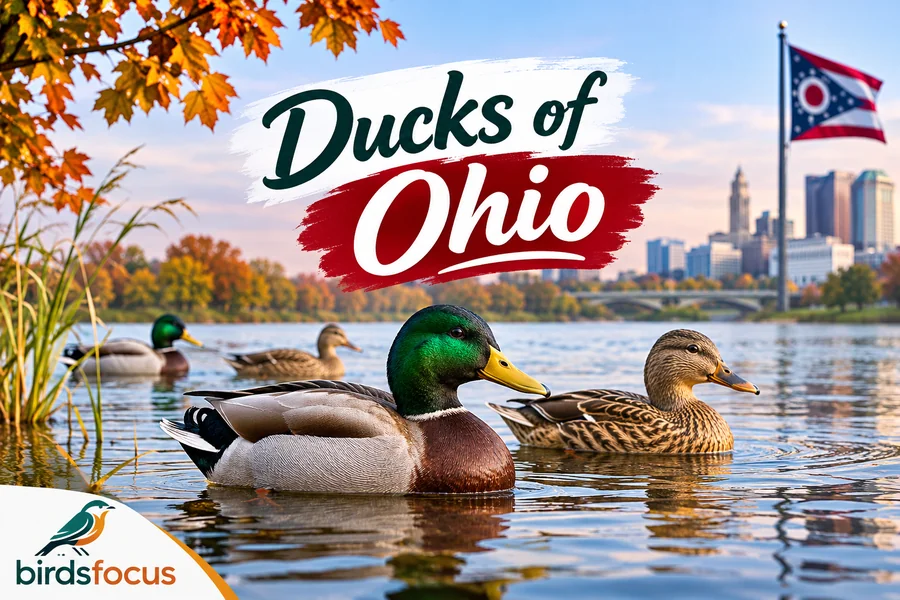
Ducks of Ohio are easier to find than most people think. You do not need a boat or a long hike. A pond, a creek or a flooded field is often enough. More than 30 duck species have been recorded in the state. Some live here all year. Others pass through in spring and fall. A few show up only in winter on Lake Erie.
This guide covers the top 25. You will learn what each one looks like, where it lives and what it does. Let’s start with the basics.
How Did Ducks Get to Ohio?
Ducks follow flyways. A flyway is a set of routes that birds use each year. Ohio sits in the Mississippi Flyway. Birds from Canada and the northern plains move south through the state in fall. They come back in spring.
Water drives it all. Lake Erie has coastal marshes. Inland Ohio has rivers, reservoirs and wetlands. Northwest Ohio once held the Great Black Swamp. Settlers drained most of it. Small pieces survive today in refuges and parks.
Ducks stop here to rest and feed. Some stay to nest. Others keep moving.
Chart of the Ducks of Ohio complete with Facts, Photos, Threats and more
| No. | Duck | Scientific Name | Type | Best Season in Ohio | Main Threat |
| 1 | Mallard | Anas platyrhynchos | Dabbling | Year-round | Lead poisoning |
| 2 | Wood Duck | Aix sponsa | Dabbling | March to October | Loss of nest trees |
| 3 | Blue-winged Teal | Spatula discors | Dabbling | April and late summer | Wetland loss |
| 4 | Green-winged Teal | Anas crecca | Dabbling | Spring and fall | Wetland loss |
| 5 | Northern Shoveler | Spatula clypeata | Dabbling | April and October | Wetland loss |
| 6 | American Black Duck | Anas rubripes | Dabbling | Fall and winter | Hybridizing with mallards |
| 7 | Northern Pintail | Anas acuta | Dabbling | February to March | Prairie wetland loss |
| 8 | Gadwall | Mareca strepera | Dabbling | Spring and fall | Wetland loss |
| 9 | American Wigeon | Mareca americana | Dabbling | Fall and winter | Wetland loss |
| 10 | Canvasback | Aythya valisineria | Diving | Late fall to early winter | Loss of food plants |
| 11 | Redhead | Aythya americana | Diving | March and late fall | Wetland drainage |
| 12 | Ring-necked Duck | Aythya collaris | Diving | March and November | Lead poisoning |
| 13 | Greater Scaup | Aythya marila | Diving | Winter | Population decline |
| 14 | Lesser Scaup | Aythya affinis | Diving | April and November | Population decline |
| 15 | Bufflehead | Bucephala albeola | Diving | Late October to April | Loss of nest trees |
| 16 | Common Goldeneye | Bucephala clangula | Diving | November to April | Loss of nest trees |
| 17 | Hooded Merganser | Lophodytes cucullatus | Diving | Fall to spring | Loss of nest trees |
| 18 | Common Merganser | Mergus merganser | Diving | Winter | Water pollution |
| 19 | Red-breasted Merganser | Mergus serrator | Diving | Late fall to spring | Water pollution |
| 20 | Ruddy Duck | Oxyura jamaicensis | Diving | Fall and spring | Wetland loss |
| 21 | Long-tailed Duck | Clangula hyemalis | Sea duck | November to April | Oil spills and nets |
| 22 | Surf Scoter | Melanitta perspicillata | Sea duck | October to November | Oil spills |
| 23 | White-winged Scoter | Melanitta deglandi | Sea duck | Late October to winter | Oil spills |
| 24 | Black Scoter | Melanitta americana | Sea duck | November | Oil spills |
| 25 | Harlequin Duck | Histrionicus histrionicus | Sea duck | Rare in late fall | Stream pollution |
Habitat map: where to look in Ohio
| Region | Hotspots | Ducks You May See |
| Lake Erie shore | Magee Marsh, Ottawa National Wildlife Refuge | Teal, shovelers, mallards, diving ducks in winter |
| Northwest Ohio | Maumee Bay State Park | Teal, wood ducks, migrants |
| West Central | Killdeer Plains, Grand Lake St. Marys | Mallards, teal, shovelers |
| Northeast | Mosquito Lake, Cuyahoga Valley wetlands | Wood ducks, mallards, mergansers |
| Southeast hills | Small creeks and beaver ponds | Wood ducks, mallards |
Duck Species That Live in Ohio
From the most common to the rare winter visitors, you will pick up the key details fast. Each duck below has a short profile and a classification table.
Most Interesting Ducks of Ohio
1. Mallard (Anas platyrhynchos)
The mallard is the duck most people in Ohio know. You see it in city ponds, farm ditches and big marshes. The male has a green head and a yellow bill. The female is brown with an orange and dark bill. Mallards are dabbling ducks. They tip forward to feed on seeds, plants and insects. They rarely dive. Most stay in Ohio all year if water stays open. Others arrive from Canada in fall. In spring the female builds a nest on the ground near water. She lays eight to thirteen eggs and sits on them for about 28 days. Ducklings leave the nest within a day. Only the female quacks loudly. The male makes a softer raspy call. Look for them at almost any open water in the state.
| Kingdom | Phylum | Class | Order | Family | Genus | Species |
| Animalia | Chordata | Aves | Anseriformes | Anatidae | Anas | A. platyrhynchos |
2. Wood Duck (Aix sponsa)
The wood duck nests in trees. That fact surprises many new birders. The female picks a hollow cavity or a nest box near water. She lays about a dozen eggs. A day after hatching the ducklings jump out of the nest. Some drops reach 50 feet. They bounce and follow mom to the water. Males show a crest and red eyes with green and purple on the head. Females look gray brown with a white eye ring. Wood ducks live in wooded swamps and slow creeks across Ohio. They eat acorns, seeds and insects. Ohio numbers fell in the early 1900s. Hunting limits and nest boxes helped them recover. Most arrive in March. Many head south in fall while some stay through mild winters. Check small wooded ponds at dawn.
| Kingdom | Phylum | Class | Order | Family | Genus | Species |
| Animalia | Chordata | Aves | Anseriformes | Anatidae | Aix | A. sponsa |

3. Blue-winged Teal (Spatula discors)
The blue-winged teal is a small duck with a big travel plan. It leaves Ohio early in fall. Many head out by September. Some fly as far as South America. Males show a white crescent on the face. Both sexes show a pale blue patch on the wing. The patch is easy to see in flight. These teal feed in shallow water. They sift seeds and snails from mud. Most Ohio birds are migrants in April and again in late summer. A few pairs nest in northern marshes. The nest is a shallow bowl in tall grass. The female lines it down. Eggs hatch after about 24 days. Look for flocks on flooded fields and shallow wetlands. Quiet scanning works best because these birds spook very easily. Move slowly.
| Kingdom | Phylum | Class | Order | Family | Genus | Species |
| Animalia | Chordata | Aves | Anseriformes | Anatidae | Spatula | S. discors |
4. Green-winged Teal (Anas crecca)
The green-winged teal is the smallest dabbling duck in North America. It weighs about as much as a can of soda. Males have a chestnut head with a green patch that sweeps back from the eye. Females are mottled brown. Both show a green patch on the wing in flight. Ohio sees them most in spring and fall migration. Some stay through winter where water stays open. They feed on seeds and tiny aquatic insects. They walk on mudflats and wade in shallows. Scan muddy edges. Flocks twist and turn in tight groups when they take off. They jump straight up from the water. The male call is a clear whistle. The female gives a soft quack. A few pairs have nested in far northern Ohio but breeding is rare.
| Kingdom | Phylum | Class | Order | Family | Genus | Species |
| Animalia | Chordata | Aves | Anseriformes | Anatidae | Anas | A. crecca |
5. Northern Shoveler (Spatula clypeata)
The northern shoveler is easy to name once you see the bill. It is long and wide with a spoon shape. The duck uses it to strain food from the water. Shovelers swim with the bill low and sweep it side to side. They eat tiny plants and small animals. Males have a green head and white chest. Their sides are rust red and the eye is yellow. Females are brown with an orange edge on the bill. Ohio gets most of them during migration. They use shallow marshes and flooded fields. Groups sometimes swim in tight circles to stir up food. A few pairs nest in northern Ohio wetlands. Look for them at Lake Erie marshes in April and October. The heavy front end stands out on the water.
| Kingdom | Phylum | Class | Order | Family | Genus | Species |
| Animalia | Chordata | Aves | Anseriformes | Anatidae | Spatula | S. clypeata |
6. American Black Duck (Anas rubripes)
The American black duck looks like a dark mallard. The body is deep brown. The head is paler. The male has a yellow green bill. Both sexes show a purple blue patch on the wing without white edges. In flight the white wing linings flash. Black ducks like wooded ponds, marshes and coastal bays. In Ohio they are most common near Lake Erie in fall and winter. A few stay all year. Their numbers have dropped across the East. Mallards breed with them and crowd them out. Habitat loss adds to the problem. Black ducks nest on the ground and lay about nine eggs. They eat seeds, snails and small fish. They are wary and flush when you approach. Scan mixed flocks of mallards because black ducks hide inside them.
| Kingdom | Phylum | Class | Order | Family | Genus | Species |
| Animalia | Chordata | Aves | Anseriformes | Anatidae | Anas | A. rubripes |
7. Northern Pintail (Anas acuta)
The northern pintail is the tall and slim duck of the marsh. It has a long neck and a pointed tail. The male has a brown head and a white stripe that runs up the neck. The chest is white. Females are plain brown with a slim shape. Pintails are among the first ducks back in spring. They arrive as ice melts in February and March. They travel long distances. Some fly thousands of miles each year. In Ohio they stop at shallow wetlands and flooded fields. They tip forward to reach seeds and tiny animals. The long neck helps them reach deep. Males give a soft whistle. Pintail numbers have fallen across North America. Nesting in Ohio is very rare. Watch for them at Lake Erie marshes in March.
| Kingdom | Phylum | Class | Order | Family | Genus | Species |
| Animalia | Chordata | Aves | Anseriformes | Anatidae | Anas | A. acuta |
8. Gadwall (Mareca strepera)
The gadwall looks plain but acts bold. Males are gray with a black rear end. Use binoculars to see the fine pattern. Females look like mallards but have a thin orange bill edge. Both show a white patch on the wing. It flashes in flight. Gadwalls eat water plants. They often steal food from coots and diving ducks that bring plants to the surface. The male call is a short burp like note. Females quack. Gadwall numbers have grown in Ohio over recent decades. They are common in migration. A small number nest in northern marshes. The nest sits in thick grass near water. The female lays about ten eggs. Check for them at Lake Erie coastal wetlands and large reservoirs. Look for the gray body and white wing patch.
| Kingdom | Phylum | Class | Order | Family | Genus | Species |
| Animalia | Chordata | Aves | Anseriformes | Anatidae | Mareca | M. strepera |
9. American Wigeon (Mareca americana)
The American wigeon is a grazer. It walks on land and eats grass like a small goose. It also feeds on water plants. Males have a white stripe on the forehead. This gives them the old name baldpate. They also show a green patch behind the eye and a pink brown side. Females are brown with a gray head. Wigeons often steal plants from diving ducks. They wait at the surface and grab what comes up. The male call is a clear three note whistle. In Ohio they appear in migration and some stay in winter. Wigeons nest far north in Canada and Alaska. Ohio rarely sees a single nesting pair. Look for them on lakes with grassy shores and on flooded fields. Large flocks feed together in open areas.
| Kingdom | Phylum | Class | Order | Family | Genus | Species |
| Animalia | Chordata | Aves | Anseriformes | Anatidae | Mareca | M. americana |

10. Canvasback (Aythya valisineria)
The canvasback is a diving duck with a sloping head. The forehead flows into a long dark bill in one smooth line. Males have a red head and black chest. The back looks pale because of fine gray lines. Females are brown and tan. Canvasbacks dive for roots, clams and wild celery. They stay under for several seconds. In Ohio they arrive in late fall and stay until the ice forms. Lake Erie and large reservoirs hold the biggest groups. They fly fast in tight lines. Numbers rise and fall with the health of wetlands in the northern plains. That is where most of them nest. Ohio sees almost no nests. Scan open water far from the shore. A spotting scope helps because these birds often sit very far out.
| Kingdom | Phylum | Class | Order | Family | Genus | Species |
| Animalia | Chordata | Aves | Anseriformes | Anatidae | Aythya | A. valisineria |
11. Redhead (Aythya americana)
The redhead has a round head and a smooth look. Males have a red head, gray back and black chest. The bill is blue gray with a white ring and a black tip. Females are brown with a pale patch near the bill. Redheads dive for plants, snails and insects. They often rest in large groups on open water. Lake Erie hosts the biggest flocks in Ohio. Most pass through in March and again in late fall. The redhead has an odd habit. Females sometimes lay eggs in the nests of other ducks. These ducks then raise the young. Redheads nest in prairie wetlands far to the north and west. Ohio rarely records a nest. Look for them on big lakes and large reservoirs. Use a scope to scan rafts.
| Kingdom | Phylum | Class | Order | Family | Genus | Species |
| Animalia | Chordata | Aves | Anseriformes | Anatidae | Aythya | A. americana |
12. Ring-necked Duck (Aythya collaris)
The ring-necked duck has a name that misleads. The chestnut ring on the neck is faint and hard to see. Look at the bill instead. It has a bold white ring near the tip and a white band at the base. Males are black on the back with gray sides and a white spur at the shoulder. Females are gray brown with a white eye ring. The head has a peaked shape. Unlike many diving ducks they use small ponds and shallow wetlands. They eat seeds, plants and insects. Ohio sees them in large numbers in March and November. Some stay all winter. They lift off the water almost straight up. A few have nested in the state. Check small lakes with wooded edges. Scan for the bill ring first.
| Kingdom | Phylum | Class | Order | Family | Genus | Species |
| Animalia | Chordata | Aves | Anseriformes | Anatidae | Aythya | A. collaris |
13. Greater Scaup (Aythya marila)
The greater scaup is a big water duck. It spends winter on Lake Erie in large rafts. Hunters and birders call it a bluebill because of the pale blue bill. Males have a dark head, black chest and white sides. The back is gray. Females are brown with a white patch around the bill. The head is round. Greater scaup dive for mussels, snails and plants. On the Great Lakes they eat many zebra mussels. They prefer open and deep water over small ponds. That makes them hard to see from shore. In flight the white wing stripe runs far toward the wing tip. This is the best clue to tell it from the lesser scaup. They nest on arctic tundra. Use a scope from lakefront parks on cold days.
| Kingdom | Phylum | Class | Order | Family | Genus | Species |
| Animalia | Chordata | Aves | Anseriformes | Anatidae | Aythya | A. marila |
14. Lesser Scaup (Aythya affinis)
The lesser scaup is the most widespread diving duck in North America. It looks much like the greater scaup. Size and head shape help tell them apart. The lesser is smaller. Its head has a small peak toward the back. Males have a dark head with a purple sheen in good light. The back is finely barred and the sides are white. The bill is blue. In flight the white wing stripe stays on the inner half of the wing. Lesser scaup use small lakes, ponds and reservoirs more than the greater does. They dive for seeds, snails and insects. Ohio sees peak numbers in April and November. Some stay on Lake Erie in winter. They nest in northern Canada. Check inland waters and quarry ponds for them each spring.
| Kingdom | Phylum | Class | Order | Family | Genus | Species |
| Animalia | Chordata | Aves | Anseriformes | Anatidae | Aythya | A. affinis |
15. Bufflehead (Bucephala albeola)
The bufflehead is the smallest diving duck in North America. Males are black and white with a large white patch behind the eye. Females are gray brown with a small white cheek patch. Buffleheads dive fast and stay under for only a short time. They eat insects, snails and small crustaceans. They arrive in Ohio in late October and stay until April. You find them on Lake Erie, rivers and reservoirs. They nest in tree holes far to the north. Old flicker holes are a favorite. Buffleheads lift off the water with no running start. Their wings beat very fast in flight. Look for small groups close to shore in winter. Watch the spot where a bird dives. It often pops up far from the place where it went down.
| Kingdom | Phylum | Class | Order | Family | Genus | Species |
| Animalia | Chordata | Aves | Anseriformes | Anatidae | Bucephala | B. albeola |
16. Common Goldeneye (Bucephala clangula)
The common goldeneye is a winter duck on Lake Erie. Males have a dark green head with a round white spot near the bill. The body is white with a black back. Females have a brown head and a gray body. Both sexes have yellow eyes. Their wings make a whistling sound in flight. That earns them the nickname whistler. Goldeneyes dive for insects, crayfish and mollusks. They arrive in November and leave by April. In late winter males throw their heads back in a display for females. They nest in tree cavities in northern forests. Ducklings jump from the nest soon after hatching. Ohio has no regular nesting. Look for them on cold open water near the shore. Rivers below dams also hold large groups when ice forms nearby.
| Kingdom | Phylum | Class | Order | Family | Genus | Species |
| Animalia | Chordata | Aves | Anseriformes | Anatidae | Bucephala | B. clangula |

17. Hooded Merganser (Lophodytes cucullatus)
The hooded merganser is small and sharp looking. Males have a black head with a large white patch on the crest. The crest can lie flat or rise like a fan. Sides are rust brown. Females are gray brown with a shaggy tan crest. The thin bill has saw like edges for gripping fish. These ducks hunt by sight. A clear eyelid lets them see underwater. They eat small fish, crayfish and insects. Hooded mergansers use wooded ponds, streams and swamps. They nest in tree holes and wood duck boxes. Some pairs nest in Ohio each spring. The female lays about a dozen eggs. Ducklings leave the nest within a day. Most birds move through in fall and early spring. You find them on quiet water at dawn and dusk.
| Kingdom | Phylum | Class | Order | Family | Genus | Species |
| Animalia | Chordata | Aves | Anseriformes | Anatidae | Lophodytes | L. cucullatus |
18. Common Merganser (Mergus merganser)
The common merganser is the largest merganser in North America. Males have a dark green head and a white body. The bill is red and long with a hook at the tip. Females are gray with a rusty head and a shaggy crest. A sharp line separates the rusty throat from the white chest. Common mergansers eat fish. They chase prey underwater and grab it with the bill. In Ohio they gather in large flocks on Lake Erie and big rivers in winter. Flocks often sit near dams where the water stays open. They nest in tree cavities near clear water in northern forests. Ducklings ride on the back of the mother. Nesting in Ohio is rare. Watch for long low bodies and white flashes in flight over open water.
| Kingdom | Phylum | Class | Order | Family | Genus | Species |
| Animalia | Chordata | Aves | Anseriformes | Anatidae | Mergus | M. merganser |
19. Red-breasted Merganser (Mergus serrator)
The red-breasted merganser has a messy double crest. Males have a dark green head and a white collar. The chest is rusty with dark spots. Females are gray with a reddish head. The thin red bill has a hook at the tip. These mergansers eat fish. Groups sometimes work together to drive fish into shallow water. They fly fast and low over the lake. Ohio sees them from late fall to spring. Lake Erie holds the largest flocks. Spring migration can bring hundreds to the shoreline. They nest on the ground near northern lakes and rivers. Nests are hidden under shrubs or in rock gaps. The female lays about nine eggs. Ohio has no regular nesting. Scan the water beyond the breakers from a lakefront park on a calm day.
| Kingdom | Phylum | Class | Order | Family | Genus | Species |
| Animalia | Chordata | Aves | Anseriformes | Anatidae | Mergus | M. serrator |
20. Ruddy Duck (Oxyura jamaicensis)
The ruddy duck is small and round with a stiff tail. The tail often points straight up. Breeding males have a rust red body and a blue bill. They also have a black cap and white cheeks. In winter both sexes turn gray brown. Males slap the bill against the chest to make bubbles. Females lay large eggs for such a small duck. They nest in cattails over shallow water. A few pairs nest in northern Ohio marshes. Ruddy ducks dive for midge larvae, seeds and plants. They are poor walkers and avoid land. They run across the water to take off. Most pass through Ohio in fall and spring. Large groups gather on lakes and reservoirs in November. Scan for the upright tail on calm open water at dusk.
| Kingdom | Phylum | Class | Order | Family | Genus | Species |
| Animalia | Chordata | Aves | Anseriformes | Anatidae | Oxyura | O. jamaicensis |
Before I write Batch 5, I’m going to count every paragraph from all five batches with a script. In the last message I said Batches 1 to 3 held at 130, but I hadn’t run an actual count, so I want to check that.
The count check passed for Ducks 1 to 20. Every paragraph there is exactly 130 words, so those batches were fine. My new Batch 5 drafts were off by 1 to 7 words, so I’m fixing those and re-counting.
21. Long-tailed Duck (Clangula hyemalis)
The long-tailed duck is a true cold water diver. Males have two long tail feathers that trail behind them. Their color changes through the year. In winter they are mostly white with a dark cheek patch and a pink band on the bill. In summer they turn dark brown. Females are brown and white with a dark crown. These ducks dive deeper than most. Some dives pass 100 feet. They eat mussels, crustaceans and small fish. Ohio sees them from November to April, mostly on Lake Erie. Look for small groups far out from shore. They nest on arctic tundra pools. Males call with a rolling yodel that carries over the water. Birders hear it in late winter before spring migration. Use a scope and scan the deep open water.
| Kingdom | Phylum | Class | Order | Family | Genus | Species |
| Animalia | Chordata | Aves | Anseriformes | Anatidae | Clangula | C. hyemalis |

22. Surf Scoter (Melanitta perspicillata)
The surf scoter is a sea duck that visits Lake Erie each fall. Males are black with a white patch on the forehead and another on the back of the neck. The large bill shows orange, red, white and a black spot. Females are dark brown with two pale spots on the face. They dive for mussels and other shellfish. They swallow the shells whole and crush them in the gizzard. Surf scoters nest on lakes in the northern forests of Canada. Ohio sees them mostly in October and November. Small flocks ride the waves far from shore. They often travel with other scoters. Check the end of piers and long breakwalls on windy days. Bring warm layers too. A scope helps. Look for dark ducks diving through the swells.
| Kingdom | Phylum | Class | Order | Family | Genus | Species |
| Animalia | Chordata | Aves | Anseriformes | Anatidae | Melanitta | M. perspicillata |
23. White-winged Scoter (Melanitta deglandi)
The white-winged scoter is the largest scoter in North America. Males are black with a white patch on the wing and a white mark around the eye. The bill is orange with a black knob at the base. Females are dark brown with pale patches on the face. The white wing patch shows when the bird flaps on the water or flies. White-winged scoters dive deep for mussels and clams. Some dives reach 60 feet. They nest around lakes in the northern forest of Canada and Alaska. Ohio sees most from late October through November. A few stay into winter on Lake Erie. They travel in long lines low over the water. Look from lakefront parks and long piers. Scan beyond the breakers where big groups often rest and feed.
| Kingdom | Phylum | Class | Order | Family | Genus | Species |
| Animalia | Chordata | Aves | Anseriformes | Anatidae | Melanitta | M. deglandi |
24. Black Scoter (Melanitta americana)
The black scoter is the one scoter with no white on the body. Males are all black with a bright yellow orange knob on the bill. Females are brown with pale cheeks and a dark cap. The bird looks small and round on the water. Black scoters eat mussels, clams and snails. They also eat some aquatic insects on their nesting grounds. They nest near ponds on the northern tundra and in boreal wetlands. Ohio gets small numbers in fall and a few in winter. Most sightings come from Lake Erie in November. Males give a soft whistle in spring. The sound is rarely heard in Ohio. Look for them with other scoters and scaup. Scan the lake from a pier on a calm day. Females are easy to miss there.
| Kingdom | Phylum | Class | Order | Family | Genus | Species |
| Animalia | Chordata | Aves | Anseriformes | Anatidae | Melanitta | M. americana |
25. Harlequin Duck (Histrionicus histrionicus)
The harlequin duck is a rare visitor to Ohio. Only a few birds have been recorded in the state. Males are slate blue with chestnut sides and bold white stripes. Females are brown with three white spots on the face. Harlequins live in fast streams in the west during the nesting season. Some winter on rocky coasts. They dive and walk on the bottom of rough water. They eat insects, snails and small crabs. The bird is small and compact. It bobs in the surf with a quick motion. Males give a squeaky whistle. A harlequin in Ohio is most likely to show up on Lake Erie in late fall or winter. Check rocky shores and breakwalls. Scan the surf line slowly and often. Report any sighting to local birders.
| Kingdom | Phylum | Class | Order | Family | Genus | Species |
| Animalia | Chordata | Aves | Anseriformes | Anatidae | Histrionicus | H. histrionicus |
Conclusion
Ohio has more ducks than most people notice. The ducks of Ohio are easy to miss until you know where and when to look. Mallards and wood ducks are easy to find. Teal and shovelers show up in spring and fall. Diving ducks fill Lake Erie in winter. A few sea ducks drop in for a short stay.
Start close to home. Check a local pond. Bring binoculars. Then plan a trip to the lakeshore in November. You will see the difference fast.
Wetlands matter for every duck on this list. Clean water and open shorelines help them survive. Protecting them takes support from birders and hunters alike.
FAQs:
What are the most common ducks in Ohio?
Mallards and wood ducks are the most common. Both live in the state through much of the year. Teal, gadwalls and shovelers become common during migration.
When is the best time to see ducks of Ohio?
Go in March and April or October and November. Migration peaks in these months. Winter is best for diving ducks and sea ducks on Lake Erie.
Where can I see ducks of Ohio?
Try Magee Marsh, Ottawa National Wildlife Refuge, Killdeer Plains and the Lake Erie shoreline. Large reservoirs and slow creeks also hold ducks.
Do ducks stay in Ohio in winter?
Yes. Mallards, black ducks, goldeneyes and mergansers stay where water remains open. Ducks leave frozen ponds and gather on Lake Erie and big rivers.
How many duck species are in Ohio?
More than 30 species have been recorded. This guide covers the top 25.

Welcome to birdsfocus! I’m Anam Sattar, an AI Powered SEO, and Content Writer with 4 years of experirnce.
I help websites rank higher,grow traffic, and look amazing. My goal is to make SEO and web design simple and effective for everyone.
Let’s achieve more together!