

If you observe the sky above almost any field in South Carolina you will eventually see a large fowl gliding through the air in large circles. The hawks in south carolina can be found in backyards, farmland, mountain ridges or salt marsh — either permanently or temporarily.
That’s because of the state’s geography. Up top you have a section of Blue Ridge foothills, followed by rolling farmland in the Midlands and then coastal marsh down at the bottom. It’s three entirely different hunting fields in one state, and hawks make good use of all three. But, whether you’re sitting on a porch swing or on a hike along a ridge trail in October, learning how to see hawk in south carolina is not difficult once you learn a few things.
This guide shows you all of the hawks you will see here, where they reside, how they hunt and where you can find them.
What Hawks Live in South Carolina?
Seven species of hawks are seen routinely in South Carolina and a few rare species fly through on migration. The two most common raptors are the Red-Tailed and Red-Shouldered Hawks — both breed and remain resident year round rather than migrate south.
There are also Cooper’s Hawks and Sharp Shinned Hawks around, but they are not as common as they are with wooded lots and bird feeders than they are in open fields. During the fall, Broad-Winged Hawks fly through in large numbers, sometimes as large flocks as many as hundreds of birds, called a kettle. In the winter, Northern Harriers appear and prey on birds that feed on the ground, close to the marsh grass.
Add Mississippi Kites in the summer, Osprey on every lake and river, and perhaps a Rough-Legged Hawk in a cool winter and they have a pretty good list to use.
Red-Tailed Hawk in South Carolina: Facts, Habitat & Identification
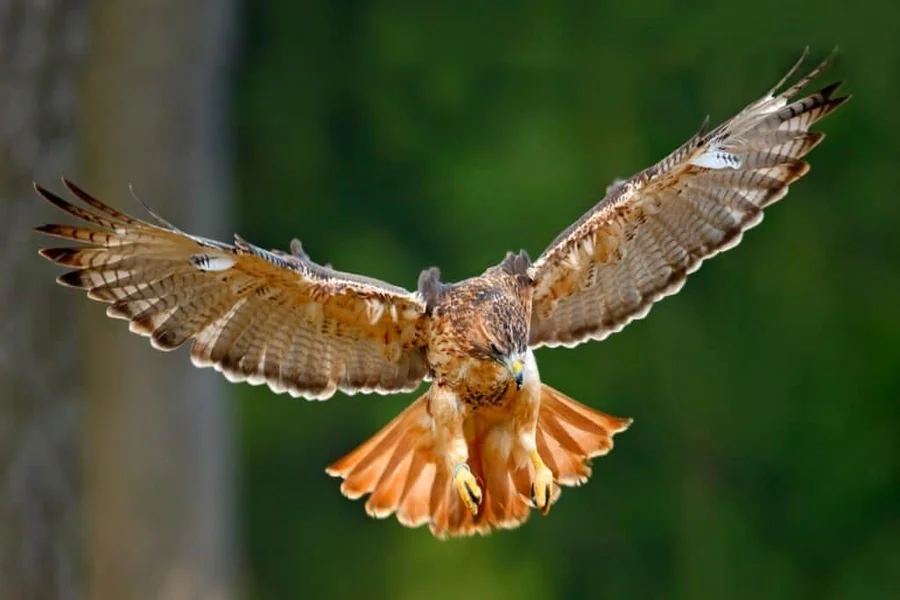
If you ask anyone to imagine a hawk they will most likely envision this one. The Red-Tailed Hawk is the most widespread and common hawk in South Carolina—mountains to coast. The rust-red tail is easy to see flashing in the sun during a soar and the body itself is short and wide, with a dark band down the centre of the belly.
Hunting style is easy yet effective. Just sit atop a fence post or dead tree on the highway, watch and wait. If it moves in the grass below, it comes down quickly. Whatever is careless enough to be seen, rabbits, squirrels, snakes, mice.
Nests are large, cobbled piles of sticks constructed high in tall trees in close proximity to open hunting areas and pairs will nest in the same location each spring, adding more sticks on top. It’s the hawk you’re likely to see from the car window on your commute to work as they’re very tolerant of people.
| Category | Detail |
| Kingdom | Animalia |
| Phylum | Chordata |
| Class | Aves |
| Order | Accipitriformes |
| Family | Accipitridae |
| Genus | Buteo |
| Species | Buteo jamaicensis |
Hawks You Should Know in South Carolina
Red-Shouldered Hawk
You’ll usually hear this one before you see it — a sharp, loud call carrying through wet forest and river bottom. Rust-colored shoulders, barred chest, a strong preference for swampy ground over open fields. It hunts frogs and crayfish near water and tends to pair up with the same mate for years, returning to the same nesting territory season after season.
| Category | Detail |
| Class | Aves |
| Order | Accipitriformes |
| Family | Accipitridae |
| Genus | Buteo |
| Species | Buteo lineatus |
Cooper’s Hawk
This is the backyard raider. Short rounded wings, a long rudder-like tail built for cutting through trees at speed, and a real taste for songbirds at your feeder. If you’ve ever had your feeder go silent for a few minutes with no obvious reason, there’s a decent chance a Cooper’s Hawk was sitting nearby, waiting.
| Category | Detail |
| Class | Aves |
| Order | Accipitriformes |
| Family | Accipitridae |
| Genus | Accipiter |
| Species | Accipiter cooperii |
Sharp-Shinned Hawk
Smallest hawk in the state, and honestly the trickiest one to tell apart from Cooper’s Hawk at a glance. You’ll see it more in fall and winter migration than during summer. It’s fast, it’s small, and it moves through dense brush chasing songbirds in short violent bursts — good luck getting a clean photo.
| Category | Detail |
| Class | Aves |
| Order | Accipitriformes |
| Family | Accipitridae |
| Genus | Accipiter |
| Species | Accipiter striatus |
Broad-Winged Hawk
Come September, this is the one everyone’s watching for. Broad-Winged Hawks migrate in huge swirling groups called kettles, riding thermals of rising warm air instead of burning energy flapping the whole way south. Some kettles number in the hundreds. During breeding season, though, they’re quiet forest birds, tucked into the canopy hunting frogs and small reptiles — nothing like the spectacle they put on come fall.
| Category | Detail |
| Class | Aves |
| Order | Accipitriformes |
| Family | Accipitridae |
| Genus | Buteo |
| Species | Buteo platypterus |
Northern Harrier
Everything about this hawk’s hunting style is different. No perching, no waiting around. It flies low, tilting side to side over marsh and open fields, using its ears almost as much as its eyes to find prey hidden in tall grass. Males are pale gray, females brown, and both flash a bright white patch above the tail when they bank.
| Category | Detail |
| Class | Aves |
| Order | Accipitriformes |
| Family | Accipitridae |
| Genus | Circus |
| Species | Circus hudsonius |
Why South Carolina Has So Many Hawk Species
Part of the answer is location. South Carolina sits right on the Atlantic Flyway, a major highway in the sky for birds moving between northern breeding grounds and southern winter territory. Add that traffic to a state that already has mountains, farmland, forest, and coast all within a few hours’ drive of each other, and you end up with ideal conditions — plenty of reasons for hawks to either settle here permanently or at least stop for a while on the way through.
Read Also: Junco Bird: Identification,Nest, Pronunciation & White Belly Facts
More hawk in south carolina
Rough-Legged Hawk
An Arctic bird that only shows up here during unusually cold winters, and even then it’s rare. Feathered legs down to the feet — a cold-weather adaptation you won’t see on the state’s other hawks. When one does get spotted in a South Carolina field, local birders tend to notice fast.
| Category | Detail |
| Class | Aves |
| Order | Accipitriformes |
| Family | Accipitridae |
| Genus | Buteo |
| Species | Buteo lagopus |
Mississippi Kite
Graceful in the air, almost more falcon-like than hawk-like in how it flies. It spends summers in South Carolina snatching dragonflies and large insects straight out of midair. Nests loosely in small colonies near open woods, and it will get aggressive fast if you walk too close to one during nesting season.
| Category | Detail |
| Class | Aves |
| Order | Accipitriformes |
| Family | Accipitridae |
| Genus | Ictinia |
| Species | Ictinia mississippiensis |
Osprey
Technically not a true hawk, but close enough in size and habit that most people lump it in anyway. Fish is basically all it eats, and it dives feet-first into lakes and rivers to get it. South Carolina’s lakes and coastline give it endless hunting ground, and its huge stick nests are easy to spot on power poles and channel markers up and down the water.
| Category | Detail |
| Class | Aves |
| Order | Accipitriformes |
| Family | Pandionidae |
| Genus | Pandion |
| Species | Pandion haliaetus |
How These Hawks Compare to Each Other
Size and hunting style will tell you more, faster, than color ever will. Big soaring hawks like the Red-Tailed hunt from high perches. Small ones like Cooper’s and Sharp-Shinned move through trees at speed instead. Harriers stay low over open ground, kites chase bugs in open air, and Osprey never bother with land prey at all. Once that pattern clicks, identification gets a lot less guesswork and a lot more recognition.
Hawks vs Other Raptors in South Carolina
People mix hawks up with vultures, falcons, and owls constantly, and it’s an easy mistake. Turkey Vultures soar with their wings held up in a shallow V, rocking side to side, while hawks keep their wings flatter and steadier. Falcons like the American Kestrel have narrow pointed wings built for raw speed, nothing like a hawk’s broad rounded shape. Owls hunt mainly after dark and have those big forward-facing eyes, while hawks work the daylight hours. None of this takes long to learn, and it makes a real difference the next time something big flies overhead.
Hawks of the Upstate, South Carolina
Blue Ridge foothills, rolling farmland, Greenville and Spartanburg country. Red-Tailed and Red-Shouldered Hawks live here year-round, and Broad-Winged Hawks pour through by the hundreds each fall. The ridgelines create strong updrafts that migrating hawks ride to cover long distances with barely a wingbeat. Table Rock State Park and Caesars Head State Park are the two spots locals point to first, especially in September when migration counts peak.
Hawks of the Midlands, South Carolina
Farmland, pine forest, river bottoms — the Midlands offer a genuine mix. Red-Tailed Hawks work the open fields around Columbia, Red-Shouldered Hawks stay closer to wooded creeks and swamp edges, and Cooper’s Hawks have settled comfortably into suburban neighborhoods with mature tree cover. Sitting dead center in the state also puts the Midlands right in the path Broad-Winged Hawks use heading south each autumn.
Hawks of the Lowcountry, South Carolina
Charleston, Beaufort, and the marsh stretching between them. It’s flat, it’s wet, and it’s exactly the kind of landscape Northern Harriers and Osprey were built for. Marsh grass, tidal creek, barrier island — each one offers something different to hunt.
Common Hawks Found in Charleston
Close to the city, Red-Shouldered Hawks tend to stick to wooded neighborhoods while Osprey nest right on structures near the harbor and rivers — you’ll see the nests before you see the birds half the time. Red-Tailed Hawks show up too, mostly along highways and open fields just outside town.
Best Hawk Watching Spots in the Lowcountry
ACE Basin National Wildlife Refuge, Francis Beidler Forest, and Folly Beach County Park top most local lists. ACE Basin’s wide open marsh makes harriers and ospreys easy to pick out, while Francis Beidler’s old-growth swamp keeps Red-Shouldered Hawks around all year.
Common Hawks of South Carolina by Size
Size alone narrows things down fast, before you even get to color or flight style.
| Size Category | Common Species |
| Large | Red-Tailed Hawk, Osprey |
| Medium | Red-Shouldered Hawk, Broad-Winged Hawk, Northern Harrier |
| Small | Cooper’s Hawk, Sharp-Shinned Hawk, Mississippi Kite |
Read Also: Meet the 8 Most Colorful Types of Orioles in North America (Identification Guide)
Best Places for Hawk Watching in South Carolina
The best hawk watching happens wherever open land runs into forest edge, ridgeline, or water — that’s where the action concentrates. Fall migration, roughly mid-September through October, is hands-down the best window if you want to see the most birds in the shortest time.
Caesars Head State Park is the go-to for migration counts, ACE Basin covers the marsh hunters, and Congaree National Park handles the forest species. Get there early morning if you can — that’s when hawks are actually out hunting, before the heat of the day slows everything down.
Interesting Hawk Facts
| Fact | Detail |
| Fastest hunter | Sharp-Shinned Hawk weaves through dense trees at high speed |
| Best eyesight | Red-Tailed Hawks can spot prey from roughly 100 feet up |
| Longest migration group | Broad-Winged Hawks travel in kettles of hundreds each fall |
| Only fish specialist | Osprey feeds almost entirely on live fish |
| Rarest visitor | Rough-Legged Hawk appears only during unusually cold winters |
| Loudest call | Red-Shouldered Hawk’s call carries clearly through forest canopy |
Conclusion
Hawk in South Carolina show up in nearly every part of the state, from mountain ridges to marsh grass along the coast. There are some basic characteristics (such as size, shape of wings, and type of hunting) which make them easier to identify than most people think. From spotting a Red-Tailed Hawk on a fence post, to watching a Broad-Winged Hawk kettle fly in September, there are many opportunities for bird watchers to see these birds up close in South Carolina all year long.
FAQs:
What is the most common hawk in South Carolina?
The Red-Tailed Hawk. It’s found in every region of the state, year-round.
How many hawk species live in South Carolina?
About seven regulars, plus occasional rare visitors like the Rough-Legged Hawk in cold winters.
What is the best time of year to see hawk in south carolina?
Mid-September through October, when Broad-Winged Hawks migrate south in large kettles.
Is the Osprey considered a hawk in South Carolina?
Not technically — it’s a separate family — but it’s commonly grouped with hawks due to size and hunting style.
Where is the best place to watch hawk in south carolina?
Caesars Head State Park, ACE Basin National Wildlife Refuge & Congaree National Park.
Read More Articles: Zoo Birds: Explore Amazing Birds in the Zoo Around the World

Welcome to birdsfocus! I’m Anam Sattar, an AI Powered SEO, and Content Writer with 4 years of experirnce.
I help websites rank higher,grow traffic, and look amazing. My goal is to make SEO and web design simple and effective for everyone.
Let’s achieve more together!