
Georgia birds show up almost everywhere you look. A cardinal at your feeder in Atlanta. A heron standing dead still in a coastal marsh. A hawk circling over a farm field in Middle Georgia. The state sits at a crossroads of habitats — mountains up north, farmland and pine woods through the middle, wetlands and barrier islands along the coast — and that mix is why over 400 recorded bird species pass through or live here at some point in the year.
Some stick around all year. Others are just passing through on their way somewhere else. Either way, if you’re into native birds of Georgia, backyard birds of Georgia, bird watching in Georgia, rare birds of Georgia, or just want to know what’s living in your own bird habitats in Georgia, there’s plenty to find.
What Is the State Bird of Georgia?
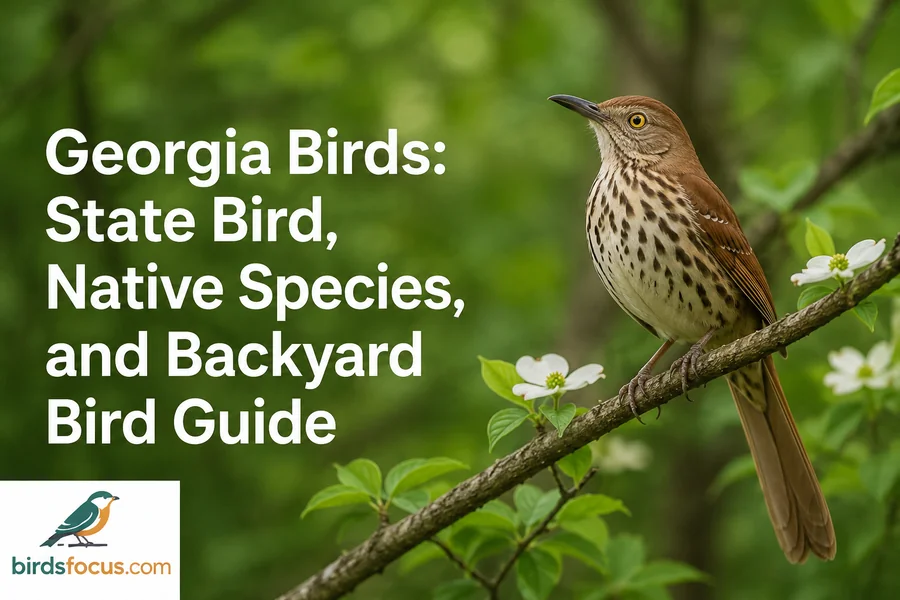
The Brown Thrasher is Georgia’s official state bird. It was decided in 1970, and to be honest, it was an easy choice — it’s found all over the state and out-signs all but the greatest of the yard. There are even some records that suggest an earlier, more informal adoption took place in 1935.
Watch for the reddish brown feathers, the curved bill, and the almost glowing yellow eyes! Nests are low, typically in thickets or hedgerows, and it can be found in cities, in cow pastures. This is one of the reasons it is so good of a choice to keep as one of the Georgia native birds: it’s not too hard to find and doesn’t require a permit.
Brown Thrasher: Facts, Habitat, and Identification
This bird doesn’t spend much time up high. It stays low, digging through leaf litter with that curved bill, flipping debris to get at insects, berries, whatever’s underneath. The rusty back and streaky white chest are the giveaways once you know to look for them.
You’ll spot thrashers in thickets, forest edges, dense shrubs — pretty much any region of the state. They don’t wander far from cover. A thrasher will often sing from a high perch first, then drop right back down into hiding once it’s made its point. Numbers are stable, and its comfort around hedges and backyard shrubs has quietly helped protect a lot of bird habitats in Georgia even as neighborhoods keep expanding.
Native Georgia Birds You Should Know
Northern Cardinal
Scientific name: Cardinalis cardinalis
You know this one already. Bright red males, a black mask, a thick seed-cracking beak — the cardinal is probably the first bird most Georgians can name without thinking twice. Females go more subtle: brown with red highlights on the wings and crest. Neither one migrates, so whatever cardinals you’ve got in your yard now, you’ll likely have all winter too.
They like shrubby edges and garden borders, somewhere low enough to nest and stay out of sight. Sunflower seeds, berries, the occasional insect — that’s the menu. Males sing loud and early, often before you’re even out of bed, especially once spring territory disputes kick in. What really keeps cardinals so visible is how little they care about people. Cities, suburbs, farmland — doesn’t matter. That comfort with humans is exactly why new birders usually learn this one first.
Eastern Bluebird
Scientific name: Sialia sialis
Open fields get a lot more interesting once an Eastern Bluebird shows up. Males carry that sky-blue back and rusty chest combo; females wear a duller, grayish version of the same look. Neither can dig its own nest hole, so they depend entirely on old cavities or nest boxes people put up for them.
Numbers took a real hit in the last century — competition from introduced species pushed bluebirds out of a lot of range. Nest box programs turned that around, and now they’re a common sight again. Watch a fence line or a stretch of power wire near open pasture and you’ll probably catch one perched, scanning the ground for insects before dropping down to grab one. Berries fill in the diet once it gets cold. They favor pastures and golf courses over thick forest, and because they take so readily to a simple wooden box, they’ve become a go-to project for landowners trying to help native birds of Georgia hang on in farm country.
Wood Thrush
Scientific name: Hylocichla mustelina
The Wood Thrush can be heard in the woods at dusk in Georgia, if you’ve heard something that sounded like a flute. It is one of the best songs in the woods period. The bird is cinnamon-brown above and spotted white below, has large dark eyes and loves the understory and wet forest floors of shaded forests.
They migrate up with the spring rush, nest in the forest interior and make their way south for the winter. On the ground, they begin to turn over leaves in search of beetles and ants, and switch to fruit later in the season. This species does not show any signs of recovery with populations declining in many areas where large continuous forest blocks are diminishing. Larger forests, such as those found in the north of Georgia, including national forestland, maintain good breeding populations. Many conservationists consider the Wood Thrush to be a sort of early warning indicator of the health of the forest in the state.
Painted Bunting
Scientific name: Passerina ciris
It’s the most colourful songbird in North America – and once you see one you’ll fall for it. A bird with a blue head, green back and red belly. They are plain yellow-green with nothing like that on their appearance, with females and young. There is a vast difference between them, so much so that early naturalists believed they were two different species.
The best chance for finding one is along the coast of southeast Georgia around scrub, maritime thickets, and around the edges of marsh. Mostly seeds but during breeding season insects are fed to the chicks. You need to be patient, low and hidden to see these birds. Over the years, populations have been depleted by illegal trapping for the pet trade in Central America and by habitat loss. Its survival effort is increasingly being taken on by coastal preserves along the Georgia coast.
Red-Cockaded Woodpecker
Scientific name: Dryobates borealis
This is one of the rarer birds you’ll come across in Georgia, and it earns that rarity honestly. Instead of dead wood, it carves nest cavities into living pine trees — specifically ones softened by a particular fungus. That process can take years. Years, for one cavity. Which makes each tree the family relies on incredibly valuable.
Small family groups live together in mature longleaf pine forest, a habitat type that’s shrunk dramatically across the Southeast. Look for black and white barring on the back, a big white cheek patch, and just a hint of red near the male’s head — barely visible, but that’s where the name comes from. Group members actually cooperate to raise young together, which isn’t typical woodpecker behavior at all. It’s federally listed as endangered, and prescribed burns that keep pine stands open remain critical to keeping the population going. Georgia holds some of the last real strongholds for this bird, which makes conservation land here matter well beyond state lines.
Bald Eagle
Scientific name: Haliaeetus leucocephalus
Pesticides and habitat loss nearly wiped this bird out decades ago. Now it’s back, and Georgia’s lakes and rivers are proof. Adults are unmistakable — white head, white tail, dark brown body, that heavy yellow hook of a beak. Young birds look nothing like this; they’re mottled brown and white until they hit full maturity around age five.
Big trees near fish-rich water are the requirement for nesting, and Georgia’s got plenty — inland reservoirs, coastal waterways, both support active pairs, and the state now tracks hundreds of nests every season. Fish dominate the diet, though an eagle won’t think twice about scavenging or muscling a smaller bird like an osprey out of a fresh catch. Nests get reused and expanded year after year until they’re genuinely massive. This recovery is one of the better American conservation stories out there, and sightings along Georgia’s rivers keep getting more common, not less.
Wild Turkey
Scientific name: Meleagris gallopavo
One of the largest game birds in the world is found here in Georgia, in the forests and farmland. The iridescent irises, the bare blue-and-red head, the whole deal with courtship was on display when toms were in spring. Hens are smaller and duller than males, thus hiding while sitting on a ground nest.
They prefer a combination of open woodland and close to the fields and search in search for acorns, seeds, insects and small reptiles. They roost up in trees at night and feed down in the flocks at dawn when ground predators are less active. By 1900, this bird was almost wiped out of Georgia due to over-hunting and habitat destruction. It was revived statewide by the middle of the 20th century and is now doing very well in almost all counties. Gobbling season in the spring is a great draw to the outdoors every year, and in truth, a healthy turkey population is one of the more positive indicators of forest management success in an area.
Barred Owl
Scientific name: Strix varia
“Who cooks for you?” That’s the call, and it’s one of the more recognizable owl sounds you’ll hear in Georgia. Round head, no ear tufts, dark eyes, brown-and-white barring across the chest — medium to large, and mostly nocturnal, hunting by silent flight and sharp hearing through the forest canopy.
Mature forest near water is the preference — swamps, river bottoms, hardwood stands. They’ll nest in a large tree cavity or just take over an abandoned hawk nest if one’s available. Small mammals, amphibians, even fish grabbed near a stream edge round out the diet. Unlike a lot of owls, this one sometimes calls during daylight, which means you don’t necessarily need a night hike to hear one. It’s adapted well to suburban wooded neighborhoods, not just deep forest, which keeps it one of the more approachable owls for anyone just getting into birding.
Why Georgia Has So Many Bird Species
Georgia sits along a major migratory flyway, and it packs several distinct habitat zones into one state — mountains, piedmont forest, coastal plain, barrier islands. That combination of geography and climate gives both resident and migratory birds somewhere to feed, breed, and rest, all year round.
Backyard Birds of Georgia
Carolina Wren
Scientific name: Thryothorus ludovicianus
Small bird, big voice. The Carolina Wren’s song is loud enough to fill an entire yard, which is impressive for something that weighs less than an ounce. Warm reddish-brown feathers, a bold white eyebrow stripe, a short tail usually cocked upright — it stays active in Georgia all year and doesn’t migrate, even through a hard freeze, as long as it’s got dense cover to retreat into.
Check brush piles, garages, porches, thick shrubs near the house — that’s wren territory. They’re constantly moving, checking crevices and leaf piles for insects and spiders. Pairs tend to stay together for life and hold the same territory season after season. And they’ll nest in the strangest places — flowerpots, mailboxes, hanging baskets — which means plenty of homeowners have discovered a nest somewhere they really weren’t expecting one. A rough winter can knock numbers down temporarily, but they usually bounce back within a year or two. Between the volume and the personality, this might be the most entertaining backyard bird Georgia has to offer.
Carolina Chickadee
Scientific name: Poecile carolinensis
The Carolina Chickadee is curious, small and will come right up to the feeder while you are standing within a few feet. Soft gray back, white cheeks, black throat, black cap. A year round Georgia resident, and one of the more readily attracted birds when feeders are out.
Chickadees are very adaptable and will survive in any type of mixed woodland, forest edge, or mature trees found in suburban yards. Their nest is a small cavity, sometimes dug by them, or sometimes a nest box. In summer insects are the main food, and seeds and berries are the main food in the cold season. In the winter months they are frequently found in flocks that include titmice and nuthatches; so if you see one, you are likely to see others as well. They’re always heard before you see any action and are quite buzzy and cheerful.
Tufted Titmouse
Scientific name: Baeolophus bicolor
Gray crest, big dark eyes, a soft peach wash on the flanks — the Tufted Titmouse is a year-round Georgia resident and a confident one at that. It’ll announce itself with a clear whistled call well before it shows up at your feeder.
Mature deciduous forest is the natural fit, but titmice adapt to suburban yards with large trees just fine. They can’t dig their own cavity, so old woodpecker holes usually do the job. Diet leans insect-heavy in summer and shifts toward seeds and nuts in winter — and they’ll actually stash food in bark crevices to get through the lean months. Like chickadees, they join mixed foraging flocks, which helps everyone in the group spot predators sooner. Between the feeder visits and their willingness to use nest boxes, titmice are one of the easier backyard birds of Georgia to bring in and keep watching.
Blue Jay
Scientific name: Cyanocitta cristata
Loud, blue, and impossible to ignore — the Blue Jay doesn’t do subtle. Bright blue, white, and black plumage, a prominent crest, and a vocabulary that includes a hawk-call impression it uses specifically to clear other birds off a feeder. It’s a year-round Georgia resident, active in both forest and neighborhood.
Jays are sharp. They cache food, especially acorns, burying them for winter retrieval — and in the process, they end up planting a fair number of oak trees without meaning to. Seeds, nuts, insects, and occasionally eggs or nestlings from other birds round out the diet. They stick together in small family groups and talk constantly, using a surprisingly wide range of calls. Some folks find their feeder behavior a bit much, but between the intelligence and the color, it’s hard not to enjoy watching one work.
American Goldfinch
Scientific name: Spinus tristis
This one throws new birders off every time. Breeding males go bright lemon-yellow with a black forehead and wings; come winter, both sexes fade to a dull olive-brown that barely resembles the summer bird. Seeds — especially thistle and sunflower — make up nearly the entire diet. Goldfinches rarely touch insects, even to feed chicks.
They breed later than most songbirds, sometimes waiting until midsummer for thistle down to line the nest. Open fields, roadsides, gardens with plenty of seed-bearing plants — that’s goldfinch habitat. Flocks fly in a distinctive up-and-down pattern and call constantly while airborne, so you can often identify one before it even lands. They’ll readily hit a feeder stocked with nyjer seed. And here’s the thing — they never actually leave Georgia in winter. People just assume the bright yellow bird from summer flew south, when really it’s sitting right there in duller feathers the whole time.
Ruby-Throated Hummingbird
Scientific name: Archilochus colubris
Georgia’s only regularly breeding hummingbird makes a nonstop flight across the Gulf of Mexico every spring to get here — roughly 500 miles, no stopping. Males show an iridescent red throat patch that can look black depending on the light; females have a plain white throat and a slightly bigger body.
Nectar from tubular flowers is the main food source, and they’ll readily take to a sugar-water feeder in the yard. Insects matter too, mostly for the protein chicks need. Despite the size, these birds are aggressive about defending feeding territory — even against birds many times their weight. Wings beat around fifty times a second, which is where the humming sound comes from. Most head back to Central America by early fall. Keeping a feeder filled through late summer helps migrating birds pass through, which makes this one of the more rewarding backyard birds of Georgia to host, even for just part of the year.
Mourning Dove
Scientific name: Zenaida macroura
That soft, sorrowful cooing that gets mistaken for an owl more often than you’d think — that’s a Mourning Dove. Grayish-brown, a long pointed tail, a small head relative to its body. It’s one of the most widespread birds in the state, showing up in just about every habitat type Georgia has.
Seeds make up nearly the whole diet, and doves forage on open ground in fields, roadsides, backyards, wherever seed’s available — including whatever’s spilled beneath a feeder meant for other birds. Nests are loose and flimsy, almost alarmingly so, but pairs can raise multiple broods a year thanks to a long breeding season. Takeoff produces a distinctive wing whistle that warns nearby doves of danger. They handle human landscapes and farmland equally well, which keeps populations stable and abundant across the state. Mourning Doves are also a popular game bird here, so they end up playing two roles at once — familiar backyard visitor and traditional hunting target.
Read Also: Zebra Dove Guide: Bird Facts, Call, Sound, Male vs Female & Pet Care
How Backyard Birds Support Georgia’s Ecosystem
Backyard birds do more than look nice at a feeder. They control insects, spread seeds, pollinate flowers — all across neighborhoods statewide. A feeder or nest box gives homeowners a direct way to support that work, and it’s often what gets people paying real attention to bird habitats in Georgia in the first place.
Birds of Coastal Georgia
Great Blue Heron
Scientific name: Ardea herodias
Tall, slate-blue-gray, and almost eerily patient — the Great Blue Heron is one of the easiest wading birds to spot along Georgia’s coast and inland waterways. Long neck, dagger of a yellow bill, slow deliberate wingbeats in flight with the neck folded into an S-shape.
Hunting means standing dead still in shallow water until a fish, frog, or small reptile wanders close enough. One quick thrust of the bill, and that’s usually it. Marshes, rivers, pond edges — herons work all of it year-round in Georgia. They nest in colonies called rookeries, typically high in trees near water to keep predators away from the ground. Because they hold so still while hunting, herons are one of the easier coastal birds to watch for long stretches without spooking them.
Wood Stork
Scientific name: Mycteria americana
The only stork that breeds in North America, and Georgia’s coastal wetlands are a big part of why it still can. Bald dark gray head, heavy downcurved bill, mostly white body with black flight feathers showing in the air. On the ground it looks a bit awkward, honestly — that grace only shows up once it’s soaring.
Feeding relies on something called tactolocation: sweep the open bill through murky water, snap shut the instant it touches prey. Works great when visibility’s too poor to hunt by sight. Storks need fluctuating water levels that concentrate fish into shrinking pools, which makes wetland management essential to the whole operation. Once listed as endangered, the species has crept back gradually thanks to protected coastal habitat across Georgia and Florida. Big nesting colonies form in cypress swamps and coastal hammocks each spring, and at this point the Wood Stork is basically a symbol of what wetland conservation can actually accomplish.
American Oystercatcher
Scientific name: Haematopus palliatus
Bright orange-red bill, yellow eyes, bold black-and-white body — the American Oystercatcher is not a subtle bird, and Georgia’s beaches are a good place to find one. That long flattened bill works like a specialized tool, prying open oysters and clams along sandy and rocky shoreline.
Nests go right on the open beach — shallow scrapes among sand and shell, camouflaged eggs, and unfortunately a lot of exposure to foot traffic, off-leash dogs, and storm tides. Georgia’s barrier islands hold some of the most important nesting sites for this species anywhere on the Atlantic coast. Pairs often forage together at low tide, calling out with a sharp piercing whistle that carries a long way across open sand. Conservation groups mark and monitor nest areas every spring to keep disturbance down. Between the look and the feeding style, it’s an easy favorite for anyone birding the Georgia shoreline.
Osprey
Scientific name: Pandion haliaetus
White head, dark eye stripe, brown back, white belly — the Osprey is a fish-hunting raptor found on nearly every river, lake, and coastal waterway in Georgia. It hovers briefly over water, then drops feet-first to grab a fish near the surface. Almost no other Georgia raptor hunts quite like this.
Nests are big stick platforms built on dead trees, channel markers, utility poles — anywhere near water — and often reused for years. Fish make up basically the entire diet, and reversible outer toes give the bird a better grip on slippery prey mid-flight. Ospreys head to Central and South America for winter, then come back to the same territory each spring to breed. Pesticide contamination hit populations hard decades ago, but they’ve rebounded strongly since. Watching one dive and coming up with a fish is genuinely one of the better moments you’ll get birding Georgia’s coast or major rivers.
Birds of North Georgia
Birding is up here mostly defined by cooler elevations and dense hardwood cover. The Chattahoochee-Oconee National Forest serves as a spring and fall stopover for Wood Thrushes, Barred Owls, and an abundant variety of migrating warblers. The higher elevations also attract ruffed grouse and some woodpecker species and are a good bet for woodpecker birders looking to stay away from the coasts of North Georgia.
Birds of Middle Georgia
Farmland, pine plantation, and river bottomland make up most of Middle Georgia, and that transitional mix suits open-country and edge species well. Eastern Bluebirds, Wild Turkeys, and Northern Bobwhite all do well here. The region’s rivers and reservoirs pull in Bald Eagles and Ospreys too, so a single outing can turn up both woodland and water birds without much trouble.
Common Birds of Georgia by Color
| Bird Color | Common Species |
| Red | Northern Cardinal, Painted Bunting (belly) |
| Blue | Eastern Bluebird, Blue Jay, Painted Bunting (head) |
| Yellow | American Goldfinch, Painted Bunting (back) |
| Brown | Brown Thrasher, Wood Thrush, Carolina Wren |
| White/Gray | Great Blue Heron, Wood Stork, Mourning Dove |
Best Places for Bird Watching in Georgia
Good bird watching in Georgia comes down to protected habitat, and the state has it spread across several regions. Coastal preserves, national forest land, and wetland refuges each pull in a different set of species depending on the time of year.
Okefenokee National Wildlife Refuge, Jekyll Island, Chattahoochee-Oconee National Forest, and Piedmont National Wildlife Refuge near Macon are the usual go-to spots. All four support resident species and seasonal migrants, which is part of why Georgia holds up as a strong Atlantic Flyway stop for birders traveling in from out of state.
Scientific Classification of Georgia Birds
| Common Name | Scientific Name | Family | Order |
| Brown Thrasher | Toxostoma rufum | Mimidae | Passeriformes |
| Northern Cardinal | Cardinalis cardinalis | Cardinalidae | Passeriformes |
| Eastern Bluebird | Sialia sialis | Turdidae | Passeriformes |
| Wood Thrush | Hylocichla mustelina | Turdidae | Passeriformes |
| Painted Bunting | Passerina ciris | Cardinalidae | Passeriformes |
| Red-Cockaded Woodpecker | Dryobates borealis | Picidae | Piciformes |
| Bald Eagle | Haliaeetus leucocephalus | Accipitridae | Accipitriformes |
| Wild Turkey | Meleagris gallopavo | Phasianidae | Galliformes |
| Barred Owl | Strix varia | Strigidae | Strigiformes |
| Carolina Wren | Thryothorus ludovicianus | Troglodytidae | Passeriformes |
| Carolina Chickadee | Poecile carolinensis | Paridae | Passeriformes |
| Tufted Titmouse | Baeolophus bicolor | Paridae | Passeriformes |
| Blue Jay | Cyanocitta cristata | Corvidae | Passeriformes |
| American Goldfinch | Spinus tristis | Fringillidae | Passeriformes |
| Ruby-Throated Hummingbird | Archilochus colubris | Trochilidae | Apodiformes |
| Mourning Dove | Zenaida macroura | Columbidae | Columbiformes |
| Great Blue Heron | Ardea herodias | Ardeidae | Pelecaniformes |
| Wood Stork | Mycteria americana | Ciconiidae | Ciconiiformes |
| American Oystercatcher | Haematopus palliatus | Haematopodidae | Charadriiformes |
| Osprey | Pandion haliaetus | Pandionidae | Accipitriformes |
Interesting Facts About Georgia Birds
| Bird | Interesting Fact |
| Brown Thrasher | Can sing over 1,000 distinct song phrases — more than nearly any other North American bird |
| Ruby-Throated Hummingbird | Crosses the Gulf of Mexico nonstop during migration, about 500 miles with no stops |
| Bald Eagle | Builds the largest nest of any North American bird — some weigh over a ton |
| Wood Stork | Snaps its bill shut in as little as 25 milliseconds once it feels prey |
| Blue Jay | Buries acorns for winter and ends up accidentally planting new oak trees |
| Wild Turkey | Nearly wiped out in Georgia by 1900, restored statewide by the mid-1900s |
Conclusion
Georgia birds travel far in search of the right spot in which to sing from a backyard hedge to a Great Blue Heron standing still in a coastal marsh. Each of these habitats has its own bird life, and this is one reason why the state is one of the most diverse in the Southeast.
Just identifying a few of the birds found in Georgia makes every walk or after work stroll in the backyard special. Whether you have a nest box in your own back garden or a weekend visit to a coastal nesting site, it’s a way to maintain these populations for future generations.
FAQs:
What is the state bird of Georgia?
The Brown Thrasher is Georgia’s official state bird, adopted in 1970 for its statewide range and its massive song repertoire.
How many bird species live in Georgia?
Georgia has recorded more than 400 bird species, including year-round residents, breeding birds, and seasonal migrants.
What are the most common backyard birds in Georgia?
Northern Cardinal, Carolina Wren, Carolina Chickadee, Tufted Titmouse, and Blue Jay are the birds most Georgia homeowners see at their feeders.
Where is the best place for bird watching in Georgia?
Okefenokee National Wildlife Refuge, Jekyll Island, and Chattahoochee-Oconee National Forest rank among the top spots for bird watching in Georgia.
Are there any endangered birds in Georgia?
Yes. The Red-Cockaded Woodpecker and Wood Stork are both listed as threatened or endangered and depend on protected habitat in the state.
Read More Articles: How Do Birds Mate? Reproduction, Diagram & Why Birds Mate Without Touching

Welcome to birdsfocus! I’m Anam Sattar, an AI Powered SEO, and Content Writer with 4 years of experirnce.
I help websites rank higher,grow traffic, and look amazing. My goal is to make SEO and web design simple and effective for everyone.
Let’s achieve more together!