

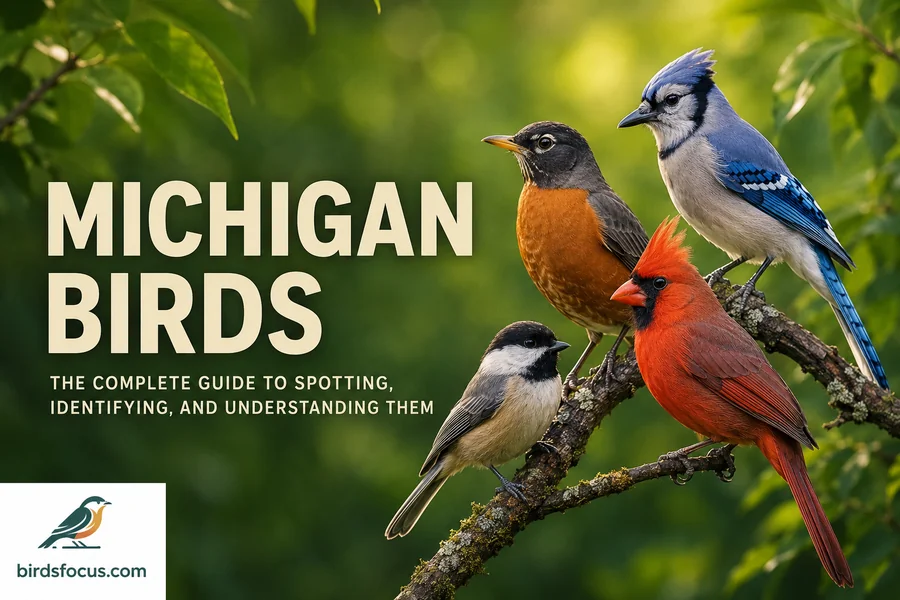
Michigan birds show up in more places than people expect. A robin on the lawn, a loon calling across a lake at midnight, an eagle circling over the Great Lakes shoreline — the state has all of it. Michigan sits on a major migration route, so what you see changes depending on the month. Spring and fall bring travelers passing through. Summer and winter bring the ones that actually live here.
This guide addresses the popular bird species michigan, state bird, the most common backyard catch, the big birds that are usually seen & the changes that occur in the UP, northern Michigan and the south. Each bird includes habitat notes, feeding habits and a table of scientific classification so you know what you’re looking at.
What Is the State Bird of Michigan?
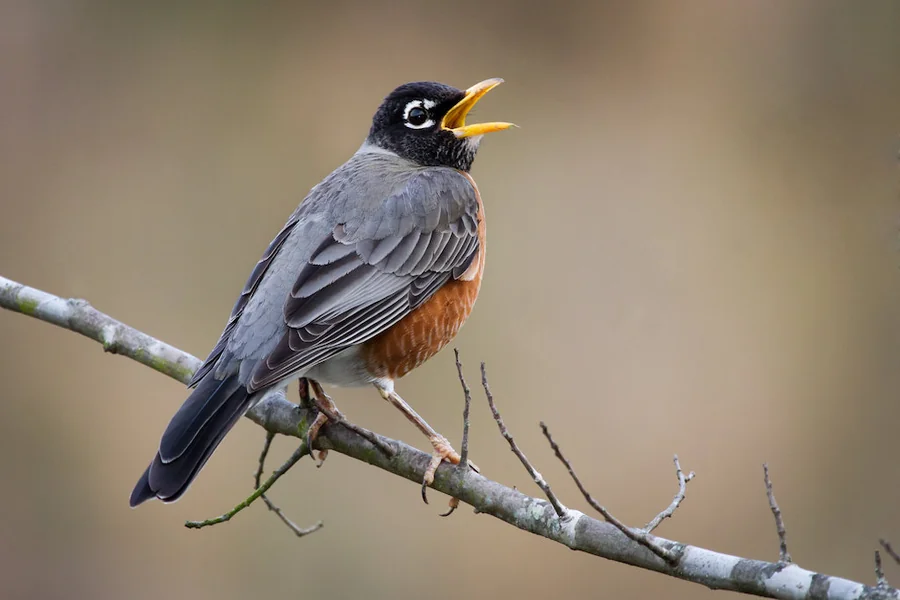
The American Robin is the Michigan State Bird. It was reintroduced in 1931 by a vote of the schoolchildren, and it is a good choice. Robins appear first in the spring and remain throughout the year, this makes them a shorthand to the seasons.
Nobody picked a rare bird buried in some remote forest. They picked one anyone could find in their own yard. That’s still true today — the robin remains one of the easiest Michigan birds to recognize, in any region of the state.
American Robin: Facts, Habitat, and Identification
Gray-brown back, orange chest, and a head that runs darker on males than females. That’s the quick version. You’ll see robins hopping across lawns tugging worms out of the dirt, or building cup-shaped nests tucked under eaves and tree branches.
Worms and insects make up most of the diet in warmer months. Once the ground freezes, robins switch to berries and fruit instead. They’re also early risers — often the first bird singing before sunrise in spring, which is why so many people associate the sound with the season itself. You’ll find them everywhere in Michigan, from city parks to farmland to forest edges.
| Rank | Classification |
| Kingdom | Animalia |
| Phylum | Chordata |
| Class | Aves |
| Order | Passeriformes |
| Family | Turdidae |
| Genus | Turdus |
| Species | T. migratorius |
Read Also: Hooded Oriole Bird
Native Michigan Birds You Should Know
Blue Jay
Loud, blue, and impossible to miss. Blue Jays have a white chest and a black necklace marking, and they’ve got a call that can mimic hawks — a trick they use to clear other birds off a feeder. They’re sharp birds too. A single jay might cache hundreds of acorns for winter and remember most of the hiding spots months later.
You’ll find them in forests, parks, and backyards year-round, usually in small family groups outside breeding season. They get a reputation for being aggressive at feeders, and fair enough, but there’s a payoff for the forest: buried acorns that never get dug back up often grow into new oak trees.
| Rank | Classification |
| Kingdom | Animalia |
| Class | Aves |
| Order | Passeriformes |
| Family | Corvidae |
| Genus | Cyanocitta |
| Species | C. cristata |
Black-capped Chickadee
This is a small, round, black cap and bib against a white face — it’s easy to tell that’s this one. One of those is that it is active all winter in Michigan, which is something most little birds cannot accomplish. Chickadees hide seeds in crevices of bark and are able to remember thousands of hiding places for weeks.
During the colder months they move in mixed flocks, along with nuthatches and woodpeckers. They too are curious around people! Put up a feeder and watch for it to come in, you never know! Their call — a distinct “chick-a-dee-dee” — is where the name derives from, and one of the most recognizable bird calls in the state.
| Rank | Classification |
| Kingdom | Animalia |
| Class | Aves |
| Order | Passeriformes |
| Family | Paridae |
| Genus | Poecile |
| Species | P. atricapillus |
Northern Cardinal
Males are bright red with a black face and a pointed crest. Females look nothing like them — soft brown, with just a hint of red on the wings and tail. What’s unusual is that both sexes sing, which isn’t common among songbirds, and pairs will actually call back and forth to each other.
Cardinals don’t migrate south. They stick around Michigan all winter, sticking to thick shrubs and forest edges, and they’ll come to a feeder if sunflower seeds are on offer. One quirk worth knowing: they’re territorial enough to fight their own reflection in a window, which is a pretty common early-spring sight.
| Rank | Classification |
| Kingdom | Animalia |
| Class | Aves |
| Order | Passeriformes |
| Family | Cardinalidae |
| Genus | Cardinalis |
| Species | C. cardinalis |
Bald Eagle
Michigan’s largest bird of prey — white head, white tail, dark brown body. Pesticide use nearly wiped these out decades ago, but the comeback across the Great Lakes has been real. Their nests get enormous over time, sometimes topping a thousand pounds after years of the same pair reusing and rebuilding.
Fish are the main target, caught along rivers and lake shorelines, though eagles won’t turn down waterfowl or carrion either. They mate for life and return to the same nesting territory year after year. If you’re near a lake anywhere in the state, especially along the Great Lakes coast, there’s a decent chance you’ll spot one overhead.
| Rank | Classification |
| Kingdom | Animalia |
| Class | Aves |
| Order | Accipitriformes |
| Family | Accipitridae |
| Genus | Haliaeetus |
| Species | H. leucocephalus |
Sandhill Crane
Tall and gray, with a bare red patch on top of the head, the Sandhill Crane is hard to miss — mostly because you’ll hear it before you see it. That rattling call carries for miles across open fields and wetlands. Come fall, cranes gather in huge flocks, and Michigan hosts some of the largest staging areas anywhere in the country.
Grains, insects, and small animals in wet meadows and farm fields make up most of the diet. Pairs also do this elaborate dance — jumping, spreading wings, bowing to each other — that’s genuinely fun to watch if you catch it. Sandhill Cranes used to be rare here. Not anymore. They’ve recovered well and now nest across most of the Lower Peninsula.
| Rank | Classification |
| Kingdom | Animalia |
| Class | Aves |
| Order | Gruiformes |
| Family | Gruidae |
| Genus | Antigone |
| Species | A. canadensis |
Common Loon
Black and white, checkered back, and a call that’s genuinely haunting when you hear it drift across a northern lake at night. Loons sit low in the water and can dive for long stretches while hunting fish. They need clean, clear water to do it well, which is part of why biologists treat them as an indicator of lake health.
Summers bring loons to Michigan’s northern lakes to breed, and they head to coastal waters once it’s over. Chicks often ride on a parent’s back during the first weeks of life — a decent way to dodge whatever’s lurking below the surface. If you’ve spent a summer night on a northern Michigan lake, you’ve probably already heard one without knowing it.
| Rank | Classification |
| Kingdom | Animalia |
| Class | Aves |
| Order | Gaviiformes |
| Family | Gaviidae |
| Genus | Gavia |
| Species | G. immer |
Why Michigan Has So Many Bird Species
Michigan sits on a major flyway between the Gulf Coast and Canada, wedged between the Great Lakes, and that geography does a lot of the work. Forest, wetland, farmland, and shoreline all sit close together, and the lakes themselves act as navigation landmarks during migration — which pulls huge numbers of birds through twice a year.
That’s really the short answer for why you get northern species like loons and cranes alongside southern regulars like cardinals, all in the same state. Not many places pack in this much variety, and it’s a big reason bird watching in Michigan pulls in visitors from well outside its borders.
Read More: 15 Asian Birds
Common Michigan Birds Around Your Backyard
House Finch
Red head and chest on the males, streaky brown on the females — one of the most common feeder birds in the state, usually showing up in small flocks. Seeds, buds, and berries make up most of the diet, and these birds do just fine in cities and suburbs.
Nests turn up in hanging planters, gutters, thick shrubs — basically anywhere close to a house. The song is a cheerful, warbling thing that fills a neighborhood most of the day. Interesting bit of trivia: House Finches are originally a western species. They spread across the whole country after a small population got released on the East Coast decades ago.
| Rank | Classification |
| Kingdom | Animalia |
| Class | Aves |
| Order | Passeriformes |
| Family | Fringillidae |
| Genus | Haemorhous |
| Species | H. mexicanus |
American Goldfinch
Bright yellow with black wings in summer, then dull olive once winter hits — the American Goldfinch is Michigan’s smallest common finch, and one of the last birds to nest each year. It actually waits for thistle down to be ready before building.
The diet is almost entirely seeds, especially thistle and sunflower. They fly in this bouncy, up-and-down pattern that makes them easy to pick out from a distance, even before you notice the color. Load a feeder with nyjer seed and you’ll likely see them in numbers through the warmer months.
| Rank | Classification |
| Kingdom | Animalia |
| Class | Aves |
| Order | Passeriformes |
| Family | Fringillidae |
| Genus | Spinus |
| Species | S. tristis |
Mourning Dove
The name is derived from this soft, grey-brown, slim body, pointed tail and its low cooing call — sadly sounding. Doves have a diet that is almost all ground feeders, selecting seeds and grain in open areas or directly under a feeder.
In Michigan, they are present throughout the year, but are more numerous in the summer. But there’s one thing that spooks people: when they take off their wings make a really loud whistling sound, loud enough to catch you by surprise before you even see the bird! Typically, pairs produce multiple broods of the year, making them one of the more prolific backyard species in the state.
| Rank | Classification |
| Kingdom | Animalia |
| Class | Aves |
| Order | Columbiformes |
| Family | Columbidae |
| Genus | Zenaida |
| Species | Z. macroura |
Downy Woodpecker
Michigan’s smallest woodpecker — black and white, short bill, with males showing a small red patch on the back of the head. Suet feeders draw them in reliably, and they’ll forage on tree trunks and branches for insects hiding under the bark.
They stick around all winter and often join mixed flocks with chickadees and nuthatches. The drumming on tree trunks isn’t just about food, either — it’s a form of communication, especially during breeding season. Backyards, parks, forest edges: Downy Woodpeckers adapt to all of it across the state.
| Rank | Classification |
| Kingdom | Animalia |
| Class | Aves |
| Order | Piciformes |
| Family | Picidae |
| Genus | Dryobates |
| Species | D. pubescens |
European Starling
Stocky, dark, short-tailed, with a sharp yellow bill in breeding season and feathers that show a glossy, speckled pattern depending on the light. Starlings aren’t native — they got introduced to North America in the 1890s and spread across the entire continent within decades.
In Michigan, they gather in large, noisy flocks outside of breeding season, and they compete hard with native cavity-nesters for tree holes and nest boxes. That’s been a real problem for bluebirds in particular. Still, love them or not, starlings are one of the most widespread birds in the state, in cities and farmland alike.
| Rank | Classification |
| Kingdom | Animalia |
| Class | Aves |
| Order | Passeriformes |
| Family | Sturnidae |
| Genus | Sturnus |
| Species | S. vulgaris |
Red-winged Blackbird
Glossy black with bright red and yellow shoulder patches — but only on the males. Females look completely different, more like an oversized streaky sparrow. This is one of the earliest signs of spring across Michigan’s wetlands, and once you know the call, you’ll hear it everywhere.
Males show up first each year and stake out marsh territory with loud, repeated calls from the cattails. They get aggressive during nesting season too — chasing off birds far bigger than themselves, hawks included. Ponds, ditches, wetlands: that’s where you’ll find them, from spring through fall, all across the state.
| Rank | Classification |
| Kingdom | Animalia |
| Class | Aves |
| Order | Passeriformes |
| Family | Icteridae |
| Genus | Agelaius |
| Species | A. phoeniceus |
How Backyard Birds Affect Native Species
Not all birds at local feeders are necessarily good news for local wildlife in Michigan. European Starlings and House Sparrows compete directly with cavity nesters for scarce tree holes and nest boxes and have adversely affected populations of bluebirds and woodpeckers in some areas.
Feeders also tend to cluster birds in a single location, increasing the potential for the spread of disease to be more rapid than it would be in the wild. Regular cleaning of feeders and moving them further away will help. It’s still a discussion to be had among Michigan bird conservationists as to how to balance backyard feeding and actual habitat support.
Birds of the Upper Peninsula, Michigan
The Upper Peninsula is an excellent area for northern species due to the thick boreal forest, rocky shores and the relatively low human population. Common Loons breed on inland lakes. Bald Eagles nest around Lake Superior. More of these species—Ruffed Grouse and Pileated Woodpeckers—travel through the deep forests here than anywhere else in the state.
Owls come south from Canada in the winter and sometimes a Snowy Owl or Great Gray Owl can be seen near open fields and shorelines. The Whitefish Point migration watch point, in its entirety, is one of the best migration watch points in the entire Great Lakes area — worthy of the trip alone in the spring and fall.
Birds of Northern Michigan
Northern Michigan mixes all three and provides habitats for Sandhill Cranes, Common Loons and many warblers migrating through in the spring. Also here is the Kirtland’s Warbler, one of the rarest songbirds in North America, that nests almost exclusively in young jack pine stands, this part of the state.
Birders from other states come only in search of it in June when it is in its brief breeding season. Visitors are provided with a genuine opportunity to see these jack pine plains through guided tours.
Birds of Southern Michigan
More farmland, suburbs, and cities down here, which shapes a different mix of birds than the north. Cardinals, Blue Jays, and Robins dominate backyard sightings, while wetlands near rivers and lakes bring in herons, egrets, and ducks.
Common Birds Found in Southern Michigan
American Robins, Northern Cardinals, House Finches, Mourning Doves — these show up in neighborhoods across southern Michigan daily, no real searching required. Yards, parks, tree-lined streets: they’re everywhere.
Wetland Birds of Southern Michigan
Marshes and river bends across the south support Great Blue Herons, Wood Ducks, and Red-winged Blackbirds. These wetlands act as key stopover points for shorebirds migrating north in spring and south in fall.
Best Bird Watching Spots in Southern Michigan
Pointe Mouillee State Game Area, Kensington Metropark, and the Detroit River shoreline all deliver, each with its own set of species depending on the season. Spring migration usually brings the widest variety.
Common Michigan Birds by Color
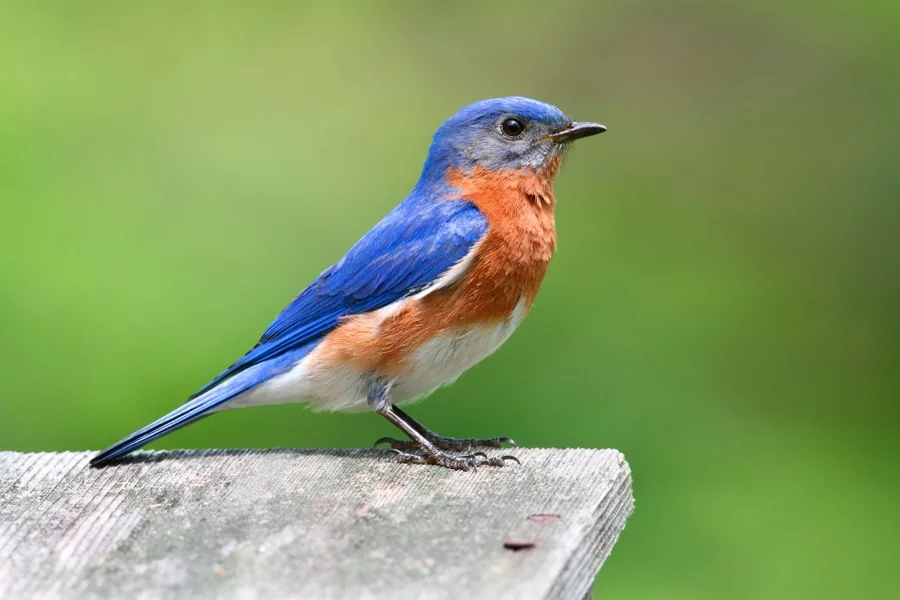
Color is often the quickest way to narrow down an ID, especially if you’re just starting out. Red birds include the Northern Cardinal and the male House Finch. Blue species include the Blue Jay and Eastern Bluebird. Yellow points to the American Goldfinch, and black-and-white usually means Downy Woodpecker or Bald Eagle.
| Bird Color | Common Species |
| Red | Northern Cardinal, House Finch |
| Blue | Blue Jay, Eastern Bluebird |
| Yellow | American Goldfinch |
| Black and White | Downy Woodpecker, Bald Eagle |
| Gray-Brown | American Robin, Mourning Dove |
Best Places for Bird Watching in Michigan
There is something to see in every area of Michigan. Whitefish Point in the Upper Peninsula is one of the premier hawk/songbird migration locations in the Midwest. Warmers of the Lake Huron coast, Tawas Point State Park attracts huge numbers of warblers during the spring migration. Waterfowl and shorebirds are found in the southeast at Pointe Mouillee.
Late April/May is typically the best time of year in which to catch an abundance of varieties in a short time. The second peak period comes in September and October with fall migration, particularly for hawks and waterfowl.
Interesting Facts About Michigan Birds
| Fact | Detail |
| State bird | American Robin, chosen by schoolchildren in 1931 |
| Rarest nesting songbird | Kirtland’s Warbler, tied almost entirely to jack pine forest |
| Loudest call | Sandhill Crane, audible from over a mile away |
| Biggest comeback story | Bald Eagle, once nearly wiped out by pesticide use |
| Best migration hotspot | Whitefish Point, Upper Peninsula |
| Total species recorded | Over 450 across the state |
Conclusion
Michigan birds cover a surprising amount of ground for one state. It’s where backyard birds, such as robins and cardinals, are found, northern birds, such as loons and cranes, and rare birds, such as Kirtland’s Warbler, which brings pullers from around the world. Migration patterns, nesting habitat and even the path of mostly birds around the Great Lakes are shaped by it.
Provide a feeder in your yard or go to Whitefish Point during spring migration. In either case, Michigan will give you a good reason to raise your gaze. Just learning a few common species will make you realize that a lot is actually going on.
FAQs:
What is the state bird of Michigan?
The American Robin — chosen by a vote of schoolchildren in 1931.
How many bird species live in Michigan?
Over 450, counting year-round residents, migrants, and rare visitors.
What is the rarest bird in Michigan?
The Kirtland’s Warbler. It nests almost exclusively in young jack pine forest.
When is the best time for bird watching in Michigan?
Late April through May, and again in September and October, for the strongest migration activity.
What birds come to Michigan backyard feeders?
Northern Cardinal, Blue Jay, Black-capped Chickadee, House Finch, and American Goldfinch are the regulars.

Welcome to birdsfocus! I’m Anam Sattar, an AI Powered SEO, and Content Writer with 4 years of experirnce.
I help websites rank higher,grow traffic, and look amazing. My goal is to make SEO and web design simple and effective for everyone.
Let’s achieve more together!