

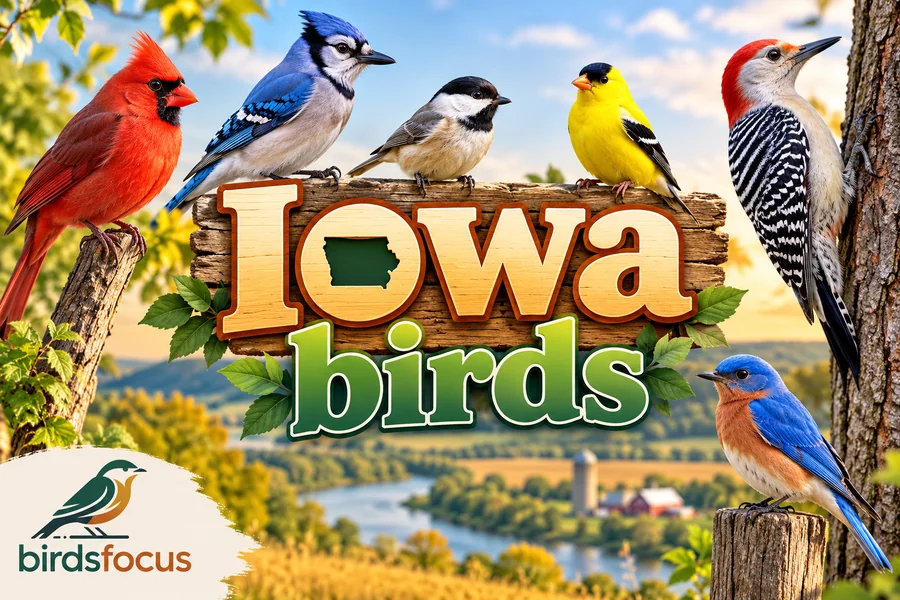
Iowa birds keep the state busy in every season. Prairie, woodland, river and wetland habitats all meet here. That mix has produced more than 400 recorded species. Bald eagles hunt the Mississippi in January. Dickcissels sing from hay fields in June. Snow geese cover DeSoto Lake in November. Most people think of corn and soybeans first. Birders know the state offers much more.
This guide covers the state bird of Iowa and 12 top species. You will also find regional hot spots and simple tips. Along the way you will learn about native birds of Iowa, backyard birds in Iowa, migratory birds in Iowa, winter birds in Iowa and bird watching in Iowa. Every profile includes a habitat map note and a classification table. Grab your binoculars and let’s go.
What Is the State Bird of Iowa?
The official state bird of Iowa is the American goldfinch. Iowa adopted it in 1933 under the name eastern goldfinch. Many people call it the wild canary. Males turn bright yellow with a black cap in summer.
This small finch fits the state well. It lives here year-round and uses fields, ditches and backyards. It also molts twice a year. That is why the yellow color fades to olive-brown each winter. Many Iowans see it daily and never notice the change.
American Goldfinch of Iowa: Facts, Habitat, and Identification
Start with the black forehead and the white wing bars. Males show a bold yellow body in summer. Females stay duller with olive tones. In winter both sexes look tan and brown. The bill is short and cone-shaped. That shape is perfect for seeds.
You can find goldfinches in every part of the state. They like weedy fields and prairie edges. They also use parks and backyard birds in Iowa feeders. They eat thistle and sunflower and coneflower seeds. Their wave-like flight is a quick giveaway. Listen for the “po-ta-to-chip” call over open ground.
Native Iowa Birds You Should Know
American Goldfinch
The American goldfinch is the state bird of Iowa. Locals call it the wild canary. Large numbers overwinter. Males are brightly yellow in the spring. They have black caps and wings with white bars. The females have olive hues and tend to be duller. Both sexes change to tan/brown in the winter season. A lot of people do not notice them at that time. Goldfinches eat seeds. Their favorite plants are thistle, coneflower and sunflower. They are also known to go to feeders of nyjer seed. This bird is late nesting. Typically, most pairs are formed in July or August. The thistle seeds mature and are fed to the chicks then. The female constructs a compact cup nest with plant material. She stuffs it with thistle down. Goldfinches fly in a wave formation. They hop up and down and sing along the way. They make a po-ta-to-chip sound call. Search for them near fence lines and along ditches, where weeds grow. They also inhabit prairie edges and city parks. Flocks form near feeders in winter. Have native seed producers in your yard and they will follow. Keep seed heads in the fall. The best time to see the birds is the early morning. Look out for spots of yellow in tall grass. The largest gatherings tend to be near water.
| Rank | Classification |
| Kingdom | Animalia |
| Phylum | Chordata |
| Class | Aves |
| Order | Passeriformes |
| Family | Fringillidae |
| Genus | Spinus |
| Scientific name | Spinus tristis |
| Iowa habitat map | Statewide: weedy fields, prairie edges, yards |
Northern Cardinal
The northern cardinal brings color to Iowa winters. It stays in the state all year. Males are bright red with a black mask. Females are tan with red touches on the wings and tail. Both sexes have a tall crest. The beak is thick and orange. The beak cracks seeds with ease. Cardinals eat sunflower and safflower seeds. They also take fruit and insects. In summer they feed insects to their chicks. Cardinals live in thickets and woodland edges. They also use backyards and hedgerows across Iowa. Dense shrubs give them cover from hawks. Females build the nest in low branches. Pairs raise two or three broods each year. Males guard their space with loud songs. The song is a clear whistle that repeats. Some males attack their own reflection in windows. They think it is a rival. Cover the window outside with paper to stop it. Winter feeders bring them close. Fill a platform feeder at dawn. Cardinals feed early and again before dark. Look for a red shape against snow. It is easy to spot. Pairs often stay together through the cold months. Listen for sharp chip calls in the brush. Quiet yards often hold a pair nearby.
| Rank | Classification |
| Kingdom | Animalia |
| Phylum | Chordata |
| Class | Aves |
| Order | Passeriformes |
| Family | Cardinalidae |
| Genus | Cardinalis |
| Scientific name | Cardinalis cardinalis |
| Iowa habitat map | Statewide: thickets, woodland edges, backyards |
Bald Eagle
The bald eagle is a top hunter along Iowa rivers. It disappeared as a nesting bird in Iowa for decades. Hunting and habitat loss caused the drop. Recovery work in the 1980s changed that. Now eagles nest across the state. Adults have a white head and white tail. Young birds look brown and mottled for about five years. Wingspans reach about seven feet. Eagles eat fish first. They also take ducks and carrion. Open water in winter draws them in. Dams keep the river from freezing. Fish gather below the dams. Eagles gather there to feed. The Mississippi River holds the biggest winter groups. Look near Lock and Dam 14 and Keokuk. Decorah draws crowds for its famous nest cameras. Pairs build large stick nests in tall trees. They reuse the same nest for years. Each year they add more sticks. Some nests weigh over a ton. Females lay one to three eggs in late winter. Both parents share the work. Bring binoculars and warm layers. Scan treetops along the water. Eagles often perch in one spot for hours. Watch for the white head first. Then look for a flat wing shape in flight. Keep a safe distance from active nests.
| Rank | Classification |
| Kingdom | Animalia |
| Phylum | Chordata |
| Class | Aves |
| Order | Accipitriformes |
| Family | Accipitridae |
| Genus | Haliaeetus |
| Scientific name | Haliaeetus leucocephalus |
| Iowa habitat map | Mississippi and Missouri rivers, large lakes, dam tailwaters |
Eastern Bluebird
The eastern bluebird is a small thrush with a big following. Males have bright blue backs and a rusty chest. Females look paler with gray-blue wings. Both sexes have a white belly. Bluebirds perch on fence posts and wires. They watch the grass below. When they spot a beetle or cricket they drop to grab it. In winter they switch to berries. Sumac and dogwood and juniper feed them then. Many bluebirds head south in fall. Some stay in southern Iowa all winter. Bluebirds nest in holes. They use old woodpecker cavities and nest boxes. Volunteers across Iowa run bluebird trails. These boxes helped the species rebound. Starlings and house sparrows compete for the same holes. Good box placement helps. Mount boxes on a post in open ground. Face them toward a tree or shrub. Young birds then have a safe perch to land on. Pairs raise two broods in a good year. Eggs are pale blue. The soft warble carries across fields. Look along county roads and pastures. Golf courses and cemeteries also work. Early spring is the best time to scout. Keep dogs and cats away from boxes. Clean old nests out in late winter. Check boxes weekly.
| Rank | Classification |
| Kingdom | Animalia |
| Phylum | Chordata |
| Class | Aves |
| Order | Passeriformes |
| Family | Turdidae |
| Genus | Sialia |
| Scientific name | Sialia sialis |
| Iowa habitat map | Statewide: pastures, roadsides, cemeteries, open woods |
Red-Headed Woodpecker
The red-headed woodpecker looks like it dipped its head in paint. The whole head is deep red. The body is black and white. Adults show big white patches on the wings. Young birds have a brown head. This species has declined across much of the country. Iowa still holds good numbers in the right habitat. Look in oak savanna and river bottoms and open woods. Dead trees matter most. The birds drill nest holes in dead wood. They also use fence posts and utility poles. Red-headed woodpeckers catch insects in midair. They fly out from a perch like a flycatcher. They also hunt on the ground. In fall they store acorns and beechnuts. They tuck food into bark cracks. Some cover the stash with wood chips. Many birds stay through winter where acorns are plentiful. Others move south. Pairs guard their trees from rivals. They will chase off starlings. Listen for a harsh churr call. Watch for a flash of white in flight. Try oak woods near the Des Moines River. Leave dead trees standing when safe. Iowa lists it as a species of greatest conservation need. Your sightings help track it. Go early in spring.
| Rank | Classification |
| Kingdom | Animalia |
| Phylum | Chordata |
| Class | Aves |
| Order | Piciformes |
| Family | Picidae |
| Genus | Melanerpes |
| Scientific name | Melanerpes erythrocephalus |
| Iowa habitat map | Oak savanna, river bottoms, open woodland |
Dickcissel
Image: Dickcissel
The dickcissel is the voice of Iowa summer fields. It arrives in May from South America. Males perch on tall stems and sing all day. The song sounds like dick dick ciss ciss. Males have a yellow chest and a black bib. They also show a gray head and a rusty shoulder. Females look like sparrows with a faint yellow wash. Dickcissels live in grassland and hay fields. They also use roadside ditches and restored prairie. Alfalfa fields hold many nests. Females build the nest low in thick plants. Hay cutting can destroy nests. Delayed mowing helps the birds finish raising young. Dickcissels eat insects in summer. Grasshoppers are a favorite food for chicks. In late summer they switch to seeds. Large flocks form before fall migration. Males may have several mates. Females raise the young alone. Iowa is part of the core breeding range. Numbers shift from year to year. Drive gravel roads in June. Scan fence posts and wires. Stop and listen. Good spots include Neal Smith National Wildlife Refuge. That refuge near Prairie City protects tallgrass habitat. Stay on the paths. Do not walk through nesting fields. Bring a hat and water. Start early for cooler air.
| Rank | Classification |
| Kingdom | Animalia |
| Phylum | Chordata |
| Class | Aves |
| Order | Passeriformes |
| Family | Cardinalidae |
| Genus | Spiza |
| Scientific name | Spiza americana |
| Iowa habitat map | Statewide in summer: grassland, hay fields, roadside ditches |
Baltimore Oriole
The Baltimore oriole flashes orange through Iowa treetops. Males have a black head and a bright orange body. Their wings show white bars. Females are dull orange with gray wings. The birds return in early May. Their arrival matches the first leaf out. Orioles winter in Central America and the Caribbean. They nest in tall deciduous trees. Elm and cottonwood and maple are common choices. The female weaves a hanging pouch. She uses grass and plant fibers and hair. The nest hangs from the tip of a branch. This keeps eggs away from predators. Orioles eat caterpillars and beetles. They also eat ripe fruit and nectar. Many yards attract them with orange halves. Grape jelly in a small dish works too. Put it out in early May. Males sing a loud flute-like whistle. They sing from high branches. You may hear them before you see them. Look along river corridors and city parks. Older neighborhoods with large trees often have pairs. The Orioles leave early. Many head south by August. Plant native trees to help them. Avoid heavy pruning in nesting season. Keep cats indoors. Watch for movement in leafy canopies. Bright oranges often give them away. Binoculars help a lot.
| Rank | Classification |
| Kingdom | Animalia |
| Phylum | Chordata |
| Class | Aves |
| Order | Passeriformes |
| Family | Icteridae |
| Genus | Icterus |
| Scientific name | Icterus galbula |
| Iowa habitat map | Statewide in summer: river corridors, city parks, tall shade trees |
Trumpeter Swan
The trumpeter swan is the largest waterfowl native to North America. Adults can weigh over twenty pounds. Wingspans can pass seven feet. Iowa lost its breeding swans by the late 1800s. Hunting and wetland drainage ended their stay. A state restoration program began in 1993. Biologists released young swans at wetlands. Wild pairs now nest in several counties. Adults have white feathers and a black bill. Young swans look gray for their first year. They hold the long neck straight. Their call sounds like a horn. Swans eat aquatic plants. They reach down with long necks to pull roots. Cygnets also eat small insects. Pairs mate for life. They build a mound nest from reeds and cattails. The nest sits on a muskrat house or small island. Females lay four to six eggs. Cygnets leave the nest soon after hatching. Look for them on marshes and quiet lakes. Winter groups use open water. Marshes in northern Iowa are good places to start. Bring a spotting scope. Do not feed swans. Bread harms them. Lead sinkers also poison them. Anglers can switch to lead-free tackle. Keep boats and dogs well back. Disturbance can make pairs abandon nests. Watch from the shore.
| Rank | Classification |
| Kingdom | Animalia |
| Phylum | Chordata |
| Class | Aves |
| Order | Anseriformes |
| Family | Anatidae |
| Genus | Cygnus |
| Scientific name | Cygnus buccinator |
| Iowa habitat map | Northern and central wetlands, marshes, quiet lakes |
Why Iowa Has So Many Migratory and Prairie Bird Species
Iowa sits inside the Mississippi Flyway. Millions of birds pass through each spring and fall. Rivers guide them north and south. The state also holds oak woods and prairie potholes and small tallgrass remnants. Each habitat feeds a different group of birds. Only a tiny share of the original prairie remains. Wildlife areas and conservation fields now protect what is left.
Introduced Birds in Iowa
Ring-Necked Pheasant
The ring-necked pheasant is an introduced bird with deep roots in Iowa. It came from Asia. People released it in the early 1900s for hunting. It spread fast across farm country. Males have a green head and a red face patch. A white ring circles the neck. The body is copper with fine markings. Hens are tan and brown. This color helps them hide in the nest. Pheasants live in grassland and farm fields. They need thick cover. Roadside ditches and field edges give it. Conservation fields also help. Winter cover matters most. Cattail marshes and shelterbelts protect birds from snow. Pheasants eat waste corn and soybeans. They also eat weed seeds and insects. Chicks eat mostly insects in their first weeks. Hens nest on the ground in tall grass. Early mowing can destroy nests. Males crow at dawn to claim a patch. The call is a harsh two-note squawk. Wings whir when the bird flushes. Cold wet springs and harsh winters hurt numbers. The Iowa DNR runs a roadside survey each August. Results show how the population changes. Hunters across the state follow those counts. Birders can find pheasants at dawn near field edges. Drive slowly on gravel roads.
| Rank | Classification |
| Kingdom | Animalia |
| Phylum | Chordata |
| Class | Aves |
| Order | Galliformes |
| Family | Phasianidae |
| Genus | Phasianus |
| Scientific name | Phasianus colchicus |
| Iowa habitat map | Statewide farmland: field edges, ditches, grassland, shelterbelts |
European Starling
The European starling arrived in North America in 1890. Someone released about sixty birds in New York City. Their descendants now live across Iowa. In summer adults are glossy black with a green and purple sheen. The bill turns yellow. In winter the feathers show white spots. The bill turns dark. Starlings walk instead of hop. They probe lawns for grubs and worms. They also eat fruit and grain. Feedlots and farmyards draw large flocks. In fall and winter flocks can reach thousands. They move together in a swirling cloud. This display is called a murmuration. It helps confuse hawks. Starlings are skilled mimics. They copy phones and car alarms and other birds. Some even sound like a killdeer. They nest in cavities. Old woodpecker holes and building gaps work well. That brings trouble for native birds. Starlings can push out bluebirds and woodpeckers. They also take over nest boxes. Many bird lovers see them as a pest. Farmers face crop losses from big flocks. Still the bird is hard to ignore. Watch a winter flock at dusk. Town squares and grain bins often draw them. Look for the short tail and pointed wings. In flight they look like arrows.
| Rank | Classification |
| Kingdom | Animalia |
| Phylum | Chordata |
| Class | Aves |
| Order | Passeriformes |
| Family | Sturnidae |
| Genus | Sturnus |
| Scientific name | Sturnus vulgaris |
| Iowa habitat map | Statewide: towns, farmyards, feedlots, open fields |
House Sparrow
The house sparrow lives close to people in every Iowa town. It came from Europe. Settlers brought it to New York in 1851. It reached the Midwest within a few decades. Males have a gray crown and a black bib. Females are plain brown with a pale stripe behind the eye. This bird is not a true sparrow. It belongs to the Old World sparrow family. House sparrows eat seeds and grain. They also eat scraps near cafes and gas stations. At feeders they scatter millet and cracked corn. They travel in loud chattering flocks. Dust baths are a daily habit. They scratch a hollow in dry soil and flutter in it. Nests are messy balls of grass and trash. Pairs stuff them into building gaps and vents. They also use birdhouses. Pairs raise several broods each year. Males can kill bluebirds in nest boxes. That is why many box monitors remove sparrow nests. Check local rules before you do. Populations have dropped in many cities since the 1960s. Experts have not found a single cause. Look for them under eaves and signs. Parking lots and farmyards work well. Listen for a plain cheap call. Watch males puff up.
| Rank | Classification |
| Kingdom | Animalia |
| Phylum | Chordata |
| Class | Aves |
| Order | Passeriformes |
| Family | Passeridae |
| Genus | Passer |
| Scientific name | Passer domesticus |
| Iowa habitat map | Statewide: towns, farmsteads, parking lots, buildings |
Eurasian Collared-Dove
The Eurasian collared-dove is a newer arrival in Iowa. It spread north from Florida after escaping captivity. It reached the Midwest in recent decades. Now it lives in many Iowa towns. The bird is pale gray-tan. A thin black half collar wraps the back of its neck. The tail is square with a white tip. This helps tell it from the mourning dove. Mourning doves have a pointed tail. Collared-doves perch on wires and rooftops. They gather near grain elevators and feedlots. They also use farmsteads and small towns. Open ground nearby is key. They eat grain and seeds. Backyard feeders draw them in. Scattered seed on the ground works best. The call is a three-note coo. It sounds like a COO cook. Males also give a harsh hwaah in flight. Pairs nest in trees and on ledges. The nest is a thin platform of twigs. Females lay two white eggs. Pairs can raise many broods in a year. This fast breeding explains the spread. Impacts on native birds are still being studied. Report sightings to eBird. Check the collar and the tail. Scan wires in the early morning. Look near grain bins on country roads. Take a photo too.
| Rank | Classification |
| Kingdom | Animalia |
| Phylum | Chordata |
| Class | Aves |
| Order | Columbiformes |
| Family | Columbidae |
| Genus | Streptopelia |
| Scientific name | Streptopelia decaocto |
| Iowa habitat map | Small towns, farmsteads, grain elevators, rural edges |
How Introduced Birds Affect Native Birds of Iowa
Introduced species change how native birds live. Starlings and house sparrows compete for nest holes. That hurts bluebirds and woodpeckers. Pheasants fit farmland well and cause fewer problems. Wildlife groups track all of these birds. Nest box monitors and habitat projects help native species hold their ground. Balance is the goal.
Birds of Northern Iowa
Northern Iowa is lake and marsh country. Glacial lakes and prairie potholes hold water through much of the year. That water draws swans and pelicans and loons. Spring and fall migration bring the biggest crowds. Migratory birds in Iowa often stop here to rest and feed.
The grassland around the wetlands adds more variety. Dickcissels and meadowlarks use the fields in summer. Wetland edges hold red-winged blackbirds and marsh nesters. Expect a good day with binoculars and a thermos.
Iowa Great Lakes Region Birds
The Iowa Great Lakes sit in Dickinson County. Spirit Lake and West Okoboji are the main water bodies. American white pelicans stop on the big lakes during migration. Common loons pass through in spring and fall. Waterfowl gather in bays when the ice melts. Walk the shoreline trails at sunrise for the best light and the fewest people.
Best Bird Watching Locations in Northern Iowa
Top picks include Union Slough National Wildlife Refuge near Algona and Ventura Marsh near Clear Lake. The Iowa Great Lakes shoreline also works well. Each site offers a different mix of habitat. Marsh edges are best at dawn. Bring waterproof boots and a scope.
Birds of Eastern Iowa
The Mississippi River is the eastern Iowa boundary. Water is bordered by bluffs and bottomland forests. This is the best region for winter birds in Iowa. From December to February bald eagles flock under the dams. High river views at Pikes Peak State Park and Effigy Mounds National Monument. The Mississippi Flyway passes through the area in the Spring and Fall. The Upper Mississippi River National Wildlife and Fish Refuge covers a long area of habitat. The nearby oak woods are used by red headed woodpeckers. Consider a cold morning out and you could see tens of eagles in a single pass.
Birds of Central Iowa
Central Iowa mixes cities and lakes with prairie remnants. It is an easy place to start. Des Moines gives quick access to parks and water. A short drive reaches wildlife refuges and large reservoirs. Birds here respond to the seasons in clear ways. Spring brings warblers. Summer brings grassland singers. Winter brings eagles and hardy ducks.
Common Birds Found in Central Iowa
Several species show up in almost every yard. The American robin, blue jay, black-capped chickadee, mourning dove and downy woodpecker are daily visitors. The northern cardinal and house finch join them at feeders. These backyard birds in Iowa adapt well to neighborhoods and parks.
Native Birds of Central Iowa
Restored prairie gives native birds room to breed. Neal Smith National Wildlife Refuge protects large tallgrass tracts. Eastern meadowlarks and dickcissels use the grass in summer. Eastern bluebirds nest in boxes along trails. Conservation work keeps these Iowa bird habitats healthy.
Wetland Birds of Central Iowa
Marshes and lake edges hold wood ducks and mallards. Blue-winged teal pass through in spring. Great blue herons wade the shallows. American coots paddle in open water. These wetlands also help migrating shorebirds refuel.
Raptors Over Central Iowa
Red-tailed hawks sit on poles along highways. American kestrels hover over fields. Great horned owls call at dusk in winter. Peregrine falcons have nested on buildings in some Iowa cities. Look up often.
Best Bird Watching Spots in Central Iowa
Try Neal Smith National Wildlife Refuge and Saylorville Lake. Gray’s Lake Park in Des Moines is a good city option. Ledges State Park in Boone County adds woodland birds. Early morning is the best time of all.
Birds of Western Iowa
Western Iowa borders the Missouri River. The Loess Hills rise along the edge. These steep prairie ridges hold unusual grassland habitat. DeSoto National Wildlife Refuge is the big draw. Snow geese stop there in fall by the hundreds of thousands. Bald eagles follow them to hunt. Hitchcock Nature Center near Honey Creek hosts a fall hawk watch. Raptors ride the ridge winds on cool clear days. Plan a late October or November visit for the biggest shows.
Common Birds of Iowa by Color
Color helps new birders learn fast. Red birds include the northern cardinal and scarlet tanager. Yellow birds include the American goldfinch and dickcissel. Blue is easy with the eastern bluebird and indigo bunting. The blue jay adds a loud blue and white flash.
Orange belongs to the Baltimore oriole. Black and brown birds fill the fields. The red-winged blackbird and common grackle are easy to find near water. White birds include the trumpeter swan and snow goose.
| Bird Color | Common Species |
| Red | Northern Cardinal, Scarlet Tanager |
| Yellow | American Goldfinch, Dickcissel, Eastern Meadowlark |
| Blue | Eastern Bluebird, Indigo Bunting, Blue Jay |
| Orange | Baltimore Oriole, American Robin (chest) |
| Black | Red-winged Blackbird, Common Grackle |
| Brown | House Sparrow, Ring-necked Pheasant (hen) |
| White | Trumpeter Swan, Snow Goose, American White Pelican |
Best Places for Bird Watching in Iowa
The best bird watching in Iowa happens where habitat stays healthy. Refuges and river corridors lead the list. Wetlands and prairie remnants follow. Migration adds more variety in April and May and again in October.
Use this habitat map to plan your trip.
| Region | Main Habitat | Top Birds | Best Sites |
| Northern Iowa | Lakes and marshes | Trumpeter Swan, American White Pelican | Iowa Great Lakes, Union Slough NWR |
| Eastern Iowa | River bluffs and bottomland forest | Bald Eagle, Red-headed Woodpecker | Mississippi River dams, Pikes Peak State Park |
| Central Iowa | Prairie, reservoirs and city parks | Dickcissel, Eastern Bluebird | Neal Smith NWR, Saylorville Lake |
| Western Iowa | Loess Hills and Missouri River floodplain | Snow Goose, Bald Eagle | DeSoto NWR, Hitchcock Nature Center |
Iowa Birds Quick Facts
| Question | Quick Answer |
| What is the state bird of Iowa? | American goldfinch |
| When was it adopted? | 1933 |
| How many species are recorded? | More than 400 |
| Where do eagles gather in winter? | Mississippi River dams |
| Which bird sings over hay fields in June? | Dickcissel |
| When did swan restoration begin? | 1993 |
| Which refuge hosts huge snow goose flocks? | DeSoto National Wildlife Refuge |
| Which game bird came from Asia? | Ring-necked pheasant |
| Best month for warbler migration? | May |
| Does Iowa have a bird found nowhere else? | No |
Conclusion
Iowa birds prove that the Midwest has real wildlife drama. Goldfinches light up ditches in summer. Eagles pack the river in winter. Swans have returned to marshes that lost them long ago. Each region adds its own mix of species.
You do not need a long trip to enjoy them. A backyard feeder works. So does a gravel road at dawn. Learn a few calls and watch the seasons change. Protect habitat when you can. Plant native seed producers and leave dead trees standing. That helps these birds stay part of Iowa life for years to come.
FAQs:
What is the state bird of Iowa?
The American goldfinch is the state bird of Iowa. The state adopted it in 1933 under the name eastern goldfinch.
How many bird species live in Iowa?
Iowa has recorded more than 400 bird species. That count includes resident, migratory and rare visiting birds.
What are the most common birds in Iowa?
Common birds include the American robin, northern cardinal, blue jay, American goldfinch and mourning dove. House sparrows and starlings are also widespread.
Which part of Iowa is best for bird watching?
The Mississippi River is best for eagles in winter. DeSoto National Wildlife Refuge is best for snow geese in fall. Neal Smith National Wildlife Refuge is best for prairie birds in summer.
Are there birds found only in Iowa?
No. Iowa has no endemic bird species. Its birds also live in nearby Midwest states and across much of North America.

Welcome to birdsfocus! I’m Anam Sattar, an AI Powered SEO, and Content Writer with 4 years of experirnce.
I help websites rank higher,grow traffic, and look amazing. My goal is to make SEO and web design simple and effective for everyone.
Let’s achieve more together!