

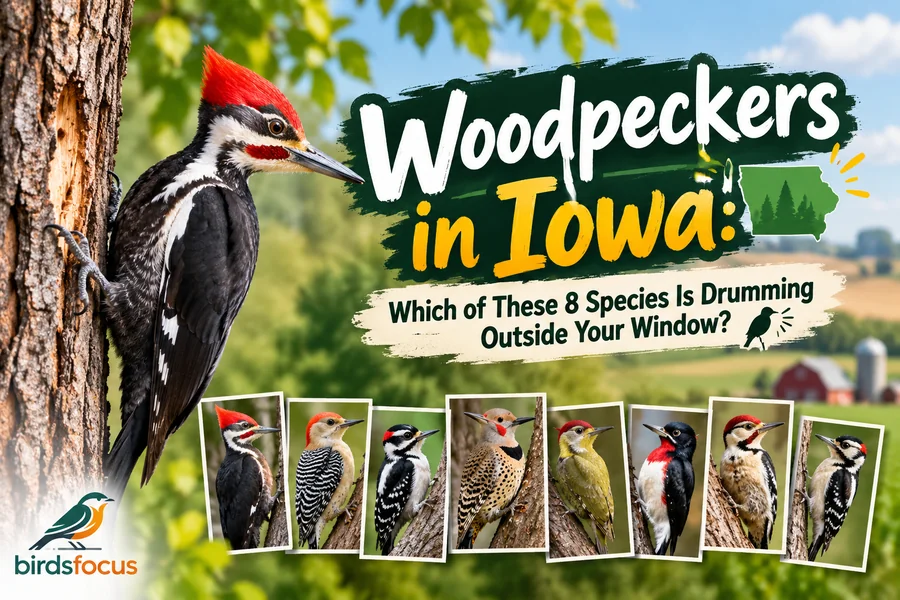
Woodpeckers in Iowa make noise before you ever see them. A drum is heard on a lifeless limb. In an oak, you see a flash of red. A bird does not seem to be part of your suet feeder, it owns it. Seven species are found or known to be found in the state annually. Any one of the rare guests appears at times. This guide will teach you each of these birds. You’ll find out how to identify them and where to look for them.
Areas of trees growing on farms or along rivers in Iowa are called farm groves or river forests. It also features oak savannas and city parks. This blend provides food and nesting sites for all of Iowa’s woodpecker species. From backyard birding to suet feeding to walking on trails to get a closer look, you’ll have a better time identifying woodpeckers, listening to their drumming & discovering about their nesting habits.
There are seven species of regular, common woodpeckers at Lowa. They are the Downy, Hairy, Red-bellied, Red-headed, Pileated, Northern Flicker & Yellow-bellied Sapsucker. The largest is the Pileated. The smallest is the Downy. Black-backed Woodpecker is a scarce visitor.
What Is the State Bird of Iowa?
The official state bird of Iowa is the Eastern Goldfinch. People also call it the American Goldfinch. Iowa adopted it in 1933. It has a yellow body and a black cap in summer. It is not a woodpecker. Iowa has no state woodpecker.
Still the Red-headed Woodpecker has a strong claim to fame here. Iowa Audubon picked it as the face of its group. It stands for the state’s bird life and its habitat worries. Think of it this way. The goldfinch stands for open fields. Woodpeckers stand for old trees and dead wood. Both tell you the land still supports wildlife.
Red-Headed Woodpeckers in Iowa: Facts, Habitat, and Identification
Red-Headed Woodpecker
Unlike the Red-bellied Woodpecker, the Red-headed Woodpecker wears red on the whole head. No other woodpecker in eastern North America does that. The red looks like a hood. A sharp line separates it from the white chest. The back and tail are black. Large white patches show on the wings and rump.
Adults reach about eight inches in length. The wingspan is close to seventeen inches. Young birds have a brown head and brown streaks. They gain the red hood by their first spring. You can find this species in oak woods, pastures, and farm groves across Iowa in summer. Numbers have dropped. Partners in Flight and the state wildlife plan both list it as a species of concern.
| Feature | Red-Headed Woodpecker |
| Length | 7.5 to 9 inches |
| Wingspan | About 16 to 17 inches |
| Head | Solid red |
| Back | Black |
| Belly | White |
| Season in Iowa | Spring to fall. Some stay in winter. |
Native Woodpeckers in Iowa You Should Know
Downy Woodpecker
The Downy Woodpecker is the smallest woodpecker in North America. It is close to the size of a House Sparrow. Do not let that fool you. This bird works hard. It has a black and white body with a white stripe down its back. The bill is short and stubby. Males have a small red patch on the back of the head. Females do not. Downy woodpeckers stay in Iowa all year. You can find them in every county. They use woods and orchards. They also visit parks and backyards. They often feed on thin branches that bigger woodpeckers cannot use. They eat beetle larvae and ants. They also take seeds and suet. They are quite bold at feeders. Some will tap into plant stems to find insects hidden inside. In winter they join small mixed flocks. Chickadees and nuthatches often travel with them. Pairs dig a new nest hole each spring in soft dead wood. Listen for a soft pik call. Also listen for a quick whinny that falls in pitch. Drumming is fast and light. A Downy looks like a small Hairy Woodpecker. Check the bill. If it looks short next to the head, you have a Downy.
| Kingdom | Phylum | Class | Order | Family | Genus | Species |
| Animalia | Chordata | Aves | Piciformes | Picidae | Dryobates | D. pubescens |
Season: Year-round
Best habitat: Woods, orchards, parks, and backyards
Hairy Woodpecker
The Hairy Woodpecker looks like a Downy that grew up. It has the same black and white pattern. It has the same white stripe down the back. The size is different. A Hairy is about as big as a robin. The bill is the best clue. It is almost as long as the head. Males have a red patch on the back of the head. Females have none. Hairy woodpeckers live in Iowa all year. They like mature forests and wooded river valleys. You will see them more often in the east. They show up less in open farm country. Downy is far more common. Behavior sets them apart too. A Hairy digs deep into trunks to reach wood-boring beetle larvae. It also eats ants and spiders. It visits feeders for suet and sunflower seeds. It is shy and leaves fast when people get close. Its call is a sharp peek. Its drumming is slow and loud. Pairs nest in dead trees or in dead limbs on live ones. They dig a new cavity every year. Other birds use the old holes later. Look at the outer tail feathers. They are clean white. A Downy has black spots on them.
| Kingdom | Phylum | Class | Order | Family | Genus | Species |
| Animalia | Chordata | Aves | Piciformes | Picidae | Dryobates | D. villosus |
Season: Year-round
Best habitat: Mature forest and wooded river valleys
Red-Bellied Woodpecker
The Red-Bellied Woodpecker is the one you hear first. It calls with a rolling churr from the treetops. Then it shows up on your suet feeder. This bird has a black and white zebra pattern on its back. Males carry a red cap from the bill to the neck. Females only have red on the nape. The red belly is faint and easy to miss. Most people never see it. Red-bellied woodpeckers live in Iowa all year. They are most common in the east and south. Their range has spread north and west over the past century. They like mature woods and river bottoms. They also live in town parks and large yards. Behavior is a big part of the story here. This bird eats insects and nuts. It also takes fruit and seeds. It wedges food into bark cracks to save for later. It will drum on metal gutters to mark its turf. Pairs dig a nest hole in a dead trunk or limb. Males and females share the work. Watch for them hitching up trunks in short hops. They also cling to feeders upside down. Zebra back and red cap? You found one. Hang suet. It will come.
| Kingdom | Phylum | Class | Order | Family | Genus | Species |
| Animalia | Chordata | Aves | Piciformes | Picidae | Melanerpes | M. carolinus |
Season: Year-round
Best habitat: Mature woods, river bottoms, and town parks
Red-Headed Woodpecker
The Red-Headed Woodpecker is hard to mistake. The whole head is red. The back is black. The belly and rump are white. Big white patches show on the wings. Young birds have a brown head and lose it in their first year. Iowa Audubon uses this bird as its symbol. In Iowa it nests in open oak woods and savannas. It also uses pastures and farm groves. It needs dead trees to nest in. Many of those have been cut. That is one reason the species is in decline. European starlings also take their nest holes. Red-headed woodpeckers act more like flycatchers than most woodpeckers. They catch insects in midair. They hunt on the ground too. They eat acorns and beechnuts. They also eat fruit and seeds. They store food in bark cracks and fence posts. Some even cover stored food with bits of wood. Most birds leave Iowa in fall. A few stay if the acorn crop is good. Listen for a harsh queer call. They are bold and noisy near the nest. Watch for the white wing flash in flight. Look for them on dead snags in open woods. They like to perch on the highest dead branch.
| Kingdom | Phylum | Class | Order | Family | Genus | Species |
| Animalia | Chordata | Aves | Piciformes | Picidae | Melanerpes | M. erythrocephalus |
Season: Spring to fall. A few stay in winter.
Best habitat: Oak savanna, pastures, and farm groves
Pileated Woodpecker
The Pileated Woodpecker is the biggest woodpecker in Iowa. It is about the size of a crow. It has a black body and a tall red crest. White stripes run down the face and neck. Males have a red stripe on the cheek. Females do not. Pileated woodpeckers live in Iowa all year. They stick to large tracts of mature forest. Eastern and southern Iowa have the most birds. They follow wooded river valleys. Some now show up in central Iowa. Carpenter ants are their main food. They also eat beetle larvae and wild fruit. To get at ants they chisel deep rectangular holes in dead wood. The chips pile up at the base of the tree. That is a sign you can spot from the trail. Pairs hold a territory all year. They dig a new nest cavity yearly. The hole is large and oval. Other animals use it later. Owls and squirrels often do. The call is a loud series of notes that rises and falls. The drumming is slow and carries far. You may hear this bird long before you see it. Look for the flight. It is a slow flap with white flashes under the wings.
| Kingdom | Phylum | Class | Order | Family | Genus | Species |
| Animalia | Chordata | Aves | Piciformes | Picidae | Dryocopus | D. pileatus |
Season: Year-round
Best habitat: Large tracts of mature forest
Northern Flicker
The Northern Flicker is a woodpecker that acts like a robin. It spends a lot of time on the ground. That is rare for this family. It hops across lawns and fields in search of ants. The bill is long and slightly curved. The back is brown with black bars. The belly is pale with black spots. A black crescent marks the chest. A white patch on the rump flashes in flight. Most Iowa birds are the yellow-shafted form. They show yellow under the wings and tail. Males have a black stripe on each cheek. Females do not. Flickers are common in Iowa from spring to fall. Some stay for winter in the south. They like open woods and forest edges. They also use farm groves and town parks. Ants make up most of their diet. They also eat beetles and berries. In winter they take fruit and seeds. Flickers drum on trees and sometimes on metal. They do it to claim territory. They nest in dead trunks and posts. The call is a loud klee-yer. A second call sounds like wick wick wick. The flight is bouncy. Watch for the white rump as the bird dips and rises.
| Kingdom | Phylum | Class | Order | Family | Genus | Species |
| Animalia | Chordata | Aves | Piciformes | Picidae | Colaptes | C. auratus |
Season: Spring to fall. Some stay in the south in winter.
Best habitat: Open woods, forest edges, and lawns
Yellow-Bellied Sapsucker
The Yellow-Bellied Sapsucker is a woodpecker that drinks. It drills small holes in trees and licks the sap. The holes line up in neat rows. These are called sap wells. Insects come to the sap. The bird eats them too. Hummingbirds and warblers also use the wells. In Iowa this bird is mostly a migrant. Look for it in April and again from September to October. It breeds far north in forests of Canada and the Great Lakes. A few may linger in southern Iowa in winter. The bird is mid-sized. It has a black and white back with a long white wing stripe. The chest has a black patch. The belly is pale yellow but can be hard to see. Males have a red forehead and a red throat. Females have a red forehead and a white throat. Young birds look brown and mottled. Sapsuckers like young woods and tree edges. They also visit parks and orchards. They often pick birch, maple and apple trees. Their call is a mewing note. Their drumming has an odd stop and start rhythm. Fresh wells look wet and shiny on the bark. Look for rows of holes on trunks to find one.
| Kingdom | Phylum | Class | Order | Family | Genus | Species |
| Animalia | Chordata | Aves | Piciformes | Picidae | Sphyrapicus | S. varius |
Season: April and September to October. Rare in winter.
Best habitat: Young woods, tree edges, and orchards
Why Iowa Supports Seven Woodpecker Species
Iowa sits where eastern forest meets prairie. River valleys link the two. Birds like the Red-bellied and the Pileated reach the western edge of their range here. Other birds pass through on long trips. Dead trees give nest sites. Insects give food. Each species also feeds in a different way. Some work thin twigs. Some chisel deep into trunks. Some feed on the ground. That keeps them from fighting over the same meal.
Rare Woodpecker Visitors to Iowa
Black-Backed Woodpecker
The Black-Backed Woodpecker is a rare visitor to Iowa. It lives in the northern forests of Canada and the northern states. Iowa is far south of its home range. Records here are very few. That makes any sighting a big deal. If you spot one, report it to the Iowa Ornithologists’ Union. The bird is solid black on the back. It has white bars on the sides. The belly is white. Males wear a yellow patch on the crown. Females do not. It is about the same size as a Hairy Woodpecker. It has only three toes on each foot. That helps it brace against trunks. It feeds on larvae of wood-boring beetles. It prefers burned forests and dead spruce. It strips bark in flakes to find them. Some years food runs short in the north. Then a few birds move south. That is how a stray might reach Iowa. Its call is a sharp single note. Its drumming is fast and loud. Do not expect to see one on a normal day. The odds are small. Know the field marks anyway. Compare it to a Hairy Woodpecker. A Hairy has a white stripe down the back. The Black-backed does not.
| Kingdom | Phylum | Class | Order | Family | Genus | Species |
| Animalia | Chordata | Aves | Piciformes | Picidae | Picoides | P. arcticus |
Season: No regular season. Vagrant only.
Best habitat: Burned or dead conifer forest in the far north
Other Rare Woodpecker Reports
Old Iowa bird lists mention Lewis’s Woodpecker and the American Three-toed Woodpecker. Treat both as extremely rare. A western or northern woodpecker in Iowa is far off its normal path. Take clear photos. Note the date and place. Then send the details to the Iowa Ornithologists’ Union so reviewers can check the record.
How Forest Loss Affects Iowa Woodpeckers
Iowa lost most of its original forest and savanna. Woodpeckers lost nest trees and food with it. Tidy yards add to the problem. Dead trees get cut even when they are safe. European Starlings take over nest holes too. Some change is helpful. Emerald ash borer kills ash trees. Woodpeckers then feed on the larvae under the bark. The best fix is simple. Leave safe snags standing and plant native oaks.
Woodpeckers of Eastern Iowa
Eastern Iowa has the most forest in the state. The Mississippi River bluffs and the side valleys hold old oak and maple. Dead trees stand in many of these woods. That is what woodpeckers need. This region gives you the best shot at all seven regular species in one trip.
The Pileated Woodpecker is the star here. You can also expect Red-bellied and Hairy woodpeckers in most woods. Northern Flickers work the open edges. Sapsuckers pass through in April and again in fall. Winter is a good time to look. The leaves are down and the birds are easy to see.
Yellow River State Forest and Effigy Mounds Birds
Yellow River State Forest and Effigy Mounds National Monument sit in the northeast corner of Iowa. Both protect large blocks of woods near the Mississippi River. Hike the ridge trails at dawn. Listen for the loud call of the Pileated. Scan dead oaks for the Red-headed. Look low on trunks for Downy and Hairy. Bring binoculars and go slow.
Best Bird Watching Locations in Eastern Iowa
Good stops include Backbone State Park, Pikes Peak State Park, and Maquoketa Caves State Park. Each site has mature woods and steep valleys. Go early in the morning. Activity peaks in the first two hours after sunrise. Spring and fall give the best mix of resident birds and migrants.
Woodpeckers of Western Iowa
Western Iowa has fewer forests than the east. Prairie and farm fields fill most of the land. Woodpeckers use the strips of trees that remain. River valleys and the Loess Hills hold the best habitat. Oak groves along the Missouri River draw Red-headed Woodpeckers and Northern Flickers.
Downy and Hairy woodpeckers live in tree belts and town parks. Red-bellied Woodpeckers have moved west and now nest in many river groves. Pileated Woodpeckers are rare here. Try Stone State Park near Sioux City and Loess Hills State Forest. Waubonsie State Park in the southwest is another good stop. Walk the oak slopes early and listen for drumming.
Woodpeckers of Central Iowa
Central Iowa mixes cropland with river corridors and city green space. That sounds plain. It still holds woodpeckers in every season. The Des Moines River and its side creeks carry strips of old trees through the region. Cities such as Des Moines and Ames add parks and tree-lined streets.
Most birders here start in their own backyard. A suet feeder brings Downy and Red-bellied woodpeckers within days. Hairy woodpeckers follow in colder weeks. Flickers show up on lawns in spring. Central Iowa is also a path for migrants. Sapsuckers pass through in April and again in fall.
Common Woodpeckers Found in Central Iowa
Four species make up most sightings in the region. These are the Downy Woodpecker, the Hairy Woodpecker, the Red-bellied Woodpecker, and the Northern Flicker. They use woodlots, cemeteries, and golf courses. They also use any yard with mature trees.
Woodpeckers in City Parks and Backyards
Backyard birds learn fast. A bird that finds a feeder will check it every day. Place suet near a tree trunk. Add a mix of sunflower seeds. Leave dead limbs in place if they are safe. Woodpeckers use them for food and nests. Metal siding and chimney caps can draw drumming in spring. Block access with netting or hardware cloth. Not sure which small woodpecker you have? Use this quick check.
| Feature | Downy Woodpecker | Hairy Woodpecker |
| Size | Near a House Sparrow | Near a robin |
| Bill | Short and stubby | About as long as the head |
| Outer tail feathers | White with black spots | Clean white |
| Call | Soft peep | Sharp peek |
Woodpeckers Along River Bottoms
River bottoms are the best habitat in central Iowa. Cottonwood and silver maple stand along the banks. Floods kill some trees. Dead trunks then hold insects and nest holes. Hairy and Red-bellied woodpeckers work these woods. Pileated Woodpeckers use the largest stands. Red-headed Woodpeckers use open bottomland with standing dead trees.
Woodpeckers Through the Iowa Winter
Winter thins the crowd. Most Red-headed Woodpeckers and flickers move south. The year-round birds stay. Downy Woodpeckers lead the pack. Red-bellied and Hairy woodpeckers follow. All of them rely on suet and dormant insects under bark. Cold weeks give you easy views. Bare trees show every move. Keep feeders full on frozen days.
Best Bird Watching Spots in Central Iowa
Try Ledges State Park near Madrid. Dolliver Memorial State Park near Lehigh is another good choice. Brown’s Woods in West Des Moines and the woods near Saylorville Lake also draw woodpeckers. Check each site in the early morning. Walk the oldest stands of trees first.
Woodpeckers of Southern Iowa
Southern Iowa has rolling hills and oak-hickory woods. Large state forests and lakes protect the habitat. This part of the state suits Red-bellied Woodpeckers well. Red-headed Woodpeckers also do well in the open oak woods.
Pileated Woodpeckers live in the larger tracts. Northern Flickers feed on pastures and old fields. A few stay through winter here. Good places include Stephens State Forest, Lake Rathbun, and Shimek State Forest. Lacey-Keosauqua State Park along the Des Moines River is another strong choice. Look for dead oaks on ridge tops.
Common Woodpeckers in Iowa by Color
Color gives beginners a quick way to sort woodpeckers. Red is the first clue. The Red-headed has a full red hood. The Red-bellied has a red cap and nape. The Pileated wears a tall red crest. Downy and Hairy males show a small red patch on the back of the head. Sapsuckers have a red forehead.
Black and white birds fill much of the list. Downy and Hairy are the main two. Check bill length and tail feathers to split them. Brown is the color of the Northern Flicker. Yellow shows under its wings and tail. A pale yellow wash tints the Sapsucker’s belly.
| Bird Color | Common Species | Key Mark |
| Red | Red-headed, Red-bellied, Pileated | Red head, red cap, or red crest |
| Black and white | Downy, Hairy | White back stripe and red patch on males |
| Brown | Northern Flicker | Spotted belly and white rump |
| Yellow | Yellow-bellied Sapsucker | Pale yellow wash on the belly |
| Solid black | Black-backed (rare) | Black back and yellow crown on males |
Best Places for Bird Watching in Iowa
Dead wood and mature trees are the best places to watch birds in Iowa. State parks, state forests and river corridors are best. A number of sites are located along the Mississippi and Des Moines rivers. Each spring and fall, there are more variations because of migration. Look for recent recent reports from eBird around your area.
The northeast bluffs, Loess Hills, and the southern state forests are all recommended by birders. These two together occupy all the habitats used by the regular species. Choose one district per season. Take binoculars and a note book. Listen first. Look second. The typical woodpecker sounds come from most species of woodpeckers.
Iowa Woodpecker Facts at a Glance
| Question | Quick Answer |
| How many woodpecker species are regular in Iowa? | Seven |
| Which is the smallest? | Downy Woodpecker (about 6 inches) |
| Which is the largest? | Pileated Woodpecker (up to about 19 inches) |
| Which has a fully red head? | Red-headed Woodpecker |
| Which drills rows of sap wells? | Yellow-bellied Sapsucker |
| Which one feeds on the ground? | Northern Flicker |
| When do sapsuckers pass through? | April and September to October |
| What is the best feeder food? | Suet |
| What does the Pileated eat most? | Carpenter ants |
| Which is the rare visitor? | Black-backed Woodpecker |
| Are woodpeckers protected? | Yes. The Migratory Bird Treaty Act covers them. |
Conclusion
Woodpeckers in Iowa are easy to enjoy once you know what to look for. Start in your own yard with a suet feeder. You will meet the Downy and the Red-bellied within days. Then head to a state park or river forest. Listen for a drum. Scan the dead trees. You might spot the Pileated or the Red-headed.
Seven species live here or pass through. One rare visitor adds a bit of luck to the list. Every bird needs old trees and dead wood to thrive. Leave safe snags standing. Put out food in winter. Share what you see on eBird. Your small steps help woodpeckers in Iowa keep drumming for years to come.
FAQs:
What is the state bird of Iowa?
The Eastern Goldfinch, also called the American Goldfinch, is the official state bird of Iowa. The state adopted it in 1933.
How many woodpecker species live in Iowa?
Seven woodpecker species live in or pass through Iowa each year. They are the Downy, Hairy, Red-bellied, Red-headed, Pileated, Northern Flicker and Yellow-bellied Sapsucker. A few rare visitors also appear.
What is the most common woodpecker in Iowa?
The Downy Woodpecker is the most common year-round. The Red-bellied Woodpecker is the second most common in the cold months.
Which part of Iowa is best for woodpeckers?
Eastern Iowa is best. The Mississippi River bluffs and nearby state forests hold the most mature woods and the most species.
Are woodpeckers protected in Iowa?
Yes. The Migratory Bird Treaty Act protects woodpeckers across the state. Do not harm the birds or their nests. Use exclusion methods to stop damage.

Welcome to birdsfocus! I’m Anam Sattar, an AI Powered SEO, and Content Writer with 4 years of experirnce.
I help websites rank higher,grow traffic, and look amazing. My goal is to make SEO and web design simple and effective for everyone.
Let’s achieve more together!