

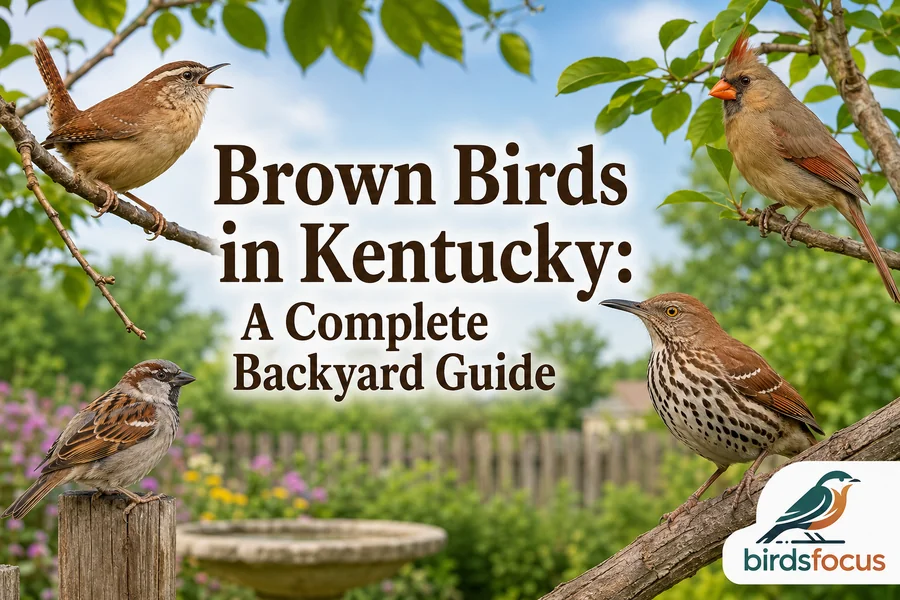
You’ve seen a brown bird hopping around your Kentucky yard and you thought, “Could possibly be a dozen different species,” you’re right. One of the most challenging groups for the new birder is brown birds in Kentucky, largely because many of them have the same soft, streaky and camouflaged appearance. Once you know what to watch for, it’s easy to tell a Carolina Wren from a Song Sparrow.
This guide includes 15 of Kentucky’s most prevalent brown birds, from bird feeders in Louisville to the woods of the Daniel Boone National Forest. Identification is guaranteed by a complete scientific classification table and each entry contains a description of what the bird looks like, where it lives, how it acts and more.
Why Are So Many Kentucky Birds Brown?
Brown isn’t a color that people don’t find attractive in nature. It’s a survival device. Brown, streaked feathers are for ground-feeding and low-shrub birds to blend in with dead leaves, bark and dry grass. It is much harder for predators such as hawks and cats to see a brown sparrow that is perched quietly in the leaf litter than it is to see a bright red cardinal. Of course, a brown coloration may seem like a plain look on the outside, but it’s doing a lot of other things for the bird on the inside.
Where Kentucky’s Grassland Sparrows Live
Several other brown birds on this list are also habitat dependent and are suffering from habitat loss. Some of the best areas to search are overgrown fields, fencerows and reclaimed mining sites throughout eastern and central Kentucky. An unknown field in a year or two is worth a leisurely stroll with binoculars.
Where to See Brown Birds in Kentucky
If you’re looking to catch multiple species from the above list in a single trip, the good news is that there is significant habitat overlap. Browse in brushy field edges, backyard hedgerows and borders of mixed woodland. They are well represented in some state parks, such as Mammoth Cave, Land Between the Lakes & Red River Gorge. Overall, early morning is best for activity, particularly from March to June when birds are singing to establish territories and find mates.
Read More: Hawk In South Carolina: Species, Habitat, and Identification Guide
Top Common Brown Birds in Kentucky
House Wren
The House Wren is small, loud, and always seems to be in motion. It is one of the most common brown birds in Kentucky backyards, especially near brush piles and garden edges.
| Category | Detail |
| Kingdom | Animalia |
| Phylum | Chordata |
| Class | Aves |
| Order | Passeriformes |
| Family | Troglodytidae |
| Genus | Troglodytes |
| Species | T. aedon |
House Wrens are small birds, 4-5 inches in length & are warm brown with light dark barring on the wings and tail. One of the most noticeable clues to them is that they will keep their tail up virtually in all positions. They sing a babble, hurried series of notes quite loud for their size, stretching across a whole yard. House Wrens nest in holes and are somewhat indiscriminate in their choice of nesting site. Any kind of old boot or mail box, hanging planters and nesting boxes will do. They feed primarily upon insects and spiders and are a very beneficial bird to have in the garden. The males will place sticks in multiple sites during the breeding season to leave an alternative nest site for the female, which may appear disorganized but effectively results in an available nest for the species. House Wrens are found in most habitats in Kentucky from spring on through fall, as long as they have some shrubs or brush to hide behind. If you get to know their song, you will hear them anywhere.
Carolina Wren
The Carolina Wren is Kentucky’s most recognizable wren, known for a song that sounds far too big for such a small bird.
| Category | Detail |
| Kingdom | Animalia |
| Phylum | Chordata |
| Class | Aves |
| Order | Passeriformes |
| Family | Troglodytidae |
| Genus | Thryothorus |
| Species | T. ludovicianus |
Carolina Wrens are a richer and warmer brown than House Wrens & have a prominent white eyebrow stripe that is easily discerned. They also tend to be larger, thicker in body, and are not migratory, meaning that you can observe them in your garden in January as well as July. They actually sing a song that is often referred to as “teakettle-teakettle-teakettle”, and it is loud enough to be heard through closed windows. Pairs remain together throughout the year and sometimes sing in unison, calling back and forth to one another when foraging. Carolina Wrens are actively searching for food in brush piles, under porches, and in dense shrubs, probing into all cracks and crevices for insects, spiders and small fruits. One of the rare wrens that will come to a feeder, particularly suet. They are affected by cold winters, but are found to do well in Kentucky’s climate as long as it is not too cold. When you hear a song that sounds louder and more cheerful than usual from a bird that you can’t see, you can be sure it’s a Carolina Wren probing a brush pile.
Song Sparrow
The Song Sparrow earns its name honestly. It sings often, and it sings well, making it one of the more pleasant brown birds Kentucky to have nearby.
| Category | Detail |
| Kingdom | Animalia |
| Phylum | Chordata |
| Class | Aves |
| Order | Passeriformes |
| Family | Passerellidae |
| Genus | Melospiza |
| Species | M. melodia |
Song Sparrows are brown with a very heavily patterned breast that sometimes has a dark centre spot, sometimes referred to as a “stickpin”. This is in the centre of the area where they can be separated from similar sparrows in the fastest way. They prefer areas of brushy edges, wetland borders and overgrown fields and are found throughout Kentucky all year long. Their call consists of distinct notes followed by a trill and each bird has its own small variation – sort of a personal signature. Song Sparrows feed primarily on the ground and pick up seeds and insects by hopping and scratching between leaves. They will go to places where seed has fallen and hangers they will visit ground feeders. Nesting is low, typically among dense shrubs or clumps of grass, and thus is at risk from outdoor cats and snakes. Yet, Song Sparrows are one of the most common and persistent of Connecticut’s sparrow species, and their steady and cheerful song is one of the easiest of all bird songs to learn.
Brown Thrasher
Kentucky’s state bird earns its name from a habit that looks almost violent: thrashing through leaf litter with its beak to flip debris out of the way.
| Category | Detail |
| Kingdom | Animalia |
| Phylum | Chordata |
| Class | Aves |
| Order | Passeriformes |
| Family | Mimidae |
| Genus | Toxostoma |
| Species | T. rufum |
Brown Thrashers are about eleven inches long, larger than most birds that people think of when speaking of brown species, with rusty red-brown upperparts, a heavily streaked white breast and bright yellow eyes that stand out immediately once they are noticed. They tend to hide in hedgerows, thickets and in the open, but are rarely seen. They have a very large song repertoire, and can sing more than a thousand different types of phrases, often in pairs. Brown Thrashers feed almost exclusively on the ground, probing through the soil and leaf litter with that long curved beak for insects, worms and berries. They construct cup nests in low areas of dense shrubbery, and are aggressive in nest defense both defending their nest and pushing intruders away. The Brown Thrasher is Kentucky’s state bird and is a favorite for Kentucky birders, though its shy nature means it is never seen by many who live near some of the state’s many populations. A long, heterogeneous song, often heard at the edges of brushy fields, is the best clue for finding one.
Read Also: Indiana Birds: The State Bird, Common Species, and Backyard Bird Guide
Eastern Towhee
The Eastern Towhee sounds like it is saying its own name, which makes it one of the easier brown birds in Kentucky to identify by ear alone.
| Category | Detail |
| Kingdom | Animalia |
| Phylum | Chordata |
| Class | Aves |
| Order | Passeriformes |
| Family | Passerellidae |
| Genus | Pipilo |
| Species | P. erythrophthalmus |
The male Eastern Towhee is actually quite black above, but the females and males are, like most other towhees, a warm brown, with rufous flanks and white bellies. Adults have striking red eyes and they are chunky, ground dwelling birds, slightly larger than a sparrow. They typically sound very much like “drink-your-tea” with a final trill that may sound buzzy. Eastern Towhees kick both feet backwards simultaneously, a distinctive double scratch motion that flips leaves to reveal insects and seeds beneath. This habit alone can be used to help identify them before you can get a proper look at them. They are found in dense understory, forest edges and overgrown fields and are usually low and in the shadows. Nests are constructed on or near the ground, under shrubs or piles of brush to provide cover. Eastern Towhees occur on the ground throughout Kentucky, but populations are slightly more southerly in the coldest months in the northern part of the state. They have a very loud and distinctive call, and are one of the most rewarding brown birds to master early.
Carolina Chickadee
Not every “brown” bird here is solid brown, and the Carolina Chickadee is a good example, showing soft gray-brown tones that still fit the general category people search for.
| Category | Detail |
| Kingdom | Animalia |
| Phylum | Chordata |
| Class | Aves |
| Order | Passeriformes |
| Family | Paridae |
| Genus | Poecile |
| Species | P. carolinensis |
Carolina Chickadees are tiny, round birds with a black cap and bib and white cheeks and soft gray-brown wings and back. They are regular feeders in all of Kentucky, and are one of the most approachable birds that people can see, often perching on a hand that extends a feeder. Their call note is “chick-a-dee-dee-dee” and their song is “fee-bee-fee-bay. After the breeding season, chickadees are social and will follow mixed flocks of titmice, nuthatches, and woodpeckers. This is a beneficial habit for all the birds in the flock, as the more eyes the better they will be protected, as predators will be spotted quicker. They nest in tree holes, sometimes digging their own nest hole in soft rotten wood, and readily utilize nest boxes. Chickadees store food to eat later in many different locations, remembering the locations of most of the food for several weeks. They are non-migratory, which means they can be found throughout Kentucky in the year, and are one of the most predictable birds to find at any feeder. For a dependable, easy-to-watch bird to begin with, the Carolina Chickadee is a good choice.
Tufted Titmouse
The Tufted Titmouse pairs a gray body with warm peachy-brown flanks, giving it just enough brown tone to belong firmly on this list.
| Category | Detail |
| Kingdom | Animalia |
| Phylum | Chordata |
| Class | Aves |
| Order | Passeriformes |
| Family | Paridae |
| Genus | Baeolophus |
| Species | B. bicolor |
Tufted Titmice are easy to spot thanks to the pointed gray crest on top of their head, paired with rusty-brown flanks and a black patch just above the beak. They are common at Kentucky feeders year-round and often the boldest bird in the yard, willing to grab a seed and fly off before a chickadee even gets close. Their call is a loud, whistled “peter-peter-peter,” repeated over and over, especially in late winter as breeding season approaches. Titmice are cavity nesters and will use old woodpecker holes or nest boxes, often lining the nest with soft material, including fur they pluck directly off live animals when they get the chance. They store food for later just like chickadees, hiding seeds in bark crevices and remembering the spots. Titmice stay in Kentucky through every season and does not migrate. They travel in small family groups outside of breeding season and often join mixed flocks with chickadees and nuthatches. Their loud call and confident feeder behavior make them one of the easiest brown-toned birds for beginners to learn quickly.
The Winter Wren
During colder months, Kentucky occasionally hosts the smaller, darker Winter Wren, a bird easy to miss but rewarding to find.
| Category | Detail |
| Kingdom | Animalia |
| Phylum | Chordata |
| Class | Aves |
| Order | Passeriformes |
| Family | Troglodytidae |
| Genus | Troglodytes |
| Species | T. hiemalis |
Winter Wrens are tiny, even smaller than House Wrens, with dark brown feathers, heavy barring, and a stub of a tail held straight up. They are shy birds, often staying low in brush piles, root tangles, and streamside vegetation where they are easy to hear but hard to see. Their song is remarkable for such a small bird, a long, cascading series of high, tinkling notes that can last ten seconds or more. Winter Wrens visit Kentucky mainly from late fall through early spring, breeding farther north and in higher elevation forests. They forage by creeping through tangled roots and fallen logs, gleaning insects and spiders from bark and leaf litter rather than flying to catch prey. Because they favor dense, damp understory, Winter Wrens are often found near creeks and wooded ravines rather than open yards. Spotting one usually takes patience and a good ear, since their preferred habitat gives them plenty of places to disappear. Birders who track one down after hearing that long, bubbling song often describe it as one of the most satisfying finds of the winter season.
House Finch
Female House Finches show streaky brown plumage, which is why many people searching for brown birds end up finding this species at their own feeder.
| Category | Detail |
| Kingdom | Animalia |
| Phylum | Chordata |
| Class | Aves |
| Order | Passeriformes |
| Family | Fringillidae |
| Genus | Haemorhous |
| Species | H. mexicanus |
Female House Finches are plain brown with heavy streaking on the chest and belly, no bold markings, which makes them easy to overlook next to their red-headed male counterparts. Males show red or orange coloring on the head and chest, but females stick to brown tones year-round. House Finches are extremely common feeder birds across Kentucky, often showing up in small flocks and dominating sunflower or nyjer feeders for long stretches at a time. Their song is a cheerful, warbling series of notes that often ends in a slightly buzzy note. They nest almost anywhere, including hanging planters, porch light fixtures, and dense shrubs, and they will raise two or three broods in a single season. House Finches are non-migratory in Kentucky and present at feeders all year long. One thing to watch for is conjunctivitis, an eye disease that spreads easily at crowded feeders and can affect entire local populations. Keeping feeders clean helps reduce the spread. Despite that risk, House Finches remain one of the steadiest, most reliable birds at Kentucky feeders in every season.
Field Sparrow
The Field Sparrow is a small, soft brown bird best known for a song that speeds up like a bouncing ball coming to rest.
| Category | Detail |
| Kingdom | Animalia |
| Phylum | Chordata |
| Class | Aves |
| Order | Passeriformes |
| Family | Passerellidae |
| Genus | Spizella |
| Species | S. pusilla |
Field Sparrows differ from other small brown sparrows in Kentucky in having no eye-ring, white eye-ring, and a plain unstreaked chest. They prefer overgrown fields, brushy pastures and land being reclaimed from farms than dense forest, and in recent years have become somewhat rare with the reduction of this type of open scrubby habitat. The song begins with a few slow clear whistles and then progresses into a quick trill which is indeed one of the easiest sparrow songs to learn by ear. Field Sparrows feed in low vegetation and on the ground, feeding primarily on seeds in the fall and winter, and insects in the breeding season when they feed their young. Nests are constructed low, sometimes on the ground surface in early spring and a little higher in bushes later in the growing season as vegetation grows in. Field Sparrows can be found in Kentucky throughout the year, but some birds move somewhat to the south during the winter. An indicator of the presence of a wild edge is the presence of open, brushy habitat, not mowed lawns or dense woods.
Chipping Sparrow
The Chipping Sparrow trades the heavy streaking of most sparrows for a clean, tidy look, with a rusty cap that makes summer identification simple.
| Category | Detail |
| Kingdom | Animalia |
| Phylum | Chordata |
| Class | Aves |
| Order | Passeriformes |
| Family | Passerellidae |
| Genus | Spizella |
| Species | S. passerina |
Chipping sparrows are small, slender birds with a bright rusty-colored crown and gray breast and in breeding plumage have a black eye stripe. That cap gets a more streaked brown color in winter, and makes many beginners’ identification of photos difficult when looking at birds in their yards. They are found around Kentucky in spring and fall, and are frequently seen walking around lawns, gardens and the edge of open woods, rather than hopping, eating on the ground. Their call is a rapid dry trill, and is all on the same pitch, often mistaken initially for an insect call. Chipping sparrows nest in low conifers or dense shrubs, using animal hair to line the nest, which is constructed from a loose mass of stems. In breeding season, they feed almost entirely upon insects, but during the rest of the year, they will turn to seeds. A few Chipping Sparrows winter in Kentucky, with numbers declining as some move slightly southward. They are one of the more approachable and easy sparrows to find and identify for new birders due to their neat appearance and preference for open habitat.
White-throated Sparrow
Every winter, Kentucky yards fill up with White-throated Sparrows, easily one of the most striking brown birds in the state thanks to a bold facial pattern.
| Category | Detail |
| Kingdom | Animalia |
| Phylum | Chordata |
| Class | Aves |
| Order | Passeriformes |
| Family | Passerellidae |
| Genus | Zonotrichia |
| Species | Z. albicollis |
White-throated sparrows show a sharp white throat patch, yellow spots between the eye and bill, and either bold black-and-white or more muted tan-and-brown stripes on the head, depending on the individual. They winter in all of Kentucky, arriving in the fall and departing in early spring to breed north of the area. The song is a sharp whistled series easily recalled as “oh-sweet-canada-canada,” and is easily heard in bare winter Woods. White-throated sparrows have the same double-scratch kicking motion used in excavating food in leaf litter by towhees, but they forage on the ground in small flocks. They prefer to inhabit brushy edges, woodland borders and yards with high ground cover, and readily explore feeders with ground-level seed. Their flocks move in the winter so if you spot one, there are likely to be more in the vicinity. They are also one of the most popular Kentucky fall birds because of their bold markings and distinct song which is a whistle, “whit,” that is clearly audible.
Brown-headed Cowbird
The Brown-headed Cowbird looks unassuming, but its nesting habits make it one of the more talked-about brown birds in Kentucky among birders.
| Category | Detail |
| Kingdom | Animalia |
| Phylum | Chordata |
| Class | Aves |
| Order | Passeriformes |
| Family | Icteridae |
| Genus | Molothrus |
| Species | M. ater |
Male Brown-headed Cowbirds have a glossy black body with a solid brown head, while females are plain gray-brown all over with faint streaking, making females easy to overlook in a mixed flock. Cowbirds are brood parasites, that is, a female cowbird will lay her eggs in the nests of other species of birds and will leave the egg to be hatched by the other species, which may also raise the nestling, often at the expense of her own nestlings. The habit emerged along with the species’ track record of riding along after grazing bison herds—where there was little time to make and tend a nest. Today Cowbirds follow the mowing and cattle movements and feed on insects on the ground that are dislodged by the mowing or cattle movement. They are frequently found in open fields and pastures as well as in farm areas throughout Kentucky, and are known for their head-bobbing gait when walking through the short grass. Cowbirds flock in mixed bands with blackbirds and starlings, particularly in the fall and winter. Their nesting behavior is detrimental to smaller songbirds, but the Cowbirds are not new or invasive pests in Kentucky’s grassland system.
Hermit Thrush
The Hermit Thrush is a quiet, solitary bird best known for one of the most beautiful songs in North American woods.
| Category | Detail |
| Kingdom | Animalia |
| Phylum | Chordata |
| Class | Aves |
| Order | Passeriformes |
| Family | Turdidae |
| Genus | Catharus |
| Species | C. guttatus |
The Hermit Thrush is a warm brown bird with a spotted breast and a reddish tail which it often slowly pumps up and down when perched, a good fieldmark. They migrate through Kentucky primarily as migrants and winter visitors, preferring the shady floor of the forest and thick undergrowth where they hunt quietly and individually. They sing a number of distinct phrases, each a flute-like sound on a different pitch, and said to be one of the most musical sounds in the forest. Hermit Thrushes feed on insects and spiders in the warm season and turn to fruit and berries when these are plentiful, particularly in winter. They crawl over the ground looking under leaves for food and they do not fly immediately when disturbed; rather, they become completely motionless. Hermit Thrushes are more frequently heard than seen, and are shy and solitary, particularly at dawn and dusk when they sing the loudest. One will typically be found by staying still in quiet woods, waiting for that layered and unmistakable song to begin.
Fox Sparrow
The Fox Sparrow is one of the largest and most richly colored sparrows to pass through Kentucky, with a name that comes straight from its reddish-brown coloring.
| Category | Detail |
| Kingdom | Animalia |
| Phylum | Chordata |
| Class | Aves |
| Order | Passeriformes |
| Family | Passerellidae |
| Genus | Passerella |
| Species | P. iliaca |
Fox Sparrows are chunky, heavily-marked birds, with rust-red markings over a white chest, and warm reddish-brown wings and tail. They are distinctly larger than the majority of the birds on this list, more like a towhee, and are brightly colored, easy to see even in the dim winter light. Fox Sparrows are typical migrants and winterers in Kentucky, nesting on brushy borders and in thickets and woodlands where leaf litter is abundant below. They forage in a similar manner as towhees, namely by adopting an aggressive double-scratch kick and flipping leaves back with both feet to find seeds and insects beneath, sometimes flipping many leaves back over for a small bird. They sing mainly on the breeding areas farther north and it can be a rich musical series of clear whistled notes, although the sharp, distinct call note is more likely to be heard by Kentucky birders. Fox Sparrows forage singly or in small groups (especially with other sparrows) but not in tightly aggregated groups. The presence of one typically leads to searching for it in winter when the color is a good contrast to the dry leaves, because they can be surprisingly hard to spot in photos as they are very colourful.
Quick Reference: Brown Birds in Kentucky Fun Facts
| Bird | Fun Fact |
| Brown Thrasher | Can sing over 1,000 different song phrases, more than any other North American bird |
| Carolina Wren | Mated pairs duet, singing back and forth to each other while foraging |
| House Wren | Males build several starter nests just to give the female a choice |
| Winter Wren | One of the smallest birds in Kentucky, yet has one of the longest songs |
| Chickadee | Remembers the locations of thousands of hidden food caches |
| Fox Sparrow | Named for its reddish, fox-colored plumage rather than any behavior |
| Cowbird | Lays eggs in other birds’ nests, a habit tied to its bison-following history |
| Hermit Thrush | Its layered, flute-like song is often ranked among the most beautiful bird songs in North America |
Final Thoughts
Kentucky’s back yards and woodlands are even more diverse than most people realize. So many birds look similar at first glance that it takes a bit of patience to learn to identify them as brown birds in Kentucky. However, when you start paying attention to the subtle things, a white eye ring, a cocked tail, a certain call that passes through a thicket of bushes, then it’s easy to identify pretty quickly. Maintain clean feeders, leave some brushy corners in the yard and revisit throughout the seasons. Some birds remain for the entire year, some visit for a short time and each visit equates with one more species to your list.
FAQs:
What is the most common brown bird in Kentucky?
The House Finch and Song Sparrow are the two most commonly reported brown birds at Kentucky feeders and in backyards year-round.
What is Kentucky’s state bird?
The Brown Thrasher is Kentucky’s official state bird, known for its long, varied song and rusty brown plumage.
Are brown birds harder to identify than colorful birds?
Yes, generally. Brown birds rely on subtle differences in size, streaking, and markings, so a close look or a good pair of binoculars helps a lot more than it does with brightly colored species.
What time of year is best for spotting brown birds in Kentucky?
Spring migration, from March through May, offers the widest variety, since resident, wintering, and passing-through species can all be present at once.
Do brown birds visit backyard feeders?
Many do. House Finches, House Wrens, Carolina Wrens, Chickadees, Titmice, and Song Sparrows are all regular feeder visitors across Kentucky.
Read More Articles: Ducks in Maine: The Complete Guide to Every Species, Habitat & Best Viewing Spots

Welcome to birdsfocus! I’m Anam Sattar, an AI Powered SEO, and Content Writer with 4 years of experirnce.
I help websites rank higher,grow traffic, and look amazing. My goal is to make SEO and web design simple and effective for everyone.
Let’s achieve more together!