

South Carolina ducks turn up almost everywhere, from tidal creeks near Charleston to a farm pond in the Upstate that nobody thought twice about. Some of them do not go away. Others just fly in for a couple of cold months and then they are gone when the weather turns around. It covers all the duck species found in the state, their identification, habitat and what they can be doing when seen.
South Carolina is located on the Atlantic Flyway, one of North America’s busiest bird highway. That is why the state attracts dabblers, divers, sea ducks, mergansers and even the occasional tropical whistling duck that obviously got lost. All 32 species are organized by type with a brief classification table and a brief write-up found below.
South Carolina Ducks: A Quick Overview
South Carolina ducks cover 32 species, split between year-round residents and winter migrants that arrive along the Atlantic Flyway. Birds are attracted to coastal marshes, impoundments from old rice fields, and inland lakes in different combinations from year to year. Species such as Mottled Duck, Wood Duck, and Canvasback, Pintail and Scaup remain local and nest in the area, with the exception of the Canvasback, Pintail and Scaup which migrate in the fall and return in the spring. The peak numbers are December through February, when maximum numbers of these can be seen statewide.
What Ducks Live in South Carolina?
Thirty-two species of ducks have been recorded in South Carolina, with some of them nesting in the state year round, and others arriving in South Carolina each fall from their northern nesting areas. The state offers a duck lineup that stretches beyond what most East Coast birders would find.The state boasts a duck lineup that rivals most East Coast birders.
They will begin to appear about October. Numbers increase during the fall, reach their peak in the winter (December-February) and decline rapidly as birds migrate back north to nest. Some species are reluctant to depart, such as Wood Ducks and Mottled Ducks, which raise their young right here.
Also Read: Blue Cardinal: Is This Rare Bird Real? Complete Guide, Facts & Sightings
Dabbling Ducks of South Carolina
Dabblers feed at the surface, tipping forward instead of diving. Look for them in shallow ponds, flooded fields, and along marsh edges. First five below.
Wood Duck
| Classification | Detail |
| Kingdom | Animalia |
| Phylum | Chordata |
| Class | Aves |
| Order | Anseriformes |
| Family | Anatidae |
| Genus | Aix |
| Species | Aix sponsa |
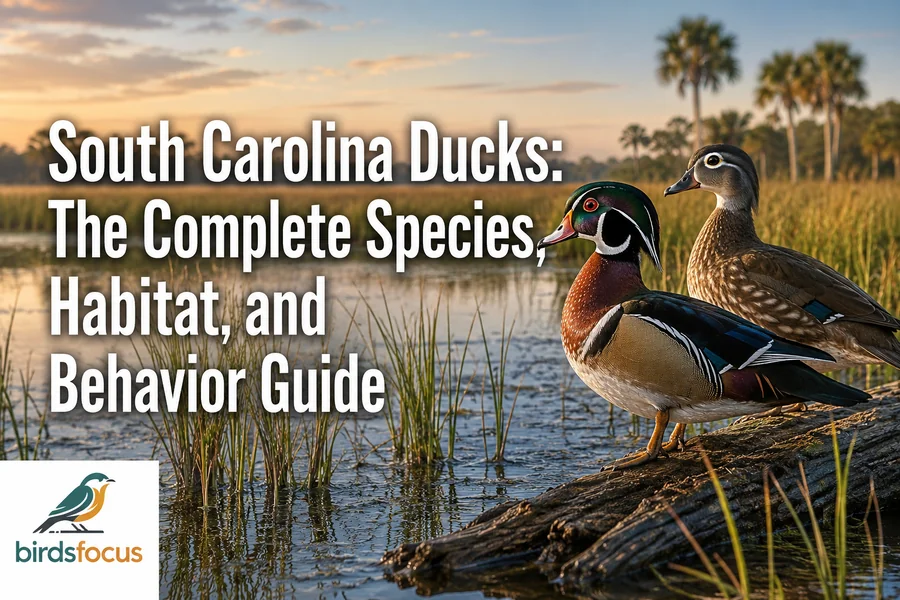
Nothing else on this list looks quite like a Wood Duck. Males carry a glossy green head, red eyes, and a patchwork of chestnut and white that seems almost too much for one bird. Females are plainer, but that white eye ring gives them away instantly. They nest in tree cavities near swamps, creeks, and beaver ponds all over South Carolina, feeding on acorns, seeds, and the odd insect. You won’t usually catch them in big flocks — they’re more of a pair-or-small-group bird. Often you’ll hear that squealing call first, right before they burst out through the trees.
Mallard
| Classification | Detail |
| Kingdom | Animalia |
| Phylum | Chordata |
| Class | Aves |
| Order | Anseriformes |
| Family | Anatidae |
| Genus | Anas |
| Species | Anas platyrhynchos |
This is the duck everyone already knows, whether they realize it or not. Green head, yellow bill, white neck ring — that’s the male. Females are mottled brown with an orange-and-black bill and honestly get overlooked a lot. Mallards show up on ponds, lakes, and city parks across South Carolina and have zero problem approaching people (skip the bread, though — it’s not good for them). Diet-wise, they’ll take seeds, aquatic plants, and small invertebrates. Some stick around year-round; migratory numbers just pile on top during winter.
American Black Duck
| Classification | Detail |
| Kingdom | Animalia |
| Phylum | Chordata |
| Class | Aves |
| Order | Anseriformes |
| Family | Anatidae |
| Genus | Anas |
| Species | Anas rubripes |
At a glance, this one gets mistaken for a female Mallard — until you notice how much darker it is, with that pale contrasting head. In flight, the wing patch flashes purple instead of blue. Black Ducks winter along South Carolina’s coastal marshes and tidal creeks, but never in Mallard-sized numbers. They’re jumpy around people and tend to hole up in quieter wetlands. Food-wise: aquatic vegetation, mollusks, small fish. Numbers have been sliding for decades, partly from habitat loss and partly from interbreeding with Mallards.
Mottled Duck
| Classification | Detail |
| Kingdom | Animalia |
| Phylum | Chordata |
| Class | Aves |
| Order | Anseriformes |
| Family | Anatidae |
| Genus | Anas |
| Species | Anas fulvigula |
Uncommon, but worth knowing — the Mottled Duck lives on South Carolina’s coastal wetlands year-round and never migrates. It looks like a female Mallard stripped of markings: warm brown, plain head, nothing flashy. Pairs form early and nest in grassy spots near shallow water. They eat seeds, aquatic plants, and small aquatic critters. Most sightings cluster in the southern coastal counties near the Georgia line, so don’t expect one on an Upstate pond.
Gadwall
| Classification | Detail |
| Kingdom | Animalia |
| Phylum | Chordata |
| Class | Aves |
| Order | Anseriformes |
| Family | Anatidae |
| Genus | Mareca |
| Species | Mareca strepera |
Gadwall don’t try hard to impress you — gray-brown overall, with a black rear end that pops at close range. Look closely at a male in good light and you’ll catch fine patterning across the chest most people miss entirely. South Carolina gets solid winter numbers on lakes, ponds, and managed wetlands, especially near the coast. They eat aquatic plants and algae mostly, and yes, they’ll flat-out steal food from diving ducks and coots when they can get away with it. By January and February, courtship displays start showing up on refuges.
More Dabbling Ducks Found in South Carolina
Five more dabblers that show up during migration and winter.
American Wigeon
| Classification | Detail |
| Kingdom | Animalia |
| Phylum | Chordata |
| Class | Aves |
| Order | Anseriformes |
| Family | Anatidae |
| Genus | Mareca |
| Species | Mareca americana |
Short pale blue-gray bill, rounded head — that’s your quickest ID cue. Males also wear a white or cream stripe across the crown that’s hard to miss once you know to look for it. Thousands arrive in South Carolina each winter, filling up lakes, flooded fields, and coastal impoundments. They graze on grasses and aquatic plants, sometimes right on land next to the water, and like Gadwall, they’ll snatch food from coots and diving ducks. You’ll usually find them mixed in with Gadwall and Mallard flocks on the same ponds.
Northern Shoveler
| Classification | Detail |
| Kingdom | Animalia |
| Phylum | Chordata |
| Class | Aves |
| Order | Anseriformes |
| Family | Anatidae |
| Genus | Spatula |
| Species | Spatula clypeata |
That oversized, spoon-shaped bill is impossible to miss. Males add a green head, white chest, and rusty sides for winter. Shovelers like shallow, muddy ponds and impoundments across South Carolina, where they sweep that bill side to side straining out crustaceans and seeds. They’ll often swim in tight little circles as a group, stirring up food from the bottom together — genuinely fun to watch once you notice the pattern. Numbers peak December through February before they head back north.
Northern Pintail
| Classification | Detail |
| Kingdom | Animalia |
| Phylum | Chordata |
| Class | Aves |
| Order | Anseriformes |
| Family | Anatidae |
| Genus | Anas |
| Species | Anas acuta |
Long slender neck, pointed tail feathers trailing well past the body of males — this is one of the more elegant ducks you’ll see in the state. Brown head, white breast stripe. South Carolina pulls in wintering Pintails on open water, flooded rice fields, and coastal marshes, where they feed on seeds, grain, and aquatic invertebrates. They fly in tight, fast flocks and can cover serious migration distances in short order.
Green-winged Teal
| Classification | Detail |
| Kingdom | Animalia |
| Phylum | Chordata |
| Class | Aves |
| Order | Anseriformes |
| Family | Anatidae |
| Genus | Anas |
| Species | Anas crecca |
Smallest dabbler on the list. Males show a chestnut head with a green eye patch and a small white bar near the shoulder. They favor shallow marshes, mudflats, and flooded fields, feeding on seeds and small invertebrates. Fall migration brings them in thick, and they form dense flocks that twist and wheel through the air together — one of the better sights on a coastal refuge in November. Common all winter.
Blue-winged Teal
| Classification | Detail |
| Kingdom | Animalia |
| Phylum | Chordata |
| Class | Aves |
| Order | Anseriformes |
| Family | Anatidae |
| Genus | Spatula |
| Species | Spatula discors |
First one in each fall, first one gone each spring. Males have a white crescent in front of the eye and a pale blue shoulder patch that flashes in flight. They like shallow, vegetated ponds and marshes and feed on seeds, aquatic plants, and small invertebrates near the surface. Unlike most of the ducks here, Blue-wings mostly winter in Central and South America — South Carolina’s really just a layover for them.
Also Read: Junco Bird: Identification,Nest, Pronunciation & White Belly Facts
Diving Ducks of South Carolina
Divers go all the way underwater to feed instead of tipping forward. Deeper lakes, rivers, and coastal bays are their turf.
Canvasback
| Classification | Detail |
| Kingdom | Animalia |
| Phylum | Chordata |
| Class | Aves |
| Order | Anseriformes |
| Family | Anatidae |
| Genus | Aythya |
| Species | Aythya valisineria |
Sloped forehead, long bill — the profile alone gives it away on the water. Males have a rusty red head and black chest against a pale, almost whitish body. South Carolina gets wintering Canvasbacks on the bigger lakes and reservoirs, where they dive deep for tubers, roots, and small clams. They’d rather sit in open water than hug the marsh edge, and they often raft up in large groups offshore. Numbers here run smaller than the traditional wintering grounds along the Gulf Coast.
Redhead
| Classification | Detail |
| Kingdom | Animalia |
| Phylum | Chordata |
| Class | Aves |
| Order | Anseriformes |
| Family | Anatidae |
| Genus | Aythya |
| Species | Aythya americana |
Similar color scheme to the Canvasback, but the head’s rounder and the bill’s shorter. Males wear a rich reddish-brown head against a gray body in winter. This one’s genuinely uncommon in South Carolina, mostly showing up on large open lakes and coastal bays. They dive for aquatic plants, seeds, and small invertebrates, and tend to tag along with Scaup and Canvasback flocks — which means you’ll want to look twice before writing off a duck as “just a Redhead.”
Ring-necked Duck
| Classification | Detail |
| Kingdom | Animalia |
| Phylum | Chordata |
| Class | Aves |
| Order | Anseriformes |
| Family | Anatidae |
| Genus | Aythya |
| Species | Aythya collaris |
Probably the diving duck you’ll see most in South Carolina winters. Peaked head, black back, and — despite the name — the ring you’ll actually notice is the faint white band around the bill, not the neck. They prefer smaller ponds, beaver swamps, and flooded timber over big open lakes. Food’s the usual: seeds, aquatic plants, small invertebrates. Big flocks pile onto freshwater impoundments from November through March.
Greater Scaup
| Classification | Detail |
| Kingdom | Animalia |
| Phylum | Chordata |
| Class | Aves |
| Order | Anseriformes |
| Family | Anatidae |
| Genus | Aythya |
| Species | Aythya marila |
A coastal bird through and through — you’re not finding this one far from salt water. Males show a rounded, green-glossed head and pale gray back. Greater scaup stick to large bays, inlets, and deep coastal water rather than inland ponds, diving for mollusks, small crustaceans, and aquatic plants. They usually mix in with the far more common Lesser Scaup, and telling the two apart takes some practice — head shape and that glossy sheen are your best clues. Best odds are around Charleston and Georgetown in winter.
Lesser Scaup
| Classification | Detail |
| Kingdom | Animalia |
| Phylum | Chordata |
| Class | Aves |
| Order | Anseriformes |
| Family | Anatidae |
| Genus | Aythya |
| Species | Aythya affinis |
Far more common than the Greater Scaup across South Carolina’s lakes and rivers. Males have a peaked head with a purple sheen instead of green. They dive for aquatic plants, mollusks, and small invertebrates in fresh and brackish water alike, and you’ll sometimes find rafts of a few hundred birds on open lakes in winter. They arrive later than most dabblers and hang around well into early spring before pushing back north.
More Diving Ducks in South Carolina
Harlequin Duck
| Classification | Detail |
| Kingdom | Animalia |
| Phylum | Chordata |
| Class | Aves |
| Order | Anseriformes |
| Family | Anatidae |
| Genus | Histrionicus |
| Species | Histrionicus histrionicus |
If you ever find one of these in South Carolina, tell your birder friends immediately. Males show slate blue, white markings, and rusty patches — nothing else on this list looks close. Normally this species winters along rocky northern coastlines, so a South Carolina sighting almost always means one lost bird near a jetty or inlet. They feed on small invertebrates in rough, rocky water. Rare enough that a confirmed sighting draws attention statewide.
Bufflehead
| Classification | Detail |
| Kingdom | Animalia |
| Phylum | Chordata |
| Class | Aves |
| Order | Anseriformes |
| Family | Anatidae |
| Genus | Bucephala |
| Species | Bucephala albeola |
Smallest diving duck in North America, and a reliable winter sight in South Carolina. Males have a big white patch wrapping around a dark, glossy head. They like open lakes, ponds, and coastal bays, diving over and over for small invertebrates and aquatic insects — rarely staying still more than a few seconds at a time. They nest up north in old woodpecker holes, then return here in small, tight little groups every winter.
Common Goldeneye
| Classification | Detail |
| Kingdom | Animalia |
| Phylum | Chordata |
| Class | Aves |
| Order | Anseriformes |
| Family | Anatidae |
| Genus | Bucephala |
| Species | Bucephala clangula |
Not a duck you’ll run into often here — mostly large lakes and coastal water, and even then, sparingly. Males have a dark green head, bright golden eye, and a round white cheek patch. They dive for mollusks, crustaceans, and small fish in water colder and deeper than most diving ducks bother with. Their wings make a distinctive whistling sound in flight that usually announces them before you spot the bird itself. Cold winters up north push more of them down here.
Sea Ducks Found in South Carolina
These three live on open ocean and coastal bays, not inland lakes.
Surf Scoter
| Classification | Detail |
| Kingdom | Animalia |
| Phylum | Chordata |
| Class | Aves |
| Order | Anseriformes |
| Family | Anatidae |
| Genus | Melanitta |
| Species | Melanitta perspicillata |
Bulky, black, and easy to spot once you clock that bold orange-white-black bill pattern. South Carolina’s coastal waters host wintering flocks that dive for mollusks and small crustaceans just offshore, riding the surf rather than sticking to calm bays. They often mix with other scoter species, so bring binoculars if you want to sort them out. Best sightings run December through February near jetties, piers, and open beaches.
White-winged Scoter
| Classification | Detail |
| Kingdom | Animalia |
| Phylum | Chordata |
| Class | Aves |
| Order | Anseriformes |
| Family | Anatidae |
| Genus | Melanitta |
| Species | Melanitta deglandi |
The biggest of the three scooters, and the least common one along South Carolina’s coast. A white wing patch shows up in flight or when the bird stretches — that’s your tell. They dive for mollusks and crustaceans in nearshore ocean water, usually near sandbars and inlets, and they never seem to gather in the numbers the other scoters do. Finding one takes patience, and local birders treat it as a small win.
Black Scoter
| Classification | Detail |
| Kingdom | Animalia |
| Phylum | Chordata |
| Class | Aves |
| Order | Anseriformes |
| Family | Anatidae |
| Genus | Melanitta |
| Species | Melanitta americana |
All black, with a bright orange knob at the base of the male’s bill. Wintering flocks gather offshore, sometimes in the hundreds, diving for mollusks and small crustaceans near beaches and inlets. Strong fliers — you’ll often see them strung out in long lines low over the water. Piers and beach access points along the coast are your best bet all winter long.
Long-tailed Duck
| Classification | Detail |
| Kingdom | Animalia |
| Phylum | Chordata |
| Class | Aves |
| Order | Anseriformes |
| Family | Anatidae |
| Genus | Clangula |
| Species | Clangula hyemalis |
Rare, but you’ll see one more winter if you look hard enough. Males grow long, pointed tail feathers, and the plumage shifts between white, black, and brown depending on the season. This species dives deeper than nearly anything else on this list — over 100 feet at times — chasing mollusks and crustaceans. They’re vocal too, with a yodeling call that carries across open water. Usually shows up as a single bird mixed into scoter or scaup flocks near the coast.
Mergansers of South Carolina
Thin, serrated bills built for grabbing fish, not filtering plants.
Hooded Merganser
| Classification | Detail |
| Kingdom | Animalia |
| Phylum | Chordata |
| Class | Aves |
| Order | Anseriformes |
| Family | Anatidae |
| Genus | Lophodytes |
| Species | Lophodytes cucullatus |
Small, sharp, and one of the few ducks that both breeds and winters right here in South Carolina. Males raise a huge fan-shaped crest with a bold white patch that really stands out on dark water. They nest in tree cavities near swamps and beaver ponds, much like Wood Ducks do, and dive for small fish, crayfish, and aquatic insects using that thin, gripping bill. Quiet, wooded wetlands over open lakes, usually in small family groups.
Common Merganser
| Classification | Detail |
| Kingdom | Animalia |
| Phylum | Chordata |
| Class | Aves |
| Order | Anseriformes |
| Family | Anatidae |
| Genus | Mergus |
| Species | Mergus merganser |
A rare winter guest here — this species is really built for northern rivers and lakes. Males are clean white with a dark green head and a long, thin red bill. They dive for fish in cold, fast water and prefer big rivers over small ponds. When they do show up in South Carolina, it’s usually during an unusually cold stretch that pushes them farther south than normal. They hunt in coordinated groups, chasing fish underwater together.
Red-breasted Merganser
| Classification | Detail |
| Kingdom | Animalia |
| Phylum | Chordata |
| Class | Aves |
| Order | Anseriformes |
| Family | Anatidae |
| Genus | Mergus |
| Species | Mergus serrator |
A common winter sight along the coast and on larger inland lakes. Males sport a shaggy, spiked crest and a reddish chest band that sets them apart from other mergansers. They dive for small fish in salt and fresh water alike, chasing prey in fast bursts, and gather in loose groups near inlets, bays, and open lakes all winter. Fast, direct flight and a thin profile help separate them from the rounder-bodied ducks nearby.
Whistling Ducks and Rare Ducks in South Carolina
Tropical whistling ducks and a few true rarities close out the list.
Black-bellied Whistling Duck
| Classification | Detail |
| Kingdom | Animalia |
| Phylum | Chordata |
| Class | Aves |
| Order | Anseriformes |
| Family | Anatidae |
| Genus | Dendrocygna |
| Species | Dendrocygna autumnalis |
Twenty years ago you barely saw these in South Carolina. Now they show up regularly. Bright pink bill, long legs, black belly against warm brown feathers — and unlike almost everything else here, this one perches in trees and walks around comfortably on land. They eat seeds, grain, and aquatic plants, usually in small, noisy flocks. Sightings keep climbing each year, especially near ponds and retention areas in the southern half of the state.
Fulvous Whistling Duck
| Classification | Detail |
| Kingdom | Animalia |
| Phylum | Chordata |
| Class | Aves |
| Order | Anseriformes |
| Family | Anatidae |
| Genus | Dendrocygna |
| Species | Dendrocygna bicolor |
More common along the Gulf Coast and Southwest than here — this is a genuine rarity for South Carolina. Warm tawny-orange feathers, a long neck, long legs built for wading. They feed on seeds and aquatic plants in shallow marshes and rice fields, gathering in small social flocks with a whistling call in flight that’s actually where the name comes from. Confirmed South Carolina sightings stay rare, usually just a few birds at a time.
Muscovy Duck
| Classification | Detail |
| Kingdom | Animalia |
| Phylum | Chordata |
| Class | Aves |
| Order | Anseriformes |
| Family | Anatidae |
| Genus | Cairina |
| Species | Cairina moschata |
Worth a mention, even though most South Carolina Muscovy Ducks trace back to domestic or feral stock, not truly wild birds. Large and heavy-bodied, with bare red skin around the face and a mix of black and white feathers that varies bird to bird. You’ll find them around park ponds, farms, and residential areas rather than natural wetlands, eating plants, seeds, and small insects. They get tame fast around people. Most checklists list them separately from wild native species for that reason.
Masked Duck
| Classification | Detail |
| Kingdom | Animalia |
| Phylum | Chordata |
| Class | Aves |
| Order | Anseriformes |
| Family | Anatidae |
| Genus | Nomonyx |
| Species | Nomonyx dominicus |
One of the rarest ducks South Carolina has ever recorded — only a handful of confirmed sightings exist. Small and secretive, with males showing a black face mask against a rich chestnut body. They prefer dense, heavily vegetated ponds where hiding is easy, feed on seeds and aquatic plants, and rarely fly unless pushed to. Any sighting here counts as a major find, and birders from across the state will show up within days of hearing about it.
Ruddy Duck
| Classification | Detail |
| Kingdom | Animalia |
| Phylum | Chordata |
| Class | Aves |
| Order | Anseriformes |
| Family | Anatidae |
| Genus | Oxyura |
| Species | Oxyura jamaicensis |
Small, stocky, and a regular winter presence on South Carolina’s lakes and coastal bays. Breeding males flash a bright blue bill against a rusty body; winter birds fade to a duller gray-brown. That stiff tail sticking straight up while swimming is the giveaway at any distance. They dive for aquatic plants and small invertebrates and rarely bother flying unless startled — most of the day they just float with heads tucked, resting in large rafts.
Additional Species Recorded in South Carolina
Cinnamon Teal
| Classification | Detail |
| Kingdom | Animalia |
| Phylum | Chordata |
| Class | Aves |
| Order | Anseriformes |
| Family | Anatidae |
| Genus | Spatula |
| Species | Spatula cyanoptera |
A true wanderer here — this species normally breeds and winters out west, so any South Carolina sighting is a bit of a fluke. Males show a deep reddish-brown body and a bright red eye that stands out fast among other teal. They feed on seeds and aquatic invertebrates in shallow marshes, much like Blue-winged Teal do. Most sightings involve a single male mixed into a Blue-winged Teal flock, so a careful side-by-side comparison is needed before calling it confirmed.
Eurasian Wigeon
| Classification | Detail |
| Kingdom | Animalia |
| Phylum | Chordata |
| Class | Aves |
| Order | Anseriformes |
| Family | Anatidae |
| Genus | Mareca |
| Species | Mareca penelope |
Rare, but regular enough that South Carolina birders expect one or two each winter, usually buried inside a big flock of American Wigeon. Males show a rusty red head and cream-colored crown stripe that separates them clearly from their American cousin once you know what to look for. They feed on grasses and aquatic plants in the same spots American Wigeon favor. Scanning coastal impoundments and large lakes carefully during winter is really the only way to find one.
South Carolina Duck Habitat Map
South Carolina breaks down into three main duck habitat zones, and each one pulls in a different mix of species depending on water type, salinity, and vegetation.
| Region | Habitat Type | Common Species |
| Coastal Marshes & Barrier Islands | Salt marsh, tidal creeks, inlets | Mottled Duck, Black Duck, Scoters, Red-breasted Merganser |
| Rice Fields & Coastal Impoundments | Managed freshwater wetlands | Gadwall, Wigeon, Teal, Pintail, Shoveler |
| Inland Lakes & Rivers | Reservoirs, farm ponds, swamps | Wood Duck, Ring-necked Duck, Bufflehead, Hooded Merganser |
The ACE Basin, Santee Delta, and Savannah River sites carry the coastal zone, while Lake Marion, Lake Moultrie, and the Congaree swamp system anchor everything inland. Winter squeezes almost every migratory species into these three areas at once — that’s exactly why refuge counts jump so hard between December and February.
Duck Behavior Patterns in South Carolina
A few patterns are worth knowing before you head out.
Dabbling ducks feed at dawn and dusk, tipping forward in shallow water instead of diving. Diving ducks and mergansers feed all day, vanishing underwater for several seconds at a stretch. Sea ducks stick to tight offshore rafts and rarely come close to shore unless a storm pushes them in. And by late winter, most species pair up — expect courtship chasing and displays on refuges from January through March, right before spring migration kicks off.
Common Ducks of South Carolina by Color
| Color | Species |
| Green head | Mallard, Green-winged Teal (eye patch) |
| Chestnut/Rusty | Canvasback, Redhead, Cinnamon Teal, Ruddy Duck |
| Black and white | Bufflehead, Ring-necked Duck, Scoters |
| Brown/Mottled | American Black Duck, Mottled Duck, Gadwall |
| Pink bill | Northern Shoveler, Black-bellied Whistling Duck |
Read More: How Do Birds Mate? Reproduction, Diagram & Why Birds Mate Without Touching
Best Places for Duck Watching in South Carolina
ACE Basin National Wildlife Refuge, Santee National Wildlife Refuge, and Savannah National Wildlife Refuge top the list for South Carolina duck watching. Each combines managed wetlands with natural marsh, which is exactly what draws the big winter flocks.
Lake Marion and Lake Moultrie pull strong numbers of Ring-necked Ducks, Scaup, and Bufflehead in winter too. And if you don’t have a boat, coastal piers near Charleston and Myrtle Beach are an easy way to scan offshore scoters and Long-tailed Duck flocks without one.
Interesting Duck Facts Table
| Fact | Detail |
| Fastest flier | Ducks can top 60 mph during migration |
| Longest dive | Long-tailed Ducks can go past 100 feet deep |
| Smallest species in SC | Green-winged Teal |
| Largest species in SC | Muscovy Duck |
| Only tree-nesting species | Wood Duck and Hooded Merganser |
| Rarest confirmed sighting | Masked Duck |
| Peak winter month | January |
| Main flyway | Atlantic Flyway |
Conclusion
South Carolina ducks come in all shapes and sizes: from the Mallard paddling around your neighborhood pond to the Masked Duck that may appear (rarely) once every few years and get birders driving all over the state. Coastal marsh, rice fields, and inland lakes all host 32 of the species recorded here, quite a variety more than might be expected of South Carolina.
After you can start distinguishing a dabbler from a diver, and a resident from a winter visitor, each time you venture out will be more captivating. Use your binoculars, select a hidden place from the above list & see how many can be ticked off this season.
FAQs:
How many duck species live in South Carolina?
South Carolina has recorded 32 duck species, including year-round residents, winter migrants, and rare vagrants.
What is the most common duck in South Carolina?
The Mallard and Wood Duck are the most commonly seen ducks year-round across South Carolina.
When is the best time to see ducks in South Carolina?
December through February is peak season, when the largest number of migratory ducks winter in the state.
Do ducks stay in South Carolina all year?
Yes — Wood Ducks, Mottled Ducks, and Hooded Mergansers breed and live in South Carolina year-round.
Where is the best place to watch ducks in South Carolina?
ACE Basin National Wildlife Refuge and Santee National Wildlife Refuge are widely considered the top spots for duck watching in the state.

Welcome to birdsfocus! I’m Anam Sattar, an AI Powered SEO, and Content Writer with 4 years of experirnce.
I help websites rank higher,grow traffic, and look amazing. My goal is to make SEO and web design simple and effective for everyone.
Let’s achieve more together!