
The letter Q isn’t on the giving end of names for birds. Most bird families skip it completely, which is exactly why a bird name start with Q search pulls up such a short and specific list. Short, however, is not dull! Birds underneath this letter contain jungle jewels, desert runners and outback ghosts, the majority of which are unknown to most people.
This guide covers all of the major groups. Real scientific names, real classes, real diets & little nuggets of useful information on an actual hike or a quiz night. No filler. No fluff. Just birds.
Bird Name Start With Q: Quick Answer
For those who did need a quick answer, here it is. The most common bird name start with Q examples are Quail, Quetzal, Quail-Dove, Quail-thrush, and Quailfinch. The quails are birds of the ground, which can be seen in deserts and grasslands. The quetzal is a bird from the rainforest, renowned for its long tail feathers. The quail-doves and quail-thrushes are quite distinct from the quail, and look like it. These groups make up the majority of the world’s Q-named birds, and every group has its own story to tell, habitat, and call.
Read Also: Michigan Birds: The Complete Guide to Spotting, Identifying, and Understanding Them
Quail Birds You Should Know
California Quail
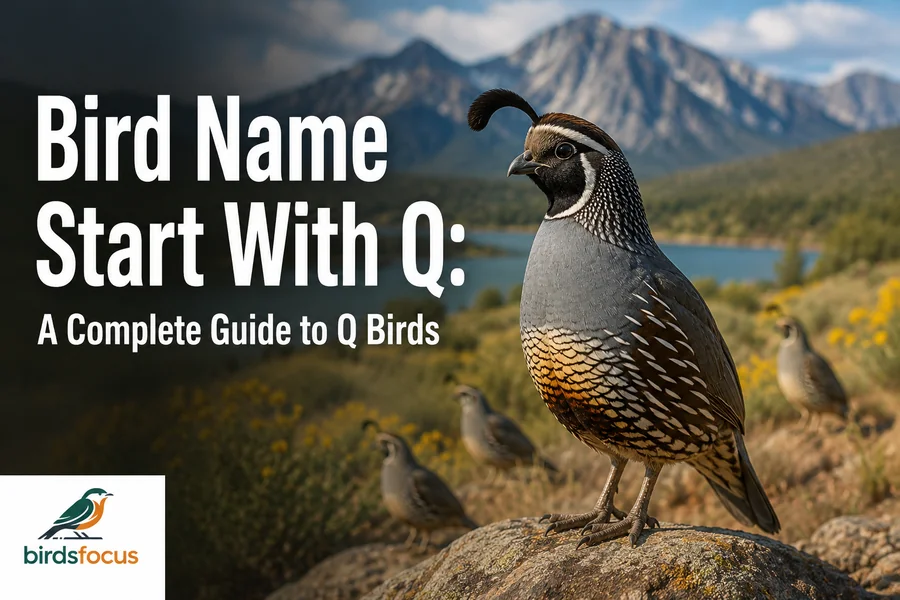
The California Quail (Callipepla californica), a small ground bird belonging to the class Aves, is easily observed by the black plume that curves over its head. It inhabits brushy hills, edges of farmland, and dry scrub in the western United States. This bird does not fly very far. It tends to run for cover and move in close groups, known as coveys. Primarily seeds, leaves and berries but insects are added during the breeding season for protein. The birds are very active during the morning and evening hours when they are feeding together and are close to dense cover. The male’s call is far-carrying and is often heard as “chi-ca-go”, which aids the group to retain contact with one another over open ground. These quail are sometimes found in backyard gardens close to wild scrub where food and cover are provided. The chicks can walk and feed themselves within hours of hatching and this contributes to the species’ survival in places where predators are prevalent. It is still one of the most identifiable quail species in North America today, and a favorite among the casual birder.
Gambel’s Quail
Gambel’s Quail (Callipepla gambelii) is a member of the class Aves, and is found in hot, dry desert country throughout Arizona, Nevada and parts of Mexico. It is similar to its California cousin, but has a brighter chestnut cap and a cleaner white belly patch in males. This bird lives in a habitat with limited water, and absorbs most if not all of its water from its food, which is composed of plants and seeds. Seeds, cactus fruit, leaves and sometimes insects are fed. Coveys are associated with shade, so they are found in areas near washes and brushy areas for protection from desert heat. The call is a call note which sounds like “ka-KAA-kaa” at the dawn of the day throughout the cliff walls. Like most quail species, chicks are born ready to run and to feed. Gambel’s Quail is a species that will not venture far from good food and cover, resulting in dense populations in favorable habitat. The covey is usually heard before seen by desert hikers, because the birds get nervous and disperse rapidly when they are approached. It has never gone out of fashion and is still a signature sound of the American Southwest.
Mountain Quail
Mountain Quail (Oreortyx pictus) is the largest quail in North America and part of the class Aves. It is found in steep brushy mountain slopes throughout California, Oregon, and Nevada, whereas its lowland relatives are found in lowland regions. It is most notable for having an erect (as opposed to forward) straight head plume. Their diet is primarily seeds, bulbs and green leaves, but berries may be included in warmer months. This species is well known for its seasonality of its elevation migrations; walking downhill in autumn to avoid the heavy snow; and walking uphill in spring to breed. It is not an easy bird to see as it favors dense chaparral, and communicates by a loud single note call across dense cover. Quail are less likely to form pairs and remain monogamous than quail. The baby chicks follow their parents soon after hatching. A shy species and very difficult to find for birders, the Mountain Quail is one of the more secretive birds of this Q-named group, and is found in rugged backcountry habitat.
Scaled Quail
The Scaled Quail, also known as the Cottontop, is a species of bird classified under the class Aves, and inhabits the arid grasslands and scrub land of the American Southwest and northern Mexico. The species is named for its scales that can be seen on its chest and back feathers in close proximity, like the scales on a fish. It has a soft, white crest on its head and looks like a cotton ball in alert positions. It feeds on seeds, insects and cactus fruit; changing seasonally according to desert availability. Likes to walk instead of fly, sprinting (jumping) when startled, across open ground. Outside of the breeding season, dozens of birds may be in a covey, where they are safer together than against predators like hawks and coyotes. Call is repeated “pecos” which is a nasal sound and can be heard from flat ground. The nesting takes place on the ground under the clumps of grass where they can not be seen by any predators. The Scaled Quail is a tough desert bird of prey, and can withstand extreme heat more than most quails.
Montezuma Quail
The Montezuma Quail (Cyrtonyx montezumae) is one of the most secretive of the class Aves in the Q bird group. It is one of the most unique quail in North America due to its patterned face and large black and white markings. This camouflage-loving bird is found in oak forests and grassy mountain flanks, from Arizona to Mexico. Diet includes a mix of underground bulbs and tubers, which they unearthed with remarkably powerful feet and paws, and seeds and insects. This bird is very quiet, not like the other, noisy quails, which run away when cornered, but it freezes on the spot. This is a habit that makes it very hard to see even when close. It tends to flush when it is almost stepped on and startles hikers with a “burst of wings. Healthy grass cover is essential for populations to live on, as they need it to eat and hide in. The quail is an indicator species for ranchers and researchers in determining healthy grasslands throughout its range.
Read More: Meet the 8 Most Colorful Types of Orioles in North America (Identification Guide)
Quetzal Birds You Should Know
Resplendent Quetzal
The Resplendent Quetzal (Pharomachrus mocinno) is a species of bird in the class Aves and one of the most sought-after birds in Central America. Females develop tail feathers that can extend more than 2 ft behind them when they fly through the misty cloud forests. Its body is emerald green and crimson red, a sacred colouring among ancient Maya and Aztec cultures. The bird inhabits humid mountain forests from southern Mexico to Panama, and is associated with fruiting trees. It is dominated by wild avocado and other small fruits which are consumed whole and then vomited with seed still inside, causing the species to be an important forest seed disperser. When eggs hatch, the insects, lizards and small frogs complete the diet. Nesting takes place in the holes of old tree trunks, in which both parents take part in incubation, even though the male has a rather long tail and has to be careful to get in. Many populations have their habitats destroyed due to deforestation. Birders are still hoping to spot this legendary quetzal in the wild in Costa Rica and Guatemala.
Golden-headed Quetzal
The Golden-headed Quetzal (Pharomachrus auriceps) belongs to the class Aves, and is a bird of the Andes humid forests of Venezuela to Bolivia. Compared to the other species of quetzal, it has a metallic golden-green appearance to its head. The Resplendent Quetzal has a long, red tail, while the male has a shorter tail, but also bright red, in contrast to the dark forest canopy. Fruit, in particular, wild relatives of the laurel and avocado, are its food, and if present, insects and small vertebrates. This bird is found in the mid to high elevation cloud forest and has been observed sitting quietly for extended periods of time before flying quickly off to pick up fruit. It has a soft, repeated whistle call that can be heard over dense foliage. They breed in tree holes, often using old woodpecker holes. Deforestation throughout its range on the Andes is a threat to its long-term population stability since it requires the presence of old-growth forest. It’s often hard to find a bird in the wild without a local guide.
Crested Quetzal
Crested Quetzal (Pharomachrus antisianus) is a species of bird in the class Aves, found in the humid slopes of the northern Andes in Colombia, Ecuador and Peru. It can be easily differentiated from other quetzal species by its puffy, forward-curled crest on its forehead which, even when the bird is at rest, must give it a somewhat untidy appearance. It has a deep green upper surface and rich red under surface, characteristic of the family of the quetzal. This bird feeds primarily on fruit of the laurel family and on insects taken in brief flights from the resting position. It prefers mid-elevation cloud forest (typically 5,000 to 9,000 ft), where fruiting trees remain prolific throughout the year. Pairs are unobtrusive and elusive unless they can be heard from nearby on their soft, low call note. Like other quetzals, nesting occurs in rotten tree trunks. Its range has been contracted by farm and logging practices, leading to forest fragmentation. The cloud forest reserves of Ecuador continue to be the best locations in which to find this elusive yet impressive bird.
Eared Quetzal
The Eared Quetzal (Euptilotis neoxenus) is a member of the class Aves that is present in the United States in small numbers, primarily during summer in the mountain canyons of southeastern Arizona. It derives its name from small tufts of feathers near its ears, unique among its quetzal relatives, which can only be seen up close. This bird differs from its Central American relatives in having a coppery green back and in having a squared instead of a curved tail. It feeds on fruit, large insects and small reptiles, which are collected while traveling around for brief periods from a perch within pine-oak canyon forest. This species breeds in old holes made in large pine or sycamore trees. It has a loud, rolling chatter call which contrasts with the soft whistles of other quetzals. Sightings north of the Mexican border continue to be sporadic and exhilarating for American birders as most of the range is remote in the Sierra Madre mountains. This species is uncommon even in its normal range because of loss of canyon habitat and poor nesting availability due to scarcity of suitable cavities.
Pavonine Quetzal
The Pavonine Quetzal (Pharomachrus pavoninus) is a bird of the class Aves endemic to the lowland rainforests of western Amazon Basin, from Peru to Ecuador, Colombia and Brazil. This species remains in the lowlands, in dense rainforest, while quetzals live in the mountains. Males are brightly coloured with a bright red abdomen and long trailing tail to display in courtship flight. It is almost exclusively a fruit diet, mainly wild figs and laurel berries, supplemented by insects in order to get protein. Despite its bright colours, this bird is difficult to see from the ground as it spends most of the time high in the rainforest canopy. The call is a short, plaintive repeated note, which is easily integrated into the overall sound of the rainforest. Its nesting site is in soft, rotting tree trunks across its range. Amazon lowland forest is relatively intact compared to other cloud forest habitat, so the quetzal is not at as great an immediate risk, although logging encroachment is a concern for researchers monitoring the species in the long term.
White-tipped Quetzal
The White-tipped Quetzal (Pharomachrus fulgidus) is a species of Classes known as Aves, which is endemic to the coastal mountain ranges of Venezuela and northern Colombia, where it is found almost exclusively. It is easily distinguished from other quetzals in the field by the sharp white tip on its tail feathers. The males have the typical quetzal coloration: iridescent green upperparts with a bright red chest and abdomen. This bird is found in moist mid-elevation forest (3,000 to 8,000 ft) where it feeds primarily on fruit of laurel and related tree families. Occasional feedings of insects and small lizards are made. Nests are excavated in rotten holes in trees, sometimes re-used from one breeding season to the next. It makes a soft, mellow whistle-like call that is repeated at intervals through the forest canopy. Habitat protection in the coastal mountains of Venezuela has a direct impact on the survival of this species as it has a smaller and more restricted range. For birders, this quetzal is a truly special bird to be spotted on a forest trip in northern South America.
Quail-Dove Birds You Should Know
Ruddy Quail-Dove
The Ruddy Quail-Dove (Geotrygon montana) is a ground-dwelling member of the class Aves, found across Central America, the Caribbean, and much of tropical South America. Although it is called a dove, it is in reality a dove, not a quail, and though it looks as though it is ground feeding, it is not. Females are duller in colour with olive brown shades for camouflage whereas males are warm red brown. This bird walks most of the time in the leaf litter on the forest floor, seldom flying except when disturbed. It feeds on fallen seeds, small fruit and small invertebrates collected from damp soil and leaf litter. It gives a mournful “whoo” as a call, and is easy to miss unless you are listening for it. Nesting occurs low in shrubs, or on the ground under extensive cover. This dove is approached from a long distance, and can be heard before seen because it remains hidden and near the ground. The widespread distribution of the species across the tropics has ensured the sustainability of the species despite some areas of forest habitat loss around it.
Key West Quail-Dove
The Key West Quail-Dove (Geotrygon chrysia) is a class Aves species found mainly in the Bahamas, Cuba, and parts of the Caribbean, with rare visits recorded in the Florida Keys. It has a soft purple colour to its feathers on its neck and chest, being brightest when held up to the light. This dove hunts on the ground, crawls slowly in the leaf litter of dry tropical forest and scrub. They eat fallen seeds and berries on the ground, as well as small snails. It remains very shy and will not flush up, but freeze toward the first movement in the vicinity. Its call is a deep single-note hoot that is repeated persistently during quiet forest mornings. Nesting takes place in low trees or dense shrubs close to the ground. The loss of coastal habitat due to coastal development in the Bahamas and Cuba has diminished habitat for this species. When you see this dove during the rare seasons when it is present, it is indeed a special event for the birders in the Florida Keys.
Violaceous Quail-Dove
The Violaceous Quail-Dove (Geotrygon violacea) belongs to the class Aves and ranges across humid lowland forests from southern Mexico through much of tropical South America. The name is derived from the faint violet tinge on the back and on the wings which can only be seen in strong light. It is a bird that mostly stays in the forest understory, but avoids open and disturbed areas. It feeds on fallen fruit, seeds and small invertebrates that it gets by moving slowly through the undergrowth. It walks in short steps, looking around for safety at every stop, before it starts searching for more food. Its call is a hoot made with a low pitch in a steady rhythm, sometimes from a concealed perch on the ground. Nesting sites are near the ground, in low branches or thick tangles of vines. Deforestation continues to be the primary threat to the populations, since it relies on the leaf area under the forest canopy. This dove is scarce and elusive, and when spotted is a delight for patient tropical birders.
Sapphire Quail-Dove
The Sapphire Quail-Dove (Geotrygon saphirina) is a class Aves species living in humid lowland and foothill forests of the western Amazon Basin, including parts of Colombia, Ecuador, Peru, and Brazil. It is named for its distinctive blue-green colour seen when sunlight can pass through the forest canopy. This secretive, ground-dwelling dove is seldom seen flying except when disturbed. The food consists of fallen fruits, seeds and small insects found in the moist soil of the forest. It takes slow and deliberate steps, sometimes pausing to stand still and breath held in anticipation of movement. It hoots or roars a deep, resonant call at long intervals, so blending in with the other calls of the rainforest that one does not notice it in isolation. Nesting is low in dense shrubs or dense tangles of vines near the ground. This dove is one of the most mysterious birds in the quail-dove family due to the necessity of patience and quiet observation in a remote forest area for sightings.
Buff-fronted Quail-Dove
The Buff-fronted Quail-Dove (Geotrygon costaricensis) is a class Aves bird restricted to mountain forests of Costa Rica and western Panama. It has a pale buff coloured forehead, contrasting sharply with the dark plumage of the rest of the body making it easier to identify in the field than many of its close relatives the quail-doves. This species grows best in cool, moist highland forest, usually at altitudes ranging from three to seven thousand feet. Food includes fallen fruit, seeds and small invertebrates collected during walks in damp litter. Remains near dense understory cover, moves slowly and deliberately as it feeds. It has a low steady hoot that can be heard in early morning through the mists in the highland forests. Nesting occurs in low vegetation near ground level, where most predators are not able to see. Its range is restricted to a lowland mountain area, thus making protection of its highland habitats in Costa Rica a direct concern to the survival of this species. Occasionally, birders visiting Monteverde and the surrounding reserves will have the good fortune to find a bird.
Quail-Thrush Birds You Should Know
Spotted Quail-thrush
The Spotted Quail-thrush (Cinclosoma punctatum) is a class Aves ground bird native to southeastern Australia, found in dry forest and woodland with a leaf litter floor. Although its name implies its connection, it is unrelated to true thrushes or quail, but its ground habits resemble these two. The males have a prominent black throat patch and a spotted chest; females are duller for camouflage while nesting. This bird walks slowly and carefully, sweeping aside leaves and other ground debris to look for insects, seeds and small invertebrates. It lives on the ground and is almost entirely camouflaged, freezing when it is scared, rather than flying. It has a high-pitched thin whistle as its call, and is usually only heard in thick woodland. Nesting is on the ground (directly or beneath grass tussocks or fallen branches). Some of its populations have been reduced by land clearance and introduced predators throughout its historical range. This species is considered by birders in Australia to be a real challenge as it fits into its forest floor habitat so seamlessly.
Chestnut-breasted Quail-thrush
The Chestnut-breasted Quail-thrush (Cinclosoma castaneothorax) is a class Aves species found across the dry inland scrub and mulga woodland of central and eastern Australia. The bird’s name is from a bold chestnut band that crosses the chest, visible on the bird’s body when it is contrasted with gray and white facial markings. It is an arid site species with scattered shrubs and open ground, it is an ideal foraging and cover ground. They feed on seeds, ants, beetles and other small invertebrates found among the leaf litter and dirt between shrubs. Migrates in short erratic flights across open ground, and becomes motionless when startled, hiding itself in the dead leaves and patterned plumage of the dry ground. It emits a soft repeated whistle in the early morning in still desert air. They nest on the ground, under low shrubs, providing shade and concealment. Long-term threats to stable populations throughout its range are largely due to land clearing for agricultural purposes, coupled with its specific requirement for undisturbed arid scrub.
Cinnamon Quail-thrush
The Cinnamon Quail-thrush (Cinclosoma cinnamomeum) is a class Aves bird adapted to some of Australia’s driest desert country, including stony plains and sparse scrubland across the continent’s interior. It has a warm cinnamon brown coloring that matches the red desert sand in which it walks every day. To cope with severe heat, the bird is very active during the cooler morning and evening times and rests in the shade during the hottest periods of the day. Eats seeds, ants, beetles, and other small insects under sparse desert vegetation. Swims rapidly, low down over open water, stopping frequently to survey any potential enemies overhead. It whistles thinly but with remarkable range on even desert lands. Nesting takes place under a small shrub with little but adequate shade. It is a strong indicator of good habitat health in deserts throughout inland Australia, as only few other birds are able to survive in these extremely dry habitats.
Copperback Quail-thrush
The Copperback Quail-thrush (Cinclosoma clarum) is a class Aves species found across dry woodland and scrub regions of Western Australia and parts of South Australia. This bird’s back is warm coppery, which distinguishes it from other quail-thrushes on the continent. Prefers habitat consisting of open space and a few scattered shrubs that provide sufficient foraging space and good escape cover. Their diet consists of seeds, ants, beetles and other ground-dwelling insects collected as they slowly walk on bare ground. It is very safe by being very quiet, many times it will stand perfectly still and not move even if a predator comes close to it. It is a quiet, high whistle that is repeated regularly in dry woods. Nesting occurs on the ground, often under a low shrub or under a fallen branch. Ongoing habitat loss, for both long-term population stability across parts of Western Australia, is a concern given the range overlaps with areas cleared for agriculture.
Other Interesting Q Birds
Quaker Parakeet (Monk Parakeet)
The Quaker Parakeet, commonly known as the Monk Parakeet (Myiopsitta monachus), is a class Aves parrot native to temperate South America, including Argentina, Bolivia, and Brazil. In contrast to other parrots, these birds do not create cavities in trees for nesting but rather create large stick nests that can be nested by several pairs in an “apartment complex. It is easy to distinguish in the wild and in urban areas by its bright green colour, gray face and chest. Diet consists of seeds, fruit, buds and agricultural crops, and it has become a pest in some farming areas. This parakeet is highly adaptable to urban environments and in the United States and Europe escaped pet birds are now a significant problem. It makes a loud, roughly-produced ‘squawking’ call, which may be repeated in noisy group calls. Nesting colonies may contain dozens of pairs and birds work together to construct and keep them going all year long. In addition to its well established wild population, the Quaker Parakeet is now one of the most popular pet species of parrots in the world, due to its intelligence and adaptability.
Queen Whydah
The Queen Whydah (Vidua regia) is a class Aves songbird native to dry savanna and scrubland across southern Africa. Breeding males develop greatly elongated black tail feathers which can be twice the length of their bodies, which are only employed for flights for courtship. The tail is shed outside of the breeding season and the male becomes plain, like a smaller, streaky brown female throughout the year. This species is a brood parasite, it does not raise chicks, but lays its eggs in the nests of the violet-eared waxbills. In the non-breeding season, they feed almost exclusively on grasses, mostly on the ground in flocks, and are eaten in their seeds. The song is a mournful chattering series of notes, sometimes resembling some of the host species’ song. During the breeding season, males conduct slow bouncing displays over the grassland carrying their long tail, to attract females. The distribution is closely related to that of the waxbills, since it relies on a specific host species for breeding and thus breeding success requires overlap in distribution from the host species during each season.
African Quailfinch
The African Quailfinch (Ortygospiza atricollis) is a small class Aves bird found across open grassland and marsh edges throughout sub-Saharan Africa. It is a quail-like bird in spite of its short tail that belongs to the finch family. The males have a bold black face and barred chest, and the females are less patterned. This bird is found in moist grassland in the vicinity of water, where grasses used for seed growth are available as a year-round food source. Mostly small grass seeds that are collected off the ground or low growing stems. It flutters rapidly on and off, when disturbed, with a buzzy sound and falls into cover right away. It flies rapidly and low, often not climbing very high above the grass tops. Nesting occurs on the ground beneath dense stands of grass, adjacent to marshy habitats. Drainage projects and habitat conversion are increasingly threatening its range in Africa as it is dependent on healthy wetland grassland.
Quail-plover
The Quail-plover (Ortyxelos meiffrenii) is one of the strangest class Aves species on this list, combining features of quail and plovers despite belonging to neither family. The miniature size and the fact that there is still not a clear consensus as to its place in evolution have made it popular among the ornithologists, who observe it in West and Central Africa in dry grassland and semi-desert habitat. It has a buff and black checkered pattern that camouflages it into the dry vegetation and bare ground when it is still. Their diet consists of small seeds and insects that they forage for in short bursts, looking around the ground. Males make an unusual “butterfly” display flight, fluttering their wings slowly above the grass in an exaggerated manner to attract a mate. It’s call is a soft and buzzy trill mainly during this display flight. Nesting is on bare ground, where complete protection is provided by the use of camouflage. Its population size and behaviour are still not well known, as it is elusive and has only been recorded in a wide area, leaving it a true mystery bird for African wildlife researchers.
Q Birds Fun Fact Table
| Bird Name | Scientific Name | Region | One Fun Fact |
| California Quail | Callipepla californica | Western USA | State bird of California |
| Gambel’s Quail | Callipepla gambelii | Desert Southwest | Gets most water from food |
| Mountain Quail | Oreortyx pictus | Pacific mountains | Migrates on foot, not by air |
| Scaled Quail | Callipepla squamata | Southwest deserts | Nicknamed the “cottontop” |
| Montezuma Quail | Cyrtonyx montezumae | Arizona, Mexico | Digs food with its feet |
| Resplendent Quetzal | Pharomachrus mocinno | Central America | Sacred bird of the Maya |
| Golden-headed Quetzal | Pharomachrus auriceps | Andes | Head shines metallic gold-green |
| Crested Quetzal | Pharomachrus antisianus | Northern Andes | Has a curling forehead crest |
| Eared Quetzal | Euptilotis neoxenus | Arizona canyons | Rare visitor north of Mexico |
| Ruddy Quail-Dove | Geotrygon montana | Tropical Americas | Almost never flies, mostly walks |
| Spotted Quail-thrush | Cinclosoma punctatum | Southeast Australia | Freezes instead of fleeing |
| Cinnamon Quail-thrush | Cinclosoma cinnamomeum | Australian outback | Survives extreme desert heat |
| Quaker Parakeet | Myiopsitta monachus | South America | Only parrot that builds stick nests |
| Queen Whydah | Vidua regia | Southern Africa | Lays eggs in another bird’s nest |
| Quail-plover | Ortyxelos meiffrenii | West Africa | Does a butterfly-style display flight |
Conclusion
Any list built around a bird name start with Q search turns out more interesting than expected. The search for these birds is truly memorable, from the quail running across the desert scrub, to the quetzal gliding through the cloud forest and the quail-thrushes freezing on the ground of the outback. There are not many backyard birds, and so seeing one is not a common occurrence but something you might feel like you accomplished.
Use this list as a reference when planning a birding trip. Whether you’re in Costa Rica looking for a Resplendent Quetzal or beyond the range of view in the Arizona desert listening for a Scaled Quail, Q birds will reward the patient and the curious.
FAQs:
What is a common bird name start with Q?
Quail is the most common bird name that starts with Q, covering several species across North America, including the California Quail and Gambel’s Quail.
Is Quetzal a real bird name?
Yes. Quetzal refers to a group of colorful rainforest birds in Central and South America, with the Resplendent Quetzal being the most famous member.
Are quail-doves actually doves or quail?
Quail-doves are true doves, not quail. They only earned the name because of their ground-feeding habits, which resemble quail behavior.
What is the rarest Q-named bird?
The Quail-plover (Ortyxelos meiffrenii) is considered one of the rarest and least studied Q-named birds, found across scattered parts of West and Central Africa.
How many bird species start with the letter Q?
Around 25 to 30 recognized bird species and subspecies carry a common name starting with Q, spread mainly across quail, quetzal, quail-dove, and quail-thrush groups.
Read More Articles: Hooded Oriole Bird Guide: Female, Male, Nest, Song, Sounds and Range

Welcome to birdsfocus! I’m Anam Sattar, an AI Powered SEO, and Content Writer with 4 years of experirnce.
I help websites rank higher,grow traffic, and look amazing. My goal is to make SEO and web design simple and effective for everyone.
Let’s achieve more together!