
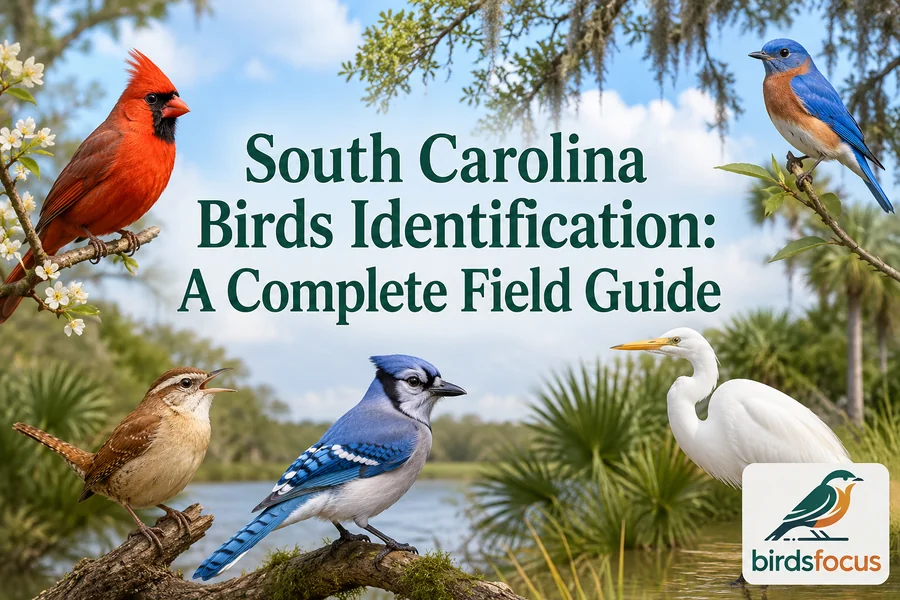
I’m not the only one who has stood on the sidelines of my front porch in Columbia or Charleston and said “what bird is that?”. Once you know what to look for, South Carolina birds identification becomes easier – their color, size, beak shape and where they are found. From backyards to the edges of marshes, here are 15 birds to see in the state, complete with real details to use the next time you run into one.
South Carolina is a birding hotspot, located in the heart of the massive migration corridor and with a combination of coastal, swamp, forest, and farmland, it has a longer list of birds than most states its size. It’s not necessary to be a bird watcher with binoculars and degrees. It’s not necessary to have the expertise of an ornithologist, in order to begin learning what is flying by your window. There’s only one thing to know, what to look for.
South Carolina Birds Identification: Where To Start Looking
South carolina birds identification is easier than it sounds once you understand where to find it; South Carolina has a lot of coastline, swamp, forest and farmland in one state. Cardinals and wrens are attracted to backyard feeders. Bringing marshes brings herons and blackbirds. Open sky means ospreys and eagles. Identify the bird by its habitat, then the rest of the identification process will take place quickly.
How to Identify Birds in South Carolina
Let’s first look at the birding field shortcut before we go into the list.
- Size and shape: How does the bird’s size and shape compare to a familiar bird, such as a sparrow, robin or crow? Check the beak too, thin beaks mean insect eaters, thick beaks mean seed eaters.
- Color pattern: Record the primary color and any wing bars, eye rings or throat patches. Males and females can be different and learn both of them.
- Behavior: Is it hopping, wading, soaring, or hammering on a tree trunk? The bird is usually identified by its behavior, not by its color.
- Habitat: A bird standing in a marsh won’t be the same species at a backyard feeder. Match bird with location.
- Sound: Many South Carolina birds are easier to identify by song than by sight, especially in thick woods or tall grass.
As you read through the list below, consider these 5 points.
Read Also: Michigan Birds: The Complete Guide to Spotting, Identifying, and Understanding Them
Detailed Look for South Carolina Birds Identification
1. Carolina Wren
The Carolina Wren is South Carolina’s official state bird, and once you learn its call you’ll hear it everywhere. A small, round bird with a loud voice that is too big for its body. It’s reddish brown in color with a bright white stripe over each eye and its tail is always up.
Wrens do not migrate in Carolina. Part of their appeal is that they stay around year round, which is why the state selected them. They can be seen in places where there is dense brush, wood piles, or in garden sheds or porch corners where they can conceal a nest. They are assertive around people and will lay their eggs in hanging planters, mailboxes and old boots on porches.
They will feed primarily on insects and spiders but in winter will eat berries and visit suet points. Male sings a rolling “teakettle-teakettle-teakettle” song, frequently from a bare perch, and sings it nearly every season. They are monogamous, mating for life; they remain together on the same territories throughout the year and actively defend them from intruders.
| Classification | Detail |
| Kingdom | Animalia |
| Phylum | Chordata |
| Class | Aves |
| Order | Passeriformes |
| Family | Troglodytidae |
| Genus | Thryothorus |
| Species | T. ludovicianus |
2. Northern Cardinal
The Northern Cardinal is probably the bird most people picture first when they think about South Carolina backyards. Males are solid red with a black mask around the beak and a pointy crest over the head. The females are softer, brownish tan in color with red on wings, tail and crest and are capable of singing nearly as well as the males.
Cardinals do not migrate so they remain with us all winter and this is why they are often seen against a snowy or bare background. They prefer shrubby edges, gardens and woodland borders, and are one of the easiest birds to get into with a basic platform feeder that is filled with sunflower seeds.
They mostly feed on the seeds and grains, but during the breeding season they turn to insects to feed the chicks. Cardinals are territorial and a male will fight his reflection in a window or car mirror as it is mistaken for a rival. They are whistlers with a clear sequence and both sexes use in communication; pairs remain mated for several seasons, sometimes feeding each other seeds by seed during courtship.
| Classification | Detail |
| Kingdom | Animalia |
| Phylum | Chordata |
| Class | Aves |
| Order | Passeriformes |
| Family | Cardinalidae |
| Genus | Cardinalis |
| Species | C. cardinalis |
3. Eastern Bluebird
The Eastern Bluebird brings a flash of color that stops people mid-step. Males have a deep sky blue back with warm rust-orange chest, females have duller, gray patterns. Small, sparrow-sized, with a long narrow beak for taking insects.
Look for bluebirds in open areas in fields, orchards, and golf courses where they can perch and feed on scattered ground with low vegetation. They are cavity nesters and require holes in trees or nest boxes; therefore, bluebird trails using wooden boxes are now popular throughout South Carolina farmland.
The bluebird hunts from a low perch from which they sit and wait, until insects are located, when they drop down and catch them. In colder months they switch to eating berries, especially holly and dogwood. Outside breeding season, they are social and will sometimes form small groups of loose birds together. In the past 100 years bluebird populations have suffered as a result of competition from non-native birds such as starlings, however, nest box programs have been successful in recovering populations throughout the Southeast.
| Classification | Detail |
| Kingdom | Animalia |
| Phylum | Chordata |
| Class | Aves |
| Order | Passeriformes |
| Family | Turdidae |
| Genus | Sialia |
| Species | S. sialis |
4. Carolina Chickadee
The Carolina Chickadee is a tiny bird with a big personality. It is black capped and black throated, white faced with gray back, fast running, and hops from branch to branch and hangs upside down on the leaves gazing at the insects on the underside. This species is very similar to the farther-north Black-capped Chickadee, but is the only one recorded in South Carolina.
Chickadees are found in woodland, parks and backyards, and are one of the most frequented visitors to feeders throughout the state. They like sunflower seeds and suet, they may take one at a time, fly off and crack it somewhere safe to feed from, instead of eating it where they were brought.
They are not particularly sensitive to human disturbance and they are curious birds so they can be seen close up. They are also frequent users of nature trails, where they interact with other bird species like titmice, nuthatches and woodpeckers and call out to communicate with each other. They are so named because of their “chick-a-dee-dee-dee” call note, which they also use as an alarm call, with increasingly more “dee” notes when a predator is on the scene.
| Classification | Detail |
| Kingdom | Animalia |
| Phylum | Chordata |
| Class | Aves |
| Order | Passeriformes |
| Family | Paridae |
| Genus | Poecile |
| Species | P. carolinensis |
5. Blue Jay
The Blue Jay is hard to miss. A big songbird with bright blue upper parts, white chest, black necklace bands and a crest, which it can raise or lower based on its mood. Loud, bright, and a known “hawk mimic” to chase birds off feeders.
The Blue Jay is a resident of forests, suburbia and parks throughout South Carolina and is clever enough to remember where it hiddens its food. They bury thousands of acorns for later and forgotten caches aid in the dispersal of oaks.
They have a mixed reputation among backyard birders, due to their diet of eggs, nestlings, and other birds, as well as insects and nuts. They can be heard throughout in a variety of notes, some of them very harsh jeers, and others more musical and soft. Jays have a reputation for being aggressive, but they are also protective parents and will mob crows, hawks, or cats that venture too near a nest, in groups driving the danger away.
| Classification | Detail |
| Kingdom | Animalia |
| Phylum | Chordata |
| Class | Aves |
| Order | Passeriformes |
| Family | Corvidae |
| Genus | Cyanocitta |
| Species | C. cristata |
6. Brown Thrasher
The Brown Thrasher is Georgia’s state bird, but it’s just as common across South Carolina, especially in thickets and hedgerows. It has a long, rust-red body with a curved beak, streaked chest and bright yellow eyes which give it a somewhat wild appearance. It is bigger than a robin and has a long tail that it frequently wags when it is feeding.
Thrashers are almost always on the ground probing leaf litter for insects, grubs and worms with their beak. They like dense shrubs and brushy edges where they can dash to hide rapidly. They are not like many backyard birds, which tend to be flamboyant and sit out in the open.They are not like many backyard birds, which tend to be flamboyant and sit out in the open.
One of their songs, and certainly one of the most impressive in South Carolina. Brown Thrashers can memorize more than a thousand song phrases, and repeat some phrases twice; they sometimes repeat phrases more often than mockingbirds do, who repeat more than three times. They nest low in thick shrubs, and are very aggressive towards snakes and cats that approach the nest.
| Classification | Detail |
| Kingdom | Animalia |
| Phylum | Chordata |
| Class | Aves |
| Order | Passeriformes |
| Family | Mimidae |
| Genus | Toxostoma |
| Species | T. rufum |
7. American Robin
The American Robin is one of the most recognized birds in the country, and South Carolina sees them year-round, with numbers swelling in winter as northern birds move south. Has gray-brown back, bright orange-red breast and yellow beak. Unmoulted young robins have spotted chests.
Robins are found on lawns, parks and open fields and they are frequently seen running a few steps, stopping and then tiltinging their head to hear or see worms. It is not their head tilting to listen for prey below, it’s actually them looking with one eye to see movement in the grass.
They are a seasonal feeder. They feed primarily on earthworms and insects in the spring and summer and switch to fruit and berries in the fall and winter, sometimes visiting trees numerous times to take all the holly berries off one tree. Robins nest in cup-like mud nests, frequently on porch lights or window ledges and may produce two or three broods in one season when conditions are favorable.
| Classification | Detail |
| Kingdom | Animalia |
| Phylum | Chordata |
| Class | Aves |
| Order | Passeriformes |
| Family | Turdidae |
| Genus | Turdus |
| Species | T. migratorius |
8. Mourning Dove
The Mourning Dove gets its name from its soft, sad-sounding call, a low “coo-oo-oo-oo” that carries across neighborhoods and open fields. A slender grayish brown bird with a small head, long pointed tail, and black spots on its wings. When in flight, it produces a whistling sound from its wings.
With the exception of the desert, doves are found all around in South Carolina, from suburban yards to farmland and around the edges of open woodland. Their food lies on the ground and they are frequently found in pairs or small flocks walking through gravel driveways and under feeders where seed has fallen, they will also feed under decks.They will feed almost exclusively on the ground picking up seeds and grain and are often seen in pairs or small flocks walking through gravel driveways and under feeders where seed has fallen, they will also feed under decks.
They are swift, direct fliers and are one of the most popular game birds to be hunted in the state during open seasons. Like a few bird families, Mourning Doves have the ability to produce “crop milk”, which is a nutrient-rich substance produced by both parents that is used to feed newly hatched chicks. They nest in a loosely laid framework that lacks strength, and are capable of several nestings annually, thus maintaining a stable population under high predation pressure.
| Classification | Detail |
| Kingdom | Animalia |
| Phylum | Chordata |
| Class | Aves |
| Order | Columbiformes |
| Family | Columbidae |
| Genus | Zenaida |
| Species | Z. macroura |
9. Red-winged Blackbird
The Red-winged Blackbird is a familiar sight around South Carolina’s marshes, ponds, and roadside ditches. Males are all black with a striking red and yellow shoulder patch which they display from a perch on tall cattails to ward off competitors. They are entirely different-looking for females, which are streaky brown, more like a large sparrow than a male.
They are very territorial when breeding. A single male will patrol a territory of marsh and fight off other males, even ones larger than himself, such as hawks and crows that encroach on his territory. They flock together to breed in large numbers with other blackbirds, sometimes thousands.
Red-winged Blackbirds nest in low cattails or shrubs near water and make a deep cup nest around several upright stems. They feed on a variety of insects during the summer, and seeds and grain during the winter. One of the loudest calls of spring in wetland habitats of the state is the male’s “conk-la-ree” and it is often the first indication that breeding has begun.
| Classification | Detail |
| Kingdom | Animalia |
| Phylum | Chordata |
| Class | Aves |
| Order | Passeriformes |
| Family | Icteridae |
| Genus | Agelaius |
| Species | A. phoeniceus |
10. Painted Bunting
The Painted Bunting is often called the most colorful bird in North America, and South Carolina’s coastal region is one of the best places in the country to see one. On a little bird, there’s a blue head, a red chest and a green back; really it’s unbelievable! The female and young males are yellow-green in colour which makes them blend in with the leaves.
Painted buntings prefer brushy edges, coastal thickets and hedgerows, particularly in the summer near the coast. These birds are shy, and may be hard to see since they like to stay in the thick cover, so it is easier to hear their sweet warbling song. Backyard birders sometimes stimulate them to come in by spreading their white millet seed around on the ground or by placing small feeders along the coast for them to feed from.
In the winter they migrate to Florida, the Caribbean and Central America and return to South Carolina to breed in the spring. Males are territorial and will fight seriously and sometimes fatally; with rivals. As elsewhere in their range, the destruction of habitat has reduced the numbers of painted bunting, and illegal trapping for the cage bird trade is also a factor that has affected the birds in this area of South Carolina.
| Classification | Detail |
| Kingdom | Animalia |
| Phylum | Chordata |
| Class | Aves |
| Order | Passeriformes |
| Family | Cardinalidae |
| Genus | Passerina |
| Species | P. ciris |
11. Great Blue Heron
The Great Blue Heron is the largest wading bird you’ll see in South Carolina, standing up to four feet tall with a wingspan that can stretch six feet across. It is slate gray-blue in colour, has a long S-shaped neck and a long dagger-like yellow beak which it uses to spear fish in one quick thrust.
These herons are found wherever water, marshes, river banks, ponds and tidal flats along the coast exist. They wait for a fish, frog or crayfish to get close and then move quickly enough to catch it, and are often completely still or moving slowly when they hunt.
Great Blue Herons nest in large groups known as rookeries; sometimes dozens of pairs nest in the same grove, and these nests are often built high in a tree above water, or in the water itself. While they are flying they have their neck bent into an S-shape and when flying they have their long legs stretched straight, unlike cranes which have their neck stretched out when they are flying. They’re patient hunters and can stand motionless for what feels like forever before making a move, which makes them one of the easiest large birds to photograph in the state.
| Classification | Detail |
| Kingdom | Animalia |
| Phylum | Chordata |
| Class | Aves |
| Order | Pelecaniformes |
| Family | Ardeidae |
| Genus | Ardea |
| Species | A. herodias |
12. Osprey
The Osprey is South Carolina’s fishing specialist, a large raptor built almost entirely around catching fish. White head and underparts, dark brown back and wings with a prominent dark eye stripe. It is slightly distinct from an eagle at a distance by its M shaped wings in flight.
The ospreys are found all along the coast, on rivers and large lakes in the state, and are one of the easiest raptors to see in action. They hover over water and then dive down, sometimes completely underwater, to catch fish with their sharp curved talons and flip-back outer toes, which aid them in holding on to a slippery fish.
They construct large-stick nests on dead trees, on channel markers and specially constructed platforms near water, and pairs may reuse their nests annually, adding sticks as the season progresses. Ospreys winter in Central and South America and their arrival in the spring is for many birders a harbinger of the season. One of the most enjoyable aspects of South Carolina birding is seeing one carrying a fish, always with head first to minimize drag.
| Classification | Detail |
| Kingdom | Animalia |
| Phylum | Chordata |
| Class | Aves |
| Order | Accipitriformes |
| Family | Pandionidae |
| Genus | Pandion |
| Species | P. haliaetus |
13. Bald Eagle
The Bald Eagle needs almost no introduction, and South Carolina has a strong, growing population thanks to decades of protection. Adults are dark brown with a white head and a white tail, a heavy yellow beak and piercing yellow eyes. When young, eagles are mottled brown, and do not develop the white head until they are about four or five years old.
Bald Eagles like to nest on tall trees over large lakes, rivers and coastal regions where there is plenty of open water to hunt fish. These feed primarily on fish, but will also feed on waterfowl, small mammals and carrion and do not hesitate to take a fish out of an osprey’s talons in flight.
They make their nests with sticks and year after year until they can reach a thousand or more pounds. In the mid-1900s, South Carolina nearly lost its eagles as a result of the use of DDT. But since the ban on DDT and protection of the species by the federal government in the 1970s, the population of eagles in the state has recovered significantly. They are a regular sight about the Santee Cooper lakes and coastal rivers these days and many are seen in the winter months when the northern eagles descend on the lakes to join the locals.
| Classification | Detail |
| Kingdom | Animalia |
| Phylum | Chordata |
| Class | Aves |
| Order | Accipitriformes |
| Family | Accipitridae |
| Genus | Haliaeetus |
| Species | H. leucocephalus |
14. Wild Turkey
The Wild Turkey is a large ground bird with dark, iridescent feathers that shift green, bronze, and copper in the sunlight. Toms (males) are bare with a red and blue head, a coarse-feathered beard on the chest, and fanning their tails dramatically during the breeding season to woo the females.
Turkeys are found in mixed forests and open clearings throughout South Carolina; they roost in trees at night and forage on the ground during the day, looking for acorns, seeds, insects, and berries. They are found in flocks, and during non-breeding time, they separate into males and females.
Although big, Wild Turkeys are capable of flying long distances but will spring up to a tree if they are alarmed. They’re also ground runners, and will run quickly if they are threatened. As early in the 1900s as a result of habitat loss and over-hunting, populations plummeted throughout the Southeast; restoration programs provided strong recovery, and South Carolina now has a healthy population on which a spring hunting season is based each year.
| Classification | Detail |
| Kingdom | Animalia |
| Phylum | Chordata |
| Class | Aves |
| Order | Galliformes |
| Family | Phasianidae |
| Genus | Meleagris |
| Species | M. gallopavo |
15. Barred Owl
The Barred Owl is one of South Carolina’s most commonly heard, if not seen, birds. It has a round head without any ear tufts, dark brown eyes rather than that of most owls which are yellow, and the name is due to the pattern of horizontal bars on the chest. A medium-large, sturdy owl which hunts in dense woodland.
Barred Owls like to live in well-established woodlands, particularly in bottomland forest, rivers, and swamps, where the dense forest provides them with ample hunting vantage points at night. They predate small mammals, amphibians and fish, which are captured in shallow water and then quickly and silently submerged.
Their call is well-known and easy to remember and often referred to as, ‘who cooks for you, who cooks for you all.’ It is often heard as a faring call through the woods, particularly at dusk and into night, and pairs occasionally duet back and forth with a loud but not necessarily a laughter-like call. Barred Owls are resident and will frequently remain on the same territory throughout their lives. While they are nocturnal, like many other owls, they are also active during the day; particularly on cloudy afternoons, so there is a good chance that a South Carolina birder can spot one in daylight hours.
| Classification | Detail |
| Kingdom | Animalia |
| Phylum | Chordata |
| Class | Aves |
| Order | Strigiformes |
| Family | Strigidae |
| Genus | Strix |
| Species | S. varia |
Read Also: Georgia Birds: State Bird, Native Species, and Backyard Bird Guide
Quick Interesting Facts About South Carolina Birds
| Bird | Interesting Fact |
| Carolina Wren | South Carolina’s official state bird since 1948 |
| Northern Cardinal | Males will attack their own reflection thinking it’s a rival |
| Eastern Bluebird | Needs nest boxes to recover from decades of habitat competition |
| Carolina Chickadee | Adds extra “dee” notes to its call when predators are more dangerous |
| Blue Jay | Buries thousands of acorns each fall, helping oak forests spread |
| Brown Thrasher | Can learn over 1,000 different song phrases |
| American Robin | Tilts its head to look, not listen, for worms underground |
| Mourning Dove | Parents feed chicks “crop milk,” found in only a few bird families |
| Red-winged Blackbird | Males will chase off hawks many times their own size |
| Painted Bunting | Considered the most colorful songbird in North America |
| Great Blue Heron | Nests in colonies of dozens of pairs called rookeries |
| Osprey | Has reversible outer toes to grip slippery fish |
| Bald Eagle | Builds nests that can weigh over 1,000 pounds |
| Wild Turkey | Can burst into flight and fly well despite its size |
| Barred Owl | Sometimes hunts fish by diving into shallow water |
Final Thoughts
South Carolina has fifteen birds that you can enjoy without having to drive an hour or pack one gear. A cardinal perched on a fence. A bird of the kind known as a wren is singing from the woodpile. An osprey with its wings folded dropping down from the sky over a river. This is not a typical weekend here, this is a typical Tuesday.
The real skill behind south carolina birds identification isn’t memorizing every species in the state. It’s about noticing. If you find yourself looking for wing bars and/or a call pattern instead of just noise, you won’t be able to stop doing it. A walk to get the mail turns into a two-minute study session. A trip through a marsh becomes a count of red winged blackbirds.
The next time you are interrupted by a flying object while reading and lose your place, grab this guide on your cell phone. All four—size, color, behavior, and habitat. Within a few weeks, you will not need the guide any longer. You’ll just know.
Once you start noticing your South Carolina birds, the whole state feels a little alive around you!
FAQs:
What is the most common bird in South Carolina?
The Northern Cardinal and Carolina Wren are two of the most commonly reported backyard birds across South Carolina year-round.
What is South Carolina’s state bird?
The Carolina Wren has been South Carolina’s official state bird since 1948.
What is the best time of year for birdwatching in South Carolina?
Spring migration, from March through May, brings the widest variety of species, including colorful migrants like the Painted Bunting.
Are there bald eagles in South Carolina?
Yes. Bald Eagle populations have recovered strongly and are commonly seen near large lakes, rivers, and coastal areas, especially in winter.
What bird sounds like it’s saying “who cooks for you”?
That call belongs to the Barred Owl, one of the most vocal owls found in South Carolina forests.
Read More Articles: Black Birds in Massachusetts: The Complete Guide to Every Species, Habitat, and Call

Welcome to birdsfocus! I’m Anam Sattar, an AI Powered SEO, and Content Writer with 4 years of experirnce.
I help websites rank higher,grow traffic, and look amazing. My goal is to make SEO and web design simple and effective for everyone.
Let’s achieve more together!